SNAA436 June 2025 AMC0311D-Q1 , AMC0311S-Q1 , AMC0381D-Q1 , AMC3330-Q1 , ISO1042-Q1 , ISO6741-Q1 , OPA388-Q1 , RES60A-Q1 , UCC33420-Q1 , UCC33421-Q1
High Voltage Measurement in HEV/EV Applications
The need for measuring high voltages is present in many different HEV/EV systems and sub-systems such as Battery Junction Boxes (BJB), On Board Chargers (OBC), DC-DC converters, Traction Inverters and High Voltage Power Distribution Boxes (PDB) among others.
One of the most common concerns in the automotive market, and in HEV/EV applications in particular, is to develop the most accurate, compact, and cost-effective system possible, which typically implies that the hardware designers need to reduce the component size, and even select devices with a smaller pin count, while keeping a high level of performance. This applies not only to analog components but also to processing elements, such as our C2000™ Real-Time MCUs, which are also impacted. Indeed, the selected processing element and its placement in the system also impacts the system design, making the hardware designer consider and decide on the isolation location and the type of amplifying element to be used.
Figure 1 shows a typical circuit for high voltage measurement in HEV/EV using the ADC converter integrated in our C2000 device.
 Figure 1 HV Measurement Circuit Example
When designing a high-voltage measurement circuit, the resistor divider is often the first element to consider. Its primary function is to step down the bus voltage to a level that is suitable for the amplifier, the next component in the measurement chain. Depending on the resistors working voltage, the designer needs to use multiple resistors in series, forming a resistor ladder as shown in the example.
The Resistors
The traditional discrete approach typically involves using either bulky and expensive high-voltage thick-film resistors or a long string of standard cased resistors, which can be a more cost-effective option but requires lot of space on the board. However, these resistors often come with significant drawbacks, including high costs, bulkiness, and potential accuracy errors.
As the first element in the measurement chain, and given that the signal is amplified later, minimizing errors from this stage is crucial. The resistor divider can account for up to two-thirds of the total error in the measurement chain, primarily due to tolerances, temperature drift, resistor mismatch, and aging. The new RES60A-Q1 family enables the designer to overcome these challenges.
RES60A-Q1 is a high-voltage matched resistor divider supporting up to 1400V between its HVIN and LVIN pins, that offers high accuracy, low drift and a wide variety of nominal ratios (210:1, 310: 1, 410:1, 500:1, 610:1, 1000:1) to scale the voltage down in an accurate way across aging and temperature.
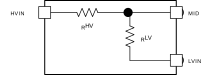 Figure 2 RES60A-Q1
The RES60A-Q1 family of devices offers high-voltage capabilities, enabling designers to connect them directly to the high-voltage bus. By using multiple RES60A-Q1 devices with different nominal ratios, designers can measure the high-voltage bus and scale it down to multiple lower voltages, eliminating the need for discrete resistor dividers.
Once the bus voltage has been scaled down by our RES60A-Q1 device, it is necessary to buffer the signal to drive the ADC in a suitable manner. Additionally, galvanic isolation is required due to the selected topology. In this scenario, a voltage sense amplifier is a suitable solution, as it can provide the necessary buffering and isolation.
The Amplifier
To achieve the most accurate measurement possible, the hardware designer must now consider a multitude of factors. Key parameters such as gain error, offset error, temperature drift, non-linearity, and input impedance are crucial and require careful consideration.
Furthermore, several other important parameters can provide significant benefits for the designer. These include the type of isolation offered (basic or reinforced), the amplifier input type (AC or DC), the output configuration (differential or single-ended), and the level of integration provided by the amplifier. By carefully evaluating these factors, designers can optimize their design and select the most suitable amplifier for their specific application.
AMC0311D-Q1 is a high-precision, isolated voltage amplifier which offers a good range of features, including a 2V input, differential output, and reinforced isolation of up to 5KVRMS (VISO for 60s). Additionally, It provides fixed gain, a high input impedance greater than 1GΩ, and exceptional accuracy with very low errors: ±0.25% gain error and ±0.8mV offset error, as well as ±50ppm gain drift and ±10µV/ºC offset drift (all specified as maximum values).
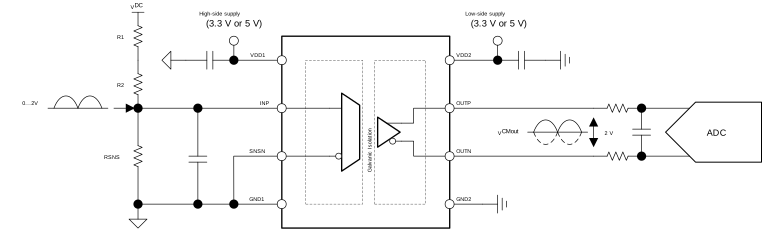 Figure 3 AMC0311D-Q1
If the processing element has only single-ended input ADCs or lacks sufficient input pins, the hardware designer can consider adding an additional operational amplifier stage to convert the differential output signal to a single-ended signal, allowing the measurement to be provided to the processing element via a single pin.
OPA388-Q1 is a precision rail to rail input and output (RRIO) amplifier with high bandwidth (10MHz), zero cross over and zero drift (±0.005µV/ºC) capabilities that is strongly recommended for this kind of function.
 Figure 4 Differential to Single-Ended
Conversion Example
Figure 4 Differential to Single-Ended
Conversion ExampleHowever, AMC0311S-Q1 now offers similar benefits to the AMC0311D-Q1, including a ±0.25% gain error and ±1mV offset error, as well as ±50ppm gain drift and ±30µV/ºC offset drift (all specified as maximum values), but with the added advantage of a single-ended output configuration, which eliminates the need for the second amplifier stage described above.
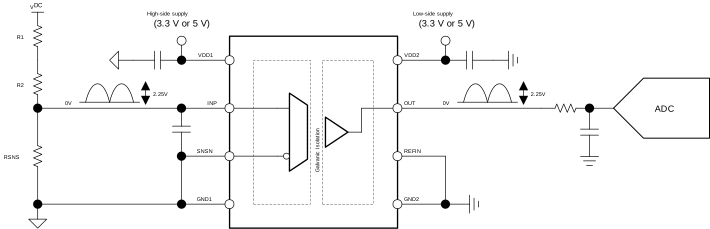 Figure 5 AMC0311S-Q1
The importance of designing more accurate and compact systems is indeed becoming a trend in HEV/EV , therefore, the higher the level of integration the designer can achieve the better.
Our latest product developments and the new amplifier additions to our portfolio allow the designers to overcome the most restrictive space constraints and meet the most exigent levels of system integration.
AMC3330-Q1 is a ±1V input, reinforced isolation amplifier with a 4.25KVRMS (VISO for 60s) rating, designed for precision measurements with differential output. It offers high accuracy, with 0.2% gain error and ±0.3mV offset error, as well as low drift, with ±45ppm/ºC gain drift and ±4µV/ºC offset drift (all specified as maximum values). Additionally, the device features an integrated, isolated DC-DC converter, enabling single supply operation from a 3.3V or 5V source on the low side.
 Figure 6 AMC3330-Q1
The AMC3330-Q1, combined with the previously discussed RES60A-Q1 matched resistor device, accurately performs the measurement function and provides an isolated DC-DC power source for the secondary side or low-voltage domain in the application.
On the other hand, AMC0381D-Q1 is a precision high-voltage DC amplifier that offers a range of features, including fixed gain, reinforced galvanic isolation of up to 5KVRMS (VISO for 60s), and differential output. The device provides high accuracy, with high input impedance and low errors and drift. Specifically, it offers ±0.25% attenuation and ±1.5mV offset errors, and ±40ppm attenuation and ±20µV/ºC offset drifts (all specified as maximum values). Additionally, the device features an integrated resistor divider allowing for direct connection to high-voltage DC sources with input range options of 600V, 1000V or 1600V.
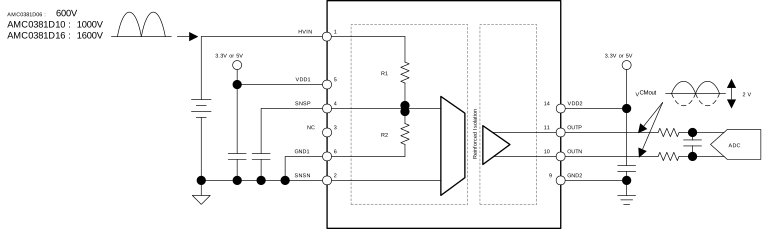 Figure 7 AMC0381D-Q1
Figure 1 was showing a typical voltage measurement circuit using a C2000 device from our portfolio with an integrated Analog-to-Digital Converter (ADC), however, there are other useful topologies based on delta-sigma modulators that can add extra benefits to the design, such as higher noise immunity. This topic is covered in a different document.
The Digital Isolator
Our C2000 devices offer a wide range of communication interfaces, with SPI and CAN being the most commonly used in HEV/EV applications. To verify reliable transmission of signals between processing elements in different voltage domains, proper isolation of these communication buses is essential.
An isolator is an electronic device with a high-voltage isolation barrier that transfers signals from one side of the isolation barrier, acting as a transmitter (Tx), to the other side of the isolation barrier where the signals are recovered, acting as a receiver (Rx), and converted into digital levels.
ISO6741-Q1 is a high-performance, quad channel (3/1) digital isolator, designed for cost-sensitive applications. It requires up to 5000VRMS isolation rating, making it suitable for isolating the SPI communication bus.
 Figure 8 SPI Bus Isolation Example Using a
Digital Isolator
Figure 8 SPI Bus Isolation Example Using a
Digital IsolatorIf multiple C2000 devices located in different power domains are communicating with each other via CAN bus, the designer also requires to isolate the bus.
ISO1042-Q1 is a galvanically isolated CAN transceiver that supports CAN FD mode (5Mbps), withstands voltages of 5000VRMS, and provides ±30V common-mode range and ±70V DC bus fault protection.
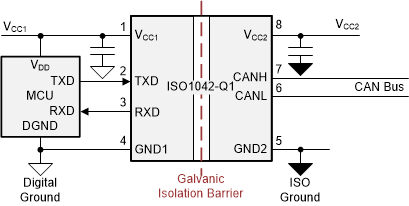 Figure 9 ISO1042-Q1
The Isolated Power
When measuring in the high-voltage domain, designers typically require an isolated power source to bias the remaining elements on the secondary side. Our latest portfolio additions offer highly integrated devices that provide a wide range of benefits and improved design flexibility, making them a suitable alternative to traditional flyback converters.
UCC33421-Q1, a new DC-DC power module with an integrated transformer, can supply 1.5W of output power while providing 5KVRMS of isolation rating, supporting low EMI and providing excellent load regulation (0.5%). This device needs minimal external components, creating a very compact and power-dense system solution.
The integrated module bias supply accepts an input voltage range of 4.5V to 5.5V and provides a regulated 5.0V output with selectable headroom of up to 5.5V, allowing the designer to easily implement an isolated point of load (POL) in the system.
 Figure 10 Simplified Application
This family also includes options with lower input and output voltages (3.3V), as well as 3KVRMS isolation rating variants, such as the UCC33420-Q1.