SNVAAA6 September 2024 LM61495
4.1 VIN, VOUT Range
The input voltage that can be applied to an integrated circuit (IC) operating in the inverting buck-boost topology is less than the input voltage for the same IC operating in the buck topology. The reason for this difference is because the ground pin of the IC is connected to the (negative) output voltage. Therefore, the input voltage across the device is VIN to VOUT, not VIN to ground. Thus, the input voltage range which needs to be considered for this design is 13.2V – ( – 8V) = 21.2V.
LM61495 is good enough to cover 21.2V input voltage range since LM61495 can cover up to 36V. The output voltage range is the same as when configured as a standard buck converter, but negative. The output voltage for the inverting buck-boost topology must be set between 1V and 95% of expected input voltage following LM61495 specification. At this time, expected input voltage for LM61495 can be VIN – ( – VOUT) for IBB implementation
The output voltage is set in the same way as the buck configuration, with two resistors connected to the FB pin. This design sets the output voltage at –8V, which gives an input voltage range of 21.2V. LM61495 uses a 1V reference for control to derive Equation 1. This equation can be used to determine RFBB for a desired output voltage and a given RFBT. In this design, RFBT = 100kohm. Therefore RFBB= 14.3k to set –VOUT = -8V.
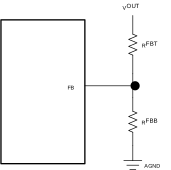 Figure 4-1 Setting Output Voltage of Adjustable Versions