SNVSCU5 June 2025 LM25137-Q1
PRODUCTION DATA
- 1
- 1 Features
- 2 Applications
- 3 Description
- 4 Related Products
- 5 Pin Configuration and Functions
- 6 Specifications
-
7 Detailed Description
- 7.1 Overview
- 7.2 Functional Block Diagram
- 7.3
Feature Description
- 7.3.1 Input Voltage Range (VIN)
- 7.3.2 Bias Supply Regulator (VCC, BIAS1/VOUT1, VDDA)
- 7.3.3 Precision Enable (EN1, EN2)
- 7.3.4 Switching Frequency (RT)
- 7.3.5 Pulse Frequency Modulation and Synchronization (PFM/SYNC)
- 7.3.6 Synchronization Out (SYNCOUT)
- 7.3.7 Dual Random Spread Spectrum (DRSS)
- 7.3.8 Configurable Soft Start (RSS)
- 7.3.9 Output Voltage Setpoints (FB1, FB2)
- 7.3.10 Minimum Controllable On-Time
- 7.3.11 Error Amplifier and PWM Comparator (FB1, FB2, COMP1, COMP2)
- 7.3.12 Inductor Current Sense (ISNS1+, BIAS1/VOUT1, ISNS2+, VOUT2)
- 7.3.13 MOSFET Gate Drivers (HO1, HO2, LO1, LO2)
- 7.3.14 Output Configurations (CNFG)
- 7.4 Device Functional Modes
-
8 Application and Implementation
- 8.1 Application Information
- 8.2
Typical Applications
- 8.2.1
Design 1 – Dual 5V and 3.3V, 20A Buck Regulator for 12V
Automotive Battery Applications
- 8.2.1.1 Design Requirements
- 8.2.1.2
Detailed Design Procedure
- 8.2.1.2.1 Custom Design With WEBENCH® Tools
- 8.2.1.2.2 Custom Design With Excel Quickstart Tool
- 8.2.1.2.3 Inductor Calculations
- 8.2.1.2.4 Shunt Resistors
- 8.2.1.2.5 Ceramic Output Capacitors
- 8.2.1.2.6 Ceramic Input Capacitors
- 8.2.1.2.7 Feedback Resistors
- 8.2.1.2.8 Input Voltage UVLO Resistors
- 8.2.1.2.9 Compensation Components
- 8.2.1.3 Application Curves
- 8.2.2 Design 2 – Two-Phase, Single-Output Synchronous Buck Regulator for Automotive ADAS Applications
- 8.2.3 Design 3 – 12V, 25A, 400kHz, Two-Phase Buck Regulator for 24V Automotive Applications
- 8.2.1
Design 1 – Dual 5V and 3.3V, 20A Buck Regulator for 12V
Automotive Battery Applications
- 8.3 Power Supply Recommendations
- 8.4 Layout
- 9 Device and Documentation Support
- 10Revision History
- 11Mechanical, Packaging, and Orderable Information
6.6 Typical Characteristics
VIN = 12V, TJ = 25°C, unless otherwise stated.


| VEN1 = 0V, VEN2 = 0V |
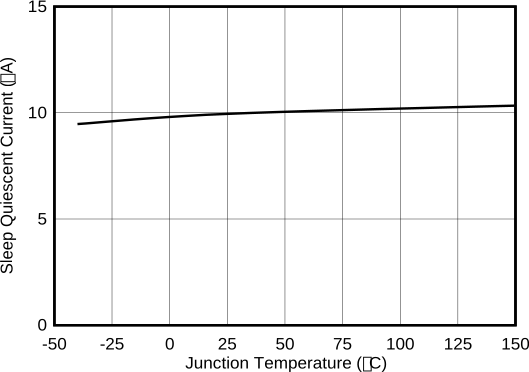
| VVOUT1 = 5V, VVOUT2 = 3.3V |
 Figure 6-11 Fixed
3.3V Output Voltage vs Temperature
Figure 6-11 Fixed
3.3V Output Voltage vs Temperature Figure 6-13 Fixed 12V Output Voltage vs Temperature
| IVDDA = 0mA |
 Figure 6-17 VCC
UVLO Thresholds vs Temperature
Figure 6-17 VCC
UVLO Thresholds vs Temperature Figure 6-19 PG UV
Thresholds vs Temperature
Figure 6-19 PG UV
Thresholds vs Temperature Figure 6-21 Current Sense Amplifier Gain vs Temperature
 Figure 6-23 EN
Rising Threshold Voltage vs Temperature
Figure 6-23 EN
Rising Threshold Voltage vs Temperature Figure 6-25 RT
Resistance vs Switching Frequency
Figure 6-25 RT
Resistance vs Switching Frequency


| 0.6V < VEN1/2 < 1V |

| VVOUT1 = 5V, VEN2 = 0V |
 Figure 6-12 Fixed
5V Output Voltage vs Temperature
Figure 6-12 Fixed
5V Output Voltage vs Temperature Figure 6-14 Feedback Voltage vs Temperature
| IVCC = 20mA |
 Figure 6-18 VCC
Current Limit vs Temperature
Figure 6-18 VCC
Current Limit vs Temperature Figure 6-20 PG OV
Thresholds vs Temperature
Figure 6-20 PG OV
Thresholds vs Temperature Figure 6-22 Current Sense Threshold vs Temperature
 Figure 6-24 Minimum On Time vs Temperature
 Figure 6-26 RSS
Resistance vs Soft-start Time
Figure 6-26 RSS
Resistance vs Soft-start Time