Typical values at TA = +25°C, ADC
Sampling Rate = 2949.12 GHz. Default conditions: output sample rate = 491.52MSPS
(decimate by 6), PLL clock mode with fREF = 491.52MHz, AIN =
–3 dBFS, DSA setting = 4 dB.

| With 1.8 GHz matching, normalized to 1.75 GHz |
|

| With 2.6 GHz matching, normalized to phase at 25°C |
|

| With 1.8 GHz matching |
| Differential Amplitude Error = PIN(DSA Setting – 1) – PIN(DSA Setting) + 1 |

| With 1.8 GHz matching |
| Integrated Amplitude Error = PIN(DSA Setting) – PIN(DSA Setting = 0) + (DSA Setting) |

| With 1.8 GHz matching |
| Differential Phase Error = PhaseIN(DSA Setting – 1) – PhaseIN(DSA Setting) |

| With 1.8 GHz matching |
| Integrated Phase Error = Phase(DSA Setting) – Phase(DSA Setting = 0) |

| With 1.8 GHz matching, 12.5-MHz offset from tone |

| With 1.8 GHz matching, 12.5-MHz offset from tone |
|

| With 1.8 GHz matching, tone spacing = 20 MHz, DSA = 4 dB |

| With 1.8 GHz matching, fin = 1900MHz, measured after HD2 trim, DDC bypass mode (TI only mode for characterization) |

| With 1.8 GHz matching, fin = 1900MHz, measured after HD2 trim, DDC bypass mode (TI only mode for characterization) |

| With 1.8 GHz matching, fin = 1900MHz, DDC bypass mode (TI only mode for characterization) |

| With 1.8 GHz matching, fin = 1900MHz, DDC bypass mode (TI only mode for characterization) |
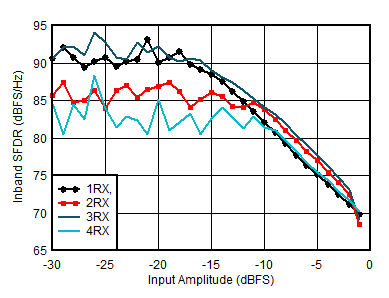
| With 1.8 GHz matching, decimated by 3 |

| With 1.8 GHz matching, –7 dBFS each tone, 20-MHz tone spacing, all supplies at MIN, TYP, or MAX recommended operating voltages |

| With 1.8 GHz matching, normalized to fullscale at 25°C for each channel |

| With 1.8 GHz matching |
| Differential Amplitude Error = PIN(DSA Setting – 1) – PIN(DSA Setting) + 1 |

| With 1.8 GHz matching |
| Integrated Amplitude Error = PIN(DSA Setting) – PIN(DSA Setting = 0) + (DSA Setting) |

| With 1.8 GHz matching |
| Differential Phase Error = PhaseIN(DSA Setting – 1) – PhaseIN(DSA Setting) |

| With 1.8 GHz matching |
| Integrated Phase Error = Phase(DSA Setting) – Phase(DSA Setting = 0) |

| With 1.8 GHz matching, fIN = 2610 MHz, AIN= –3 dBFS |

| With 1.8 GHz matching, DSA Setting = 12 dB, 12.5-MHz offset from tone |

| With 1.8 GHz matching, each tone –7 dBFS, tone spacing = 20 MHz |
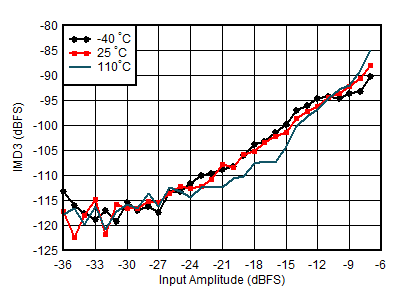
| With 1.8 GHz matching, tone spacing = 20 MHz, DSA = 12 dB |

| With 1.8 GHz matching, fin = 1900MHz, measured after HD2 trim, DDC bypass mode (TI only mode for characterization) |

| With 1.8 GHz matching, fin = 1900MHz, measured after HD2 trim, DDC bypass mode (TI only mode for characterization) |
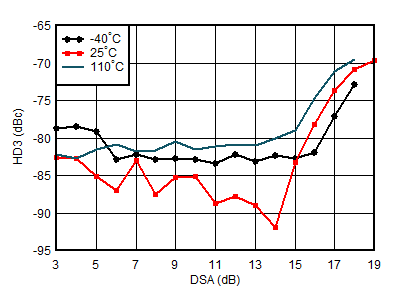
| With 1.8 GHz matching, fin = 1900MHz, DDC bypass mode (TI only mode for characterization) |

| With 1.8 GHz matching, fin = 1900MHz, DDC bypass mode (TI only mode for characterization) |
 Figure 4-108 RX Non-HD2/3 vs DSA Setting at 1.75 GHz
| With 1.8 GHz matching, 12.5-MHz offset, all supplies at MIN, TYP, or MAX recommended operating voltages |