SBASB59 July 2025 AMC0330S
PRODMIX
- 1
- 1 Features
- 2 Applications
- 3 Description
- 4 Device Comparison Table
- 5 Pin Configuration and Functions
-
6 Specifications
- 6.1 Absolute Maximum Ratings
- 6.2 ESD Ratings
- 6.3 Recommended Operating Conditions
- 6.4 Thermal Information (D Package)
- 6.5 Thermal Information (DWV Package)
- 6.6 Power Ratings
- 6.7 Insulation Specifications (Basic Isolation)
- 6.8 Insulation Specifications (Reinforced Isolation)
- 6.9 Safety-Related Certifications (Basic Isolation)
- 6.10 Safety-Related Certifications (Reinforced Isolation)
- 6.11 Safety Limiting Values (D Package)
- 6.12 Safety Limiting Values (DWV Package)
- 6.13 Electrical Characteristics
- 6.14 Switching Characteristics
- 6.15 Timing Diagram
- 6.16 Insulation Characteristics Curves
- 6.17 Typical Characteristics
- 7 Detailed Description
- 8 Application and Implementation
- 9 Device and Documentation Support
- 10Revision History
- 11Mechanical, Packaging, and Orderable Information
Package Options
Mechanical Data (Package|Pins)
- DWV|8
Thermal pad, mechanical data (Package|Pins)
Orderable Information
7.3.2 Isolation Channel Signal Transmission
As shown in Figure 7-1, the AMC0x30S uses an on-off keying (OOK) modulation scheme to transmit the modulator output bitstream across the SiO2-based isolation barrier. The transmit driver (TX) is illustrated in the Functional Block Diagram. TX transmits an internally generated, high-frequency carrier across the isolation barrier to represent a digital one. However, TX does not send a signal to represent a digital zero. The nominal frequency of the carrier used inside the AMC0x30S is 480MHz.
The receiver (RX) on the other side of the isolation barrier recovers and demodulates the signal and provides the input to the analog filter. The AMC0x30S transmission channel is optimized to achieve the highest level of common-mode transient immunity (CMTI) and the lowest level of radiated emissions. The high-frequency carrier and RX/TX buffer switching cause these emissions.
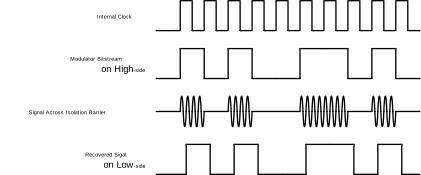 Figure 7-1 OOK-Based Modulation
Scheme
Figure 7-1 OOK-Based Modulation
Scheme