SNVSC00A February 2023 – January 2025 LM5148-Q1
PRODUCTION DATA
- 1
- 1 Features
- 2 Applications
- 3 Description
- 4 Description (continued)
- 5 Pin Configuration and Functions
- 6 Specifications
-
7 Detailed Description
- 7.1 Overview
- 7.2 Functional Block Diagram
- 7.3
Feature Description
- 7.3.1 Input Voltage Range (VIN)
- 7.3.2 High-Voltage Bias Supply Regulator (VCC, VCCX, VDDA)
- 7.3.3 Precision Enable (EN)
- 7.3.4 Power-Good Monitor (PG)
- 7.3.5 Switching Frequency (RT)
- 7.3.6 Dual Random Spread Spectrum (DRSS)
- 7.3.7 Soft Start
- 7.3.8 Output Voltage Setpoint (FB)
- 7.3.9 Minimum Controllable On Time
- 7.3.10 Error Amplifier and PWM Comparator (FB, EXTCOMP)
- 7.3.11 Slope Compensation
- 7.3.12 Inductor Current Sense (ISNS+, VOUT)
- 7.3.13 Hiccup Mode Current Limiting
- 7.3.14 High-Side and Low-Side Gate Drivers (HO, LO)
- 7.3.15 Output Configurations (CNFG)
- 7.3.16 Single-Output Dual-Phase Operation
- 7.4 Device Functional Modes
-
8 Application and Implementation
- 8.1 Application Information
- 8.2
Typical Applications
- 8.2.1
Design 1 – High Efficiency 2.1MHz Synchronous
Buck Regulator
- 8.2.1.1 Design Requirements
- 8.2.1.2
Detailed Design Procedure
- 8.2.1.2.1 Custom Design with WEBENCH® Tools
- 8.2.1.2.2 Custom Design with Excel Quickstart Tool
- 8.2.1.2.3 Buck Inductor
- 8.2.1.2.4 Current-Sense Resistance
- 8.2.1.2.5 Output Capacitors
- 8.2.1.2.6 Input Capacitors
- 8.2.1.2.7 Frequency Set Resistor
- 8.2.1.2.8 Feedback Resistors
- 8.2.1.2.9 Compensation Components
- 8.2.1.3 Application Curves
- 8.2.2 Design 2 – High Efficiency 48-V to 12-V 400-kHz Synchronous Buck Regulator
- 8.2.3 Design 3 – High Efficiency 440-kHz Synchronous Buck Regulator
- 8.2.4 Design 4 – Dual-Phase 400-kHz 20-A Synchronous Buck Regulator
- 8.2.1
Design 1 – High Efficiency 2.1MHz Synchronous
Buck Regulator
- 8.3 Power Supply Recommendations
- 8.4 Layout
- 9 Device and Documentation Support
- 10Revision History
- 11Mechanical, Packaging, and Orderable Information
Package Options
Mechanical Data (Package|Pins)
Thermal pad, mechanical data (Package|Pins)
Orderable Information
7.3.12.1 Shunt Current Sensing
Figure 7-4 illustrates inductor current sensing using a shunt resistor. This configuration continuously monitors the inductor current to provide accurate overcurrent protection across the operating temperature range. For optimal current sense accuracy and overcurrent protection, use a low inductance ±1% tolerance shunt resistor between the inductor and the output, with a Kelvin connection to the LM5148-Q1 current sense amplifier.
If the peak voltage signal sensed from ISNS+ to VOUT exceeds the current limit threshold of 60 mV, the current limit comparator immediately terminates the HO output for cycle-by-cycle current limiting. Calculate the shunt resistance using Equation 10.

where
- VCS-TH is current sense threshold of 60 mV.
- IOUT(CL) is the overcurrent setpoint that is set higher than the maximum load current to avoid tripping the overcurrent comparator during load transients.
- ΔIL is the peak-to-peak inductor ripple current.
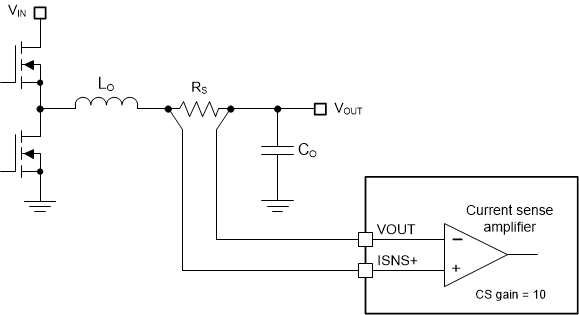 Figure 7-4 Shunt Current Sensing
Implementation
Figure 7-4 Shunt Current Sensing
ImplementationThe soft-start voltage is clamped 150 mV above FB during an overcurrent condition. 16 overcurrent events must occur before the SS clamp is enabled. This requirement makes sure that SS can be pulled low during brief overcurrent events, preventing output voltage overshoot during recovery.