SBOS753B June 2016 – February 2017 TLV2313 , TLV313 , TLV4313
PRODUCTION DATA.
- 1 Features
- 2 Applications
- 3 Description
- 4 Revision History
- 5 Device Comparison Table
- 6 Pin Configuration and Functions
-
7 Specifications
- 7.1 Absolute Maximum Ratings
- 7.2 ESD Ratings
- 7.3 Recommended Operating Conditions
- 7.4 Thermal Information: TLV313
- 7.5 Thermal Information: TLV2313
- 7.6 Thermal Information: TLV4313
- 7.7 Electrical Characteristics: 5.5 V
- 7.8 Electrical Characteristics: 1.8 V
- 7.9 Typical Characteristics: Table of Graphs
- 7.10 Typical Characteristics
- 8 Detailed Description
- 9 Application and Implementation
- 10Power Supply Recommendations
- 11Layout
- 12Device and Documentation Support
- 13Mechanical, Packaging, and Orderable Information
Package Options
Mechanical Data (Package|Pins)
- PW|14
Thermal pad, mechanical data (Package|Pins)
Orderable Information
7 Specifications
7.1 Absolute Maximum Ratings
over operating free-air temperature range (unless otherwise noted)(1)| MIN | MAX | UNIT | ||
|---|---|---|---|---|
| Voltage | Supply voltage | 7 | V | |
| Signal input terminals(2) | (V−) − (0.5) | (V+) + 0.5 | V | |
| Current | Signal input terminals(2) | –10 | 10 | mA |
| Output short circuit(3) | Continuous | |||
| Temperature | Operating, TA | –40 | 150 | °C |
| Junction, TJ | 150 | °C | ||
| Storage, Tstg | –65 | 150 | °C | |
(1) Stresses beyond those listed under Absolute Maximum Ratings may cause permanent damage to the device. These are stress ratings only, which do not imply functional operation of the device at these or any other conditions beyond those indicated under Recommended Operating Conditions. Exposure to absolute-maximum-rated conditions for extended periods may affect device reliability.
(2) Input pins are diode-clamped to the power-supply rails. Input signals that may swing more than 0.5 V beyond the supply rails must be current limited to 10 mA or less.
(3) Short-circuit to ground, one amplifier per package.
7.2 ESD Ratings
| VALUE | UNIT | |||
|---|---|---|---|---|
| V(ESD) | Electrostatic discharge | Human-body model (HBM), per ANSI/ESDA/JEDEC JS-001(1) | ±4000 | V |
| Charged-device model (CDM), per JEDEC specification JESD22-C101(2) | ±1000 | |||
(1) JEDEC document JEP155 states that 500-V HBM allows safe manufacturing with a standard ESD control process.
(2) JEDEC document JEP157 states that 250-V CDM allows safe manufacturing with a standard ESD control process.
7.3 Recommended Operating Conditions
over operating free-air temperature range (unless otherwise noted)| MIN | MAX | UNIT | ||
|---|---|---|---|---|
| VS | Supply voltage | 1.8 | 5.5 | V |
| TA | Specified temperature range | –40 | 125 | °C |
7.4 Thermal Information: TLV313
| THERMAL METRIC(1) | TLV313 | UNIT | ||
|---|---|---|---|---|
| DBV (SOT23) | DCK (SC70) | |||
| 5 PINS | 5 PINS | |||
| RθJA | Junction-to-ambient thermal resistance | 228.5 | 281.4 | °C/W |
| RθJC(top) | Junction-to-case (top) thermal resistance | 99.1 | 91.6 | °C/W |
| RθJB | Junction-to-board thermal resistance | 54.6 | 59.6 | °C/W |
| ψJT | Junction-to-top characterization parameter | 7.7 | 1.5 | °C/W |
| ψJB | Junction-to-board characterization parameter | 53.8 | 58.8 | °C/W |
| RθJC(bot) | Junction-to-case (bottom) thermal resistance | N/A | N/A | °C/W |
(1) For more information about traditional and new thermal metrics, see the Semiconductor and IC Package Thermal Metrics application report.
7.5 Thermal Information: TLV2313
| THERMAL METRIC(1) | TLV2313 | UNIT | ||
|---|---|---|---|---|
| D (SOIC) | DGK (VSSOP) | |||
| 8 PINS | 8 PINS | |||
| RθJA | Junction-to-ambient thermal resistance | 138.4 | 191.2 | °C/W |
| RθJC(top) | Junction-to-case (top) thermal resistance | 89.5 | 61.9 | °C/W |
| RθJB | Junction-to-board thermal resistance | 78.6 | 111.9 | °C/W |
| ψJT | Junction-to-top characterization parameter | 29.9 | 5.1 | °C/W |
| ψJB | Junction-to-board characterization parameter | 78.1 | 110.2 | °C/W |
| RθJC(bot) | Junction-to-case (bottom) thermal resistance | N/A | N/A | °C/W |
7.6 Thermal Information: TLV4313
| THERMAL METRIC(1) | TLV4313 | UNIT | |
|---|---|---|---|
| PW (TSSOP) | |||
| 14 PINS | |||
| RθJA | Junction-to-ambient thermal resistance | 121.0 | °C/W |
| RθJC(top) | Junction-to-case (top) thermal resistance | 49.4 | °C/W |
| RθJB | Junction-to-board thermal resistance | 62.8 | °C/W |
| ψJT | Junction-to-top characterization parameter | 5.9 | °C/W |
| ψJB | Junction-to-board characterization parameter | 62.2 | °C/W |
| RθJC(bot) | Junction-to-case (bottom) thermal resistance | N/A | °C/W |
7.7 Electrical Characteristics: 5.5 V
At TA = 25°C, RL = 10 kΩ connected to VS / 2, and VCM = VOUT = VS / 2, unless otherwise noted.(1)
| PARAMETER | TEST CONDITIONS | MIN | TYP | MAX | UNIT | ||
|---|---|---|---|---|---|---|---|
| OFFSET VOLTAGE | |||||||
| VOS | Input offset voltage | 0.75 | 3 | mV | |||
| dVOS/dT | Input offset voltage vs temperature | TA = –40°C to 125°C | 2 | μV/°C | |||
| PSRR | Power-supply rejection ratio | 74 | 90 | dB | |||
| INPUT VOLTAGE RANGE | |||||||
| VCM | Common-mode voltage range | No phase reversal, rail-to-rail input | (V–) – 0.2 | (V+) + 0.2 | V | ||
| CMRR | Common-mode rejection ratio | (VS–) – 0.2 V < VCM < (VS+) – 1.3 V | 85 | dB | |||
| VCM = –0.2 V to 5.7 V | 64 | 80 | dB | ||||
| INPUT BIAS CURRENT | |||||||
| IB | Input bias current | ±1 | pA | ||||
| IOS | Input offset current | ±1 | pA | ||||
| NOISE | |||||||
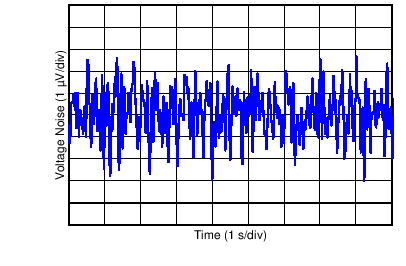
| Input voltage noise (peak-to-peak) | f = 0.1 Hz to 10 Hz | 6 | μVPP | ||||
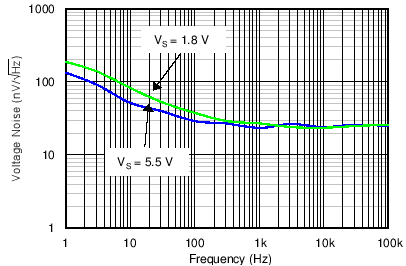
| en | Input voltage noise density | f = 10 kHz | 22 | nV/√Hz | |||
| f = 1 kHz | 26 | nV/√Hz | |||||
| in | Input current noise density | f = 1 kHz | 5 | fA/√Hz | |||
| INPUT CAPACITANCE | |||||||
| CIN | Differential | 1 | pF | ||||
| Common-mode | 5 | pF | |||||
| OPEN-LOOP GAIN | |||||||
| AOL | Open-loop voltage gain | 0.05 V < VO < (V+) – 0.05 V, RL = 100 kΩ | 104 | dB | |||
| 0.3 V < VO < (V+) – 0.3 V, RL = 2 kΩ | 100 | 110 | dB | ||||
| Phase margin | VS = 5.0 V, G = +1 | 65 | ° | ||||
| FREQUENCY RESPONSE | |||||||
| GBW | Gain-bandwidth product | VS = 5.0 V, CL = 10 pF | 1 | MHz | |||
| SR | Slew rate | VS = 5.0 V, G = +1 | 0.5 | V/μs | |||
| tS | Settling time | To 0.01%, VS = 5.0 V, 2-V step , G = +1 | 6 | μs | |||
| Overload recovery time | VS = 5.0 V, VIN × Gain > VS | 3 | μs | ||||
| OUTPUT | |||||||
| VO | Voltage output swing from supply rails | RL = 100 kΩ(2) | 5 | 20 | mV | ||
| RL = 2 kΩ(2) | 75 | 100 | mV | ||||
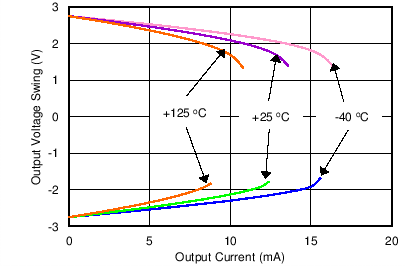
| ISC | Short-circuit current | ±15 | mA | ||||
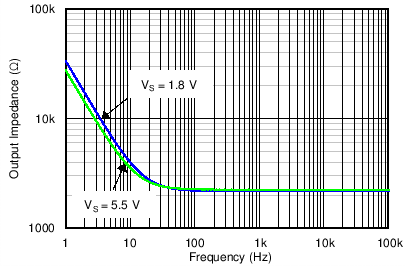
| RO | Open-loop output impedance | 2300 | Ω | ||||
| POWER SUPPLY | |||||||
| VS | Specified voltage range | 1.8 (±0.9) | 5.5 (±2.75) | V | |||
| IQ | Quiescent current per amplifier | TA = –40°C to 125°C, VS = 5.0 V, IO = 0 mA | 65 | 90 | µA | ||
| Power-on time | VS = 0 V to 5 V, to 90% IQ level | 10 | µs | ||||
(1) Parameters with minimum or maximum specification limits are 100% production tested at 25ºC, unless otherwise noted. Over-temperature limits are based on characterization and statistical analysis.
(2) Specified by design and characterization; not production tested.
7.8 Electrical Characteristics: 1.8 V
At TA = 25°C, RL = 10 kΩ connected to VS / 2, VCM = VS+ – 1.3 V, and VOUT = VS / 2, unless otherwise noted.(1)
| PARAMETER | TEST CONDITIONS | MIN | TYP | MAX | UNIT | ||
|---|---|---|---|---|---|---|---|
| OFFSET VOLTAGE | |||||||
| VOS | Input offset voltage | 0.75 | 3 | mV | |||
| dVOS/dT | Input offset voltage vs temperature | TA = –40°C to 125°C | 2 | μV/°C | |||
| PSRR | Power-supply rejection ratio | 74 | 90 | dB | |||
| INPUT VOLTAGE RANGE | |||||||
| VCM | Common-mode voltage range | No phase reversal, rail-to-rail input | (V–) – 0.2 | (V+) + 0.2 | V | ||
| CMRR | Common-mode rejection ratio | (VS–) – 0.2 V < VCM < (VS+) – 1.3 V | 85 | dB | |||
| VCM = –0.2 V to +1.8 V | 73 | dB | |||||
| INPUT BIAS CURRENT | |||||||
| IB | Input bias current | ±1 | pA | ||||
| IOS | Input offset current | ±1 | pA | ||||
| NOISE | |||||||
| Input voltage noise (peak-to-peak) | f = 0.1 Hz to 10 Hz | 6 | μVPP | ||||
| en | Input voltage noise density | f = 10 kHz | 22 | nV/√Hz | |||
| f = 1 kHz | 26 | nV/√Hz | |||||
| in | Input current noise density | f = 1 kHz | 5 | fA/√Hz | |||
| INPUT CAPACITANCE | |||||||
| CIN | Differential | 1 | pF | ||||
| Common-mode | 5 | pF | |||||
| OPEN-LOOP GAIN | |||||||
| AOL | Open-loop voltage gain | 0.1 V < VO < (V+) – 0.1 V, RL = 10 kΩ | 110 | dB | |||
| 0.05 V < VO < (V+) – 0.05 V, RL = 100 kΩ | 110 | dB | |||||
| FREQUENCY RESPONSE | |||||||
| GBW | Gain-bandwidth product | CL = 10 pF | 0.9 | MHz | |||
| SR | Slew rate | G = +1 | 0.45 | V/μs | |||
| tS | Settling time | To 0.01%, VS = 5.0 V, 2-V step , G = +1 | 6 | μs | |||
| Overload recovery time | VS = 5.0 V, VIN × Gain > VS | 3 | μs | ||||
| OUTPUT | |||||||
| VO | Voltage output swing from supply rails | RL = 100 kΩ(2) | 5 | mV | |||
| RL = 2 kΩ(2) | 25 | mV | |||||
| ISC | Short-circuit current | ±6 | mA | ||||
| RO | Open-loop output impedance | 2300 | Ω | ||||
| POWER SUPPLY | |||||||
| VS | Specified voltage range | 1.8 (±0.9) | 5.5 (±2.75) | V | |||
| IQ | Quiescent current per amplifier | TA = –40°C to 125°C, VS = 5.0 V, IO = 0 mA | 65 | 90 | µA | ||
| Power-on time | VS = 0 V to 5 V, to 90% IQ level | 10 | µs | ||||
(1) Parameters with minimum or maximum specification limits are 100% production tested at 25ºC, unless otherwise noted. Over-temperature limits are based on characterization and statistical analysis.
(2) Specified by design and characterization; not production tested.
7.9 Typical Characteristics: Table of Graphs
Table 1. Table of Graphs
| TITLE | FIGURE |
|---|---|
| Open-Loop Gain and Phase vs Frequency | Figure 1 |
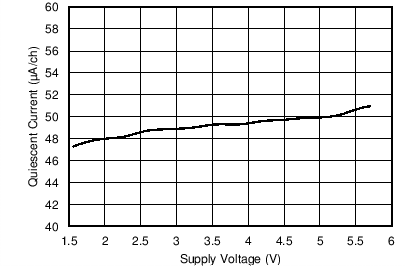
| Quiescent Current vs Supply Voltage | Figure 2 |
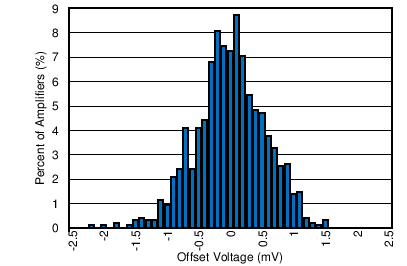
| Offset Voltage Production Distribution | Figure 3 |
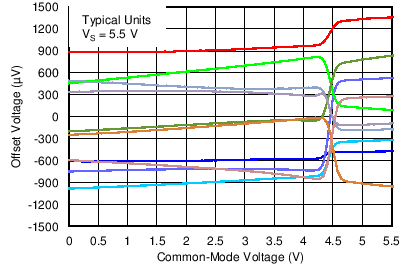
| Offset Voltage vs Common-Mode Voltage (Maximum Supply) | Figure 4 |
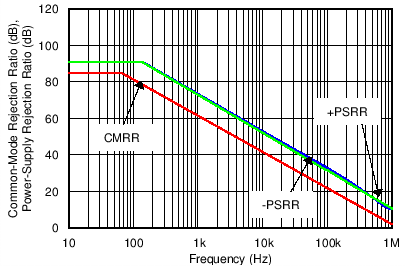
| CMRR and PSRR vs Frequency (RTI) | Figure 5 |
| 0.1-Hz to 10-Hz Input Voltage Noise (5.5 V) | Figure 6 |
| Input Voltage Noise Spectral Density vs Frequency (1.8 V, 5.5 V) | Figure 7 |
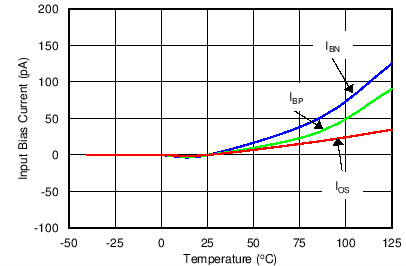
| Input Bias and Offset Current vs Temperature | Figure 8 |
| Open-Loop Output Impedance vs Frequency | Figure 9 |
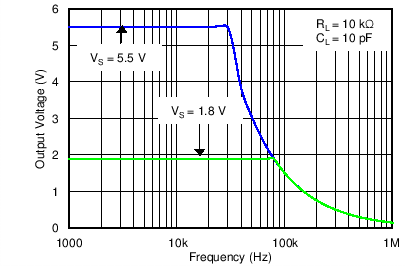
| Maximum Output Voltage vs Frequency and Supply Voltage | Figure 10 |
| Output Voltage Swing vs Output Current (over Temperature) | Figure 11 |
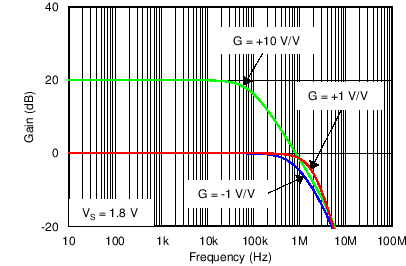
| Closed-Loop Gain vs Frequency, G = 1, –1, 10 (1.8 V) | Figure 12 |
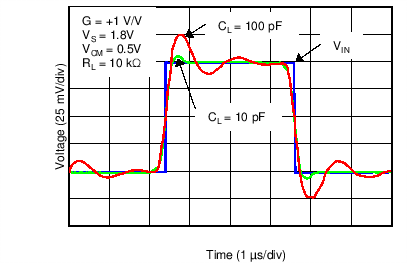
| Small-Signal Step Response, Noninverting (1.8 V) | Figure 13 |
| Small-Signal Step Response, Noninverting ( 5.5 V) | Figure 14 |
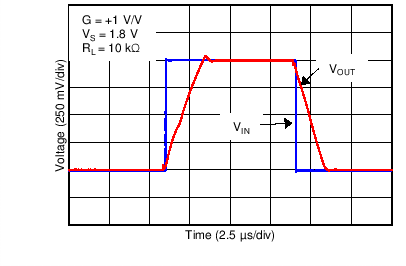
| Large-Signal Step Response, Noninverting (1.8 V) | Figure 15 |
| Large-Signal Step Response, Noninverting ( 5.5 V) | Figure 16 |
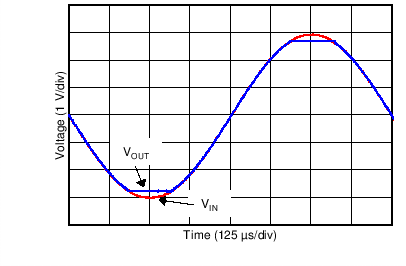
| No Phase Reversal | Figure 17 |
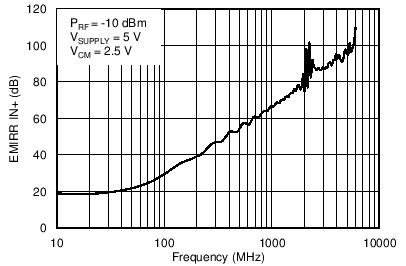
| EMIRR IN+ vs Frequency | Figure 18 |
7.10 Typical Characteristics
At TA = 25°C, VS = 5 V, RL = 10 kΩ connected to VS / 2, and VCM = VOUT = VS / 2, unless otherwise noted.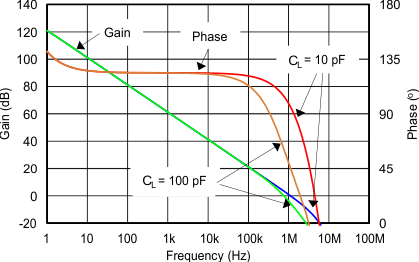
(Referred-to-Input)
(Minimum Supply)
(Minimum Supply)
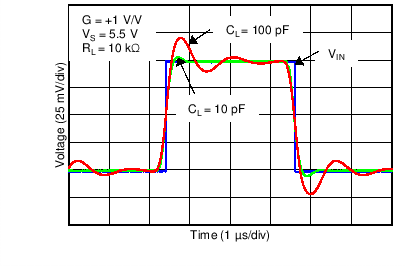
(Maximum Supply)
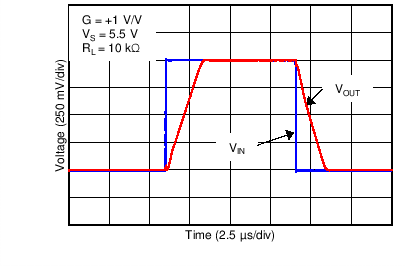
(Maximum Supply)