SCDA054 June 2025 TMUX1308 , TMUX1308-Q1 , TMUX1308A , TMUX1308A-Q1 , TMUX1309 , TMUX1309A
2 Application
In applications where an ADC is sampling data from multiple sensors, a single multiplexer can provide a design for routing and passing the signals. The TMUX1308-Q1 and TMUX1308A-Q1 devices can support up to eight sensors due to the devices configuration as shown in Figure 2-1. The devices switch between different sensor inputs and select which data is sent to an ADC.
 Figure 2-1 TMUX1308-Q1 ADC Application
This is heavily used in zone and body control modules where the potential for an overvoltage event is present, or the need to interface with a 48V battery system. A voltage divider has to be implemented on the inputs, to lower the voltage to a level where the mux can operate in. In addition to the resistors, capacitors tied to ground are used on each source to stabilize the signal. On the drain side there is also capacitance from the ADC, which greatly impacts the settling time.
 Figure 2-2 RC Components on the I/Os of the MUX
Most multiplexers have a feature called Break before Make. This is a safety feature that prevents two inputs from connecting when the device is switching. The output first breaks from the on-state switch before making the connection with the next on-state switch.
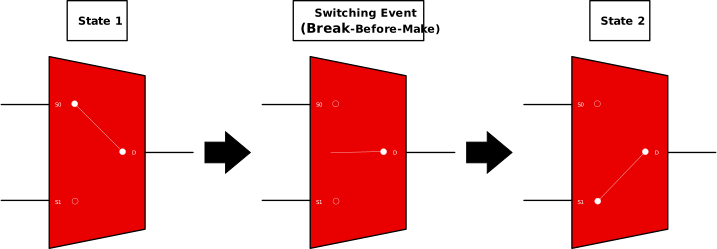 Figure 2-3 Break-Before-Make
This creates a slight delay where there is a down time when there is no connection between the source and drain. This can cause ADC reading errors, since the voltage level of the signal drops for a short period of time causing the ADC to read wrong voltage values. Having an additional RC load on the source pins can increase the time the output of the mux takes to recover which can result in inaccuracies on the ADC input. The time this takes for the signal to recover to the peak, referred to as the settling time (tst), is directly affected by the series resistance and capacitance on the source pins as seen in Figure 2-4. The capacitance on the source and drain can affect how low the signal can dip, while the resistance can impact how fast this can settle back to the original state. Combined together is your total settling time.
 Figure 2-4 Settling Time Graph