SLAAEA6 February 2025 CSD19538Q3A , LM25148 , MSP430FR2355 , TLV5624
2.1 Drive LED With Linear Constant-Current Source
The first method to drive an LED with the analog dimming function is to use an adjustable constant-current source. Figure 2-1 shows the schematic. The MOSFET (CSD19536KTT), amplifier (OPA863A), and digital-to-analog converter (DAC) (DAC60501) comprise an adjustable constant-current sink. The LED current equals the D-pole current of the CSD19536 since the sum of R1 and R2 is much larger than the sensing resistor (RS). Equation 1 shows the function between the output voltage of DAC60501 and current flow of the LED.
where
- RS is sensing resistor
- VDAC is output voltage of DAC
- R1 and R2 are divider resistors
The MOSFET runs in linear range and can potentially consume lots of power, resulting in low system efficiency. To solve this issue, the designer needs to use another DAC60501 to adjust the output voltage of the buck regulator (TLVM13610) and keep the MOSFET running in linear mode but close the switch-on mode (about 100mV–200mV higher than the switch-on drop voltage). Under these conditions, the designer can keep the system at a high efficiency consuming low power; thus, a low rise in temperature. Equation 2 shows the function between the output voltage of the buck regulator with the output voltage of DAC60501.
where
- RT is the top resistor
- RB is the bottom resistor
- RC is the serial resistor with DAC
- VREF is the reference voltage of the buck regulator
- VDAC is DAC output voltage
 Figure 2-1 LED Analog Dimming With Adjustable
Constant-Current Sink
Figure 2-1 LED Analog Dimming With Adjustable
Constant-Current SinkSometimes, the LED current is very large and the DAC cannot use all the range. For example, assume the maximum LED current is 20A and the sensing resistor is 20mΩ. The sensing voltage is then 0.4V and the designer needs to use an 8W sensing resistor. This causes the maximum output of the DAC to be 0.4V; therefore, the DAC cannot use the full range resulting in low resolution. The second issue is the large power consumption of the sensing resistor and the large package size.
To solve these two issues in large-current LED applications, consider the following changes:
- Use a smaller sensing resistor (for example, with a smaller value to 2mΩ), now the power consumed is 0.8W and the maximum sensing voltage is 0.04V.
- To extend the DAC output range, insert a current-sensing amplifier (for example, the INA241A) with a gain of 100 (see Figure 2-2). This expands the DAC output to 4V from 0.04V and improves system resolution since INA241A is a precise current-sensing amplifier with 10μV offset and is an excellent choice for this application.
- Use MSPM0L1228 as the controller to configure two DAC60501 devices with an SPI or IIC interface
- Use the TPS548D26 buck regulator with a maximum 40A output current.
Using the previously mentioned options, the designer can easily get LED current with DAC output voltage as Equation 3 shows.
where
- GINA241A is the gain of INA241
- RS is the sensing resistor
- R1 and R2 are the divider resistors
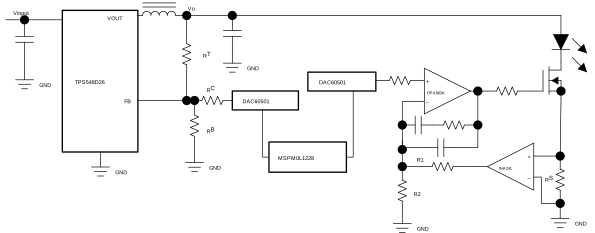 Figure 2-2 Large Current LED Analog Dimming
This design benefits from the fact that the design can dim the LED with either the analog method or in PWM mode. In analog dimming mode, this design has premium linearity. In PWM dimming mode, the design can dim with high PWM frequency to several MHz if the designer replaces OPA863A with a high-speed amplifier and high-speed DAC. In fact, this scheme can generate any desired LED drive current waveform. The drawbacks include increased cost and a larger PCB footprint.