SLLA654 February 2025 ISO6163
2.3 MCU to SPI Peripheral Communication With Single Direction Wake-up
These application use cases show MCU (microcontroller) to SPI peripherals with single direction wake-up from the MCU side.
Figure 2-1 shows a MCU to SPI peripheral with single direction wake-up from the host MCU. When the host MCU idles the communication by pulling INC HIGH, the isolator transitions to STANDBY state after the STANDBY state enable delay time, tLP_EN, and turns off the high-speed data channels since IND is wired HIGH. To initiate communication again, the MCU pulls nCS LOW (INC), the isolator transitions to ACTIVE state turning on the high-speed channels and pulls OUTC LOW. The SPI peripheral uses the input from OUTC as a wake-up interrupt or equivalent to wake-up and prepare for high-speed communication.
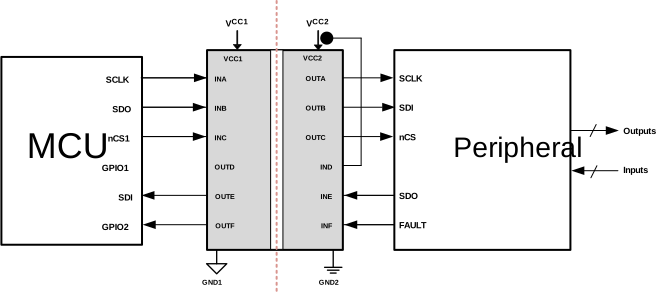 Figure 2-4 5-Channel
MCU to SPI Peripheral With Single Direction Wake-up From MCU to
Peripheral
Figure 2-4 5-Channel
MCU to SPI Peripheral With Single Direction Wake-up From MCU to
PeripheralThe next example, Figure 2-5, is similar to Figure 2-4 however this example uses a single channel opto-emulator, ISO8710, as the nCS for the second peripheral.
The MCU must control INC of the ISO6163 isolator since INC controls the wake-up and state of the ISO6163 and the chip select to peripheral 1. To keep the ISO6163 in ACTIVE state while the MCU is communicating with Peripheral2 (nCS2 LOW and nCS1 HIGH), the communication to Peripheral2 must be completed before, tLP_EN and the ISO6163 transitions to STANDBY state after INC (nCS1) is HIGH for the STANDBY state enable delay time. The STANDBY state transition timing is explained in the ISO6163 Low-Power, High-Speed Six-Channel Digital Isolator With Automatic Enable, data sheet, section 7.3.1 Low-Speed Control Channels: Timing and Level Details for Automatic Enable.
 Figure 2-5 5-Channel
MCU to Multiple SPI Peripheral Bus With Single-Direction Wake-up From MCU to
Peripheral With ISOM8710 Opto-emulator for 2nd nCS Channel
Figure 2-5 5-Channel
MCU to Multiple SPI Peripheral Bus With Single-Direction Wake-up From MCU to
Peripheral With ISOM8710 Opto-emulator for 2nd nCS Channel