SLLSEQ7F December   2015  – May 2025 TCAN330 , TCAN330G , TCAN332 , TCAN332G , TCAN334 , TCAN334G , TCAN337 , TCAN337G

PRODUCTION DATA  

  1.   1
  2. 1Features
  3. 2Applications
  4. 3Description
  5.   Device Options
  6. 4Pin Configuration and Functions
  7. 5Specifications
    1. 5.1 Absolute Maximum Ratings
    2. 5.2 ESD Ratings
    3. 5.3 Recommended Operating Conditions
    4. 5.4 Thermal Information
    5. 5.5 Electrical Characteristics
    6. 5.6 Switching Characteristics
    7. 5.7 Typical Characteristics
    8. 5.8 Typical Characteristics, TCAN330 Receiver
    9. 5.9 Typical Characteristics, TCAN330 Driver
  8.   Parameter Measurement Information
  9. 6Detailed Description
    1. 6.1 Overview
    2. 6.2 Functional Block Diagram
    3. 6.3 Feature Description
      1. 6.3.1 TXD Dominant Timeout (TXD DTO)
      2. 6.3.2 RXD Dominant Timeout (RXD DTO)
      3. 6.3.3 Thermal Shutdown
      4. 6.3.4 Undervoltage Lockout and Unpowered Device
      5. 6.3.5 Fault Pin (TCAN337)
      6. 6.3.6 Floating Pins
      7. 6.3.7 CAN Bus Short Circuit Current Limiting
      8. 6.3.8 ESD Protection
      9. 6.3.9 Digital Inputs and Outputs
    4. 6.4 Device Functional Modes
      1. 6.4.1 CAN Bus States
      2. 6.4.2 Normal Mode
      3. 6.4.3 Silent Mode
      4. 6.4.4 Standby Mode with Wake
      5. 6.4.5 Bus Wake via RXD Request (BWRR) in Standby Mode
      6. 6.4.6 Shutdown Mode
      7. 6.4.7 Driver and Receiver Function Tables
  10. 7Application Information Disclaimer
    1. 7.1 Application Information
      1. 7.1.1 Bus Loading, Length and Number of Nodes
    2. 7.2 Typical Application
      1. 7.2.1 Design Requirements
        1. 7.2.1.1 CAN Termination
      2. 7.2.2 Detailed Design Procedure
      3. 7.2.3 Application Curves
    3. 7.3 System Examples
      1. 7.3.1 ISO11898 Compliance of TCAN33x Family of 3.3V CAN Transceivers Introduction
      2. 7.3.2 Differential Signal
      3. 7.3.3 Common-Mode Signal and EMC Performance
    4. 7.4 Power Supply Recommendations
    5. 7.5 Layout
      1. 7.5.1 Layout Guidelines
      2. 7.5.2 Layout Example
  11.   Device and Documentation Support
    1. 8.1 Receiving Notification of Documentation Updates
    2. 8.2 Support Resources
    3. 8.3 Trademarks
    4. 8.4 Electrostatic Discharge Caution
    5. 8.5 Glossary
  12. 8Revision History
  13. 9Mechanical, Packaging, and Orderable Information

Detailed Design Procedure

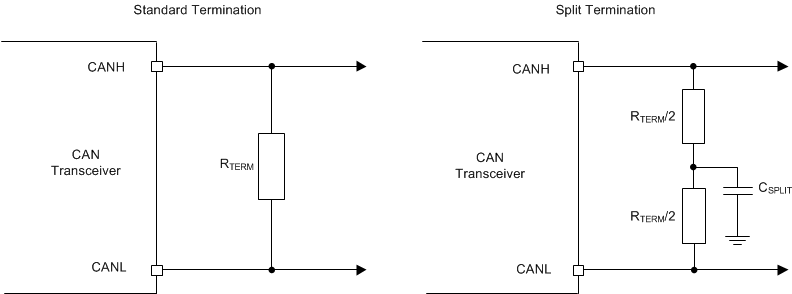
Termination is typically a 120Ω resistor at each end of the bus. If filtering and stabilization of the common mode voltage of the bus is desired, then split termination may be used. Split termination uses two 60Ω resistors with a capacitor in the middle of these resistors to ground. Split termination improves the electromagnetic emissions behavior of the network by eliminating fluctuations in the bus common mode voltages at the start and end of message transmissions.

Care should be taken in the power ratings of the termination resistors used. Typically the worst case condition would be if the system power supply was shorted across the termination resistance to ground. In most cases, the current flow through the resistor in this condition is much higher than the transceiver current limit.

TCAN330 TCAN332 TCAN334 TCAN337 TCAN330G TCAN332G TCAN334G TCAN337G Typical CAN BusFigure 7-2 Typical CAN Bus
TCAN330 TCAN332 TCAN334 TCAN337 TCAN330G TCAN332G TCAN334G TCAN337G CAN Bus Termination ConceptsFigure 7-3 CAN Bus Termination Concepts