SPRSP61C October 2021 – December 2023 TMS320F280033 , TMS320F280034 , TMS320F280034-Q1 , TMS320F280036-Q1 , TMS320F280036C-Q1 , TMS320F280037 , TMS320F280037-Q1 , TMS320F280037C , TMS320F280037C-Q1 , TMS320F280038-Q1 , TMS320F280038C-Q1 , TMS320F280039 , TMS320F280039-Q1 , TMS320F280039C , TMS320F280039C-Q1
PRODMIX
- 1
- 1 Features
- 2 Applications
- 3 Description
- 4 Device Comparison
- 5 Pin Configuration and Functions
-
6 Specifications
- 6.1 Absolute Maximum Ratings
- 6.2 ESD Ratings – Commercial
- 6.3 ESD Ratings – Automotive
- 6.4 Recommended Operating Conditions
- 6.5 Power Consumption Summary
- 6.6 Electrical Characteristics
- 6.7 Thermal Resistance Characteristics for PZ Package
- 6.8 Thermal Resistance Characteristics for PN Package
- 6.9 Thermal Resistance Characteristics for PM Package
- 6.10 Thermal Resistance Characteristics for PT Package
- 6.11 Thermal Design Considerations
- 6.12
System
- 6.12.1
Power Management Module (PMM)
- 6.12.1.1 Introduction
- 6.12.1.2 Overview
- 6.12.1.3 External Components
- 6.12.1.4 Power Sequencing
- 6.12.1.5 Power Management Module Electrical Data and Timing
- 6.12.2 Reset Timing
- 6.12.3
Clock Specifications
- 6.12.3.1 Clock Sources
- 6.12.3.2
Clock Frequencies, Requirements, and Characteristics
- 6.12.3.2.1
Input Clock Frequency and Timing
Requirements, PLL Lock Times
- 6.12.3.2.1.1 Input Clock Frequency
- 6.12.3.2.1.2 XTAL Oscillator Characteristics
- 6.12.3.2.1.3 X1 Input Level Characteristics When Using an External Clock Source - Not a Crystal
- 6.12.3.2.1.4 X1 Timing Requirements
- 6.12.3.2.1.5 AUXCLKIN Timing Requirements
- 6.12.3.2.1.6 APLL Characteristics
- 6.12.3.2.1.7 XCLKOUT Switching Characteristics - PLL Bypassed or Enabled
- 6.12.3.2.1.8 Internal Clock Frequencies
- 6.12.3.2.1
Input Clock Frequency and Timing
Requirements, PLL Lock Times
- 6.12.3.3 Input Clocks and PLLs
- 6.12.3.4 XTAL Oscillator
- 6.12.3.5 Internal Oscillators
- 6.12.4 Flash Parameters
- 6.12.5 RAM and ROM Parameters
- 6.12.6 Emulation/JTAG
- 6.12.7 GPIO Electrical Data and Timing
- 6.12.8 Interrupts
- 6.12.9
Low-Power Modes
- 6.12.9.1 Clock-Gating Low-Power Modes
- 6.12.9.2
Low-Power Mode Wake-up Timing
- 6.12.9.2.1 IDLE Mode Timing Requirements
- 6.12.9.2.2 IDLE Mode Switching Characteristics
- 6.12.9.2.3 IDLE Entry and Exit Timing Diagram
- 6.12.9.2.4 STANDBY Mode Timing Requirements
- 6.12.9.2.5 STANDBY Mode Switching Characteristics
- 6.12.9.2.6 STANDBY Entry and Exit Timing Diagram
- 6.12.9.2.7 HALT Mode Timing Requirements
- 6.12.9.2.8 HALT Mode Switching Characteristics
- 6.12.9.2.9 HALT Entry and Exit Timing Diagram
- 6.12.1
Power Management Module (PMM)
- 6.13
Analog Peripherals
- 6.13.1 Analog Pins and Internal Connections
- 6.13.2 Analog Signal Descriptions
- 6.13.3 Analog-to-Digital Converter (ADC)
- 6.13.4 Temperature Sensor
- 6.13.5 Comparator Subsystem (CMPSS)
- 6.13.6 Buffered Digital-to-Analog Converter (DAC)
- 6.14
Control Peripherals
- 6.14.1 Enhanced Pulse Width Modulator (ePWM)
- 6.14.2 High-Resolution Pulse Width Modulator (HRPWM)
- 6.14.3 External ADC Start-of-Conversion Electrical Data and Timing
- 6.14.4 Enhanced Capture (eCAP)
- 6.14.5 High-Resolution Capture (HRCAP)
- 6.14.6 Enhanced Quadrature Encoder Pulse (eQEP)
- 6.14.7 Sigma-Delta Filter Module (SDFM)
- 6.15
Communications Peripherals
- 6.15.1 Controller Area Network (CAN)
- 6.15.2 Modular Controller Area Network (MCAN)
- 6.15.3 Inter-Integrated Circuit (I2C)
- 6.15.4 Power Management Bus (PMBus) Interface
- 6.15.5 Serial Communications Interface (SCI)
- 6.15.6 Serial Peripheral Interface (SPI)
- 6.15.7 Local Interconnect Network (LIN)
- 6.15.8 Fast Serial Interface (FSI)
- 6.15.9 Host Interface Controller (HIC)
-
7 Detailed Description
- 7.1 Overview
- 7.2 Functional Block Diagram
- 7.3 Memory
- 7.4 Identification
- 7.5 Bus Architecture – Peripheral Connectivity
- 7.6 C28x Processor
- 7.7 Control Law Accelerator (CLA)
- 7.8 Embedded Real-Time Analysis and Diagnostic (ERAD)
- 7.9 Background CRC-32 (BGCRC)
- 7.10 Direct Memory Access (DMA)
- 7.11 Device Boot Modes
- 7.12 Security
- 7.13 Watchdog
- 7.14 C28x Timers
- 7.15 Dual-Clock Comparator (DCC)
- 7.16 Configurable Logic Block (CLB)
- 7.17 Functional Safety
-
8 Applications, Implementation, and Layout
- 8.1 Applications and Implementation
- 8.2 Key Device Features
- 8.3 Application Information
- 9 Device and Documentation Support
- 10Revision History
- 11Mechanical, Packaging, and Orderable Information
6.15.6 Serial Peripheral Interface (SPI)
The serial peripheral interface (SPI) is a high-speed synchronous serial input and output (I/O) port that allows a serial bit stream of programmed length (1 to 16 bits) to be shifted into and out of the device at a programmed bit-transfer rate. The SPI is normally used for communications between the MCU controller and external peripherals or another controller. Typical applications include external I/O or peripheral expansion through devices such as shift registers, display drivers, and analog-to-digital converters (ADCs). Multidevice communications are supported by the master or slave operation of the SPI. The port supports a 16-level, receive and transmit FIFO for reducing CPU servicing overhead.
The SPI module features include:
- SPISOMI: SPI slave-output/master-input pin
- SPISIMO: SPI slave-input/master-output pin
- SPISTE: SPI slave transmit-enable pin
- SPICLK: SPI serial-clock pin
- Two operational modes: Master and Slave
- Baud rate: 125 different programmable rates. The maximum baud rate that can be employed is limited by the maximum speed of the I/O buffers used on the SPI pins.
- Data word length: 1 to 16 data bits
- Four clocking schemes (controlled by clock polarity and clock phase bits) include:
- Falling edge without phase delay: SPICLK active-high. SPI transmits data on the falling edge of the SPICLK signal and receives data on the rising edge of the SPICLK signal.
- Falling edge with phase delay: SPICLK active-high. SPI transmits data one half-cycle ahead of the falling edge of the SPICLK signal and receives data on the falling edge of the SPICLK signal.
- Rising edge without phase delay: SPICLK inactive-low. SPI transmits data on the rising edge of the SPICLK signal and receives data on the falling edge of the SPICLK signal.
- Rising edge with phase delay: SPICLK inactive-low. SPI transmits data one half-cycle ahead of the rising edge of the SPICLK signal and receives data on the rising edge of the SPICLK signal.
- Simultaneous receive and transmit operation (transmit function can be disabled in software)
- Transmitter and receiver operations are accomplished through either interrupt-driven or polled algorithm
- 16-level transmit/receive FIFO
- DMA support
- High-speed mode
- Delayed transmit control
- 3-wire SPI mode
- SPISTE inversion for digital audio interface receive mode on devices with two SPI modules
Figure 6-72 shows the SPI CPU interfaces.
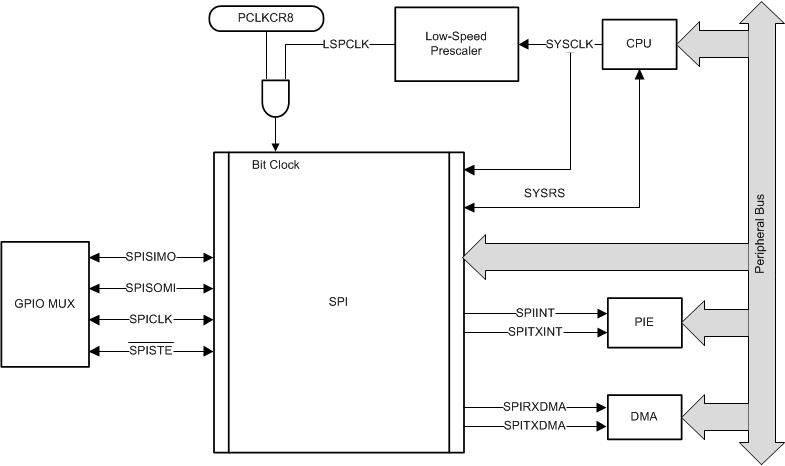 Figure 6-72 SPI CPU Interface