SPRT805 October 2025 XTR200
Introduction
Field transmitters are often used in industrial applications to communicate data from a sensor or transmitter back to a control center or programmable logic controller (PLC). The most common types are 2-wire or 3-wire current transmitters that typically output 4mA to 20mA. As sensors and transmitter systems shrink to fit small sensor housings for space-constrained environments, there is a need to integrate more functionality into the current transmitter device. XTR200 is the newest integrated analog output driver for 3-wire current transmitter systems. The device can output either current or voltage, selectable with a mode pin. XTR200 is designed for standard industrial signal ranges of 0mA to 20mA, 4mA to 20mA, or 0V to 10V.
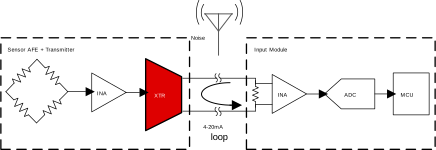 Figure 1 Field transmitter simplified diagram
Minimize board space with XTR200
XTR200 is a fully integrated, analog transmitter that offers more integration and precision in a small-form 3mm by 2mm package. Highlighted specifications include:
- Wide supply voltage of 8V to 60V allows for flexibility in surge protection and helps reduce number of external components
- Specified over the full industrial temperature range of ˗40°C to +125°C
- Low span error of ±0.01% (typ) in current mode
- Low gain error of ±0.007% (typ) in voltage mode
- Low input offset voltage of ±200µV and offset drift of ±0.5µV/°C
- Available in small 3mm by 2mm, 10-pin WSON surface-mount package
Integrated features include:
- Integrated PMOS transistor: The internal PMOS transistor is protected by short circuit protection circuity and is able to handle a wide range of load resistances. An optional external PNP or PMOS transistor can implemented to reduce power dissipation by delivering the majority of the load current when used in high-temperature environments with high supply voltages.
- Error diagnostics: The device provides internal error diagnosis capability with the error flag pin detecting several fault conditions including over-temperature, short-circuit current limit, open-circuit load, and short to ground at the SET pin.
- Output disable: XTR200 provides an output disable pin to maintain a reliable, glitch-free start up output during power on or multiplexing.
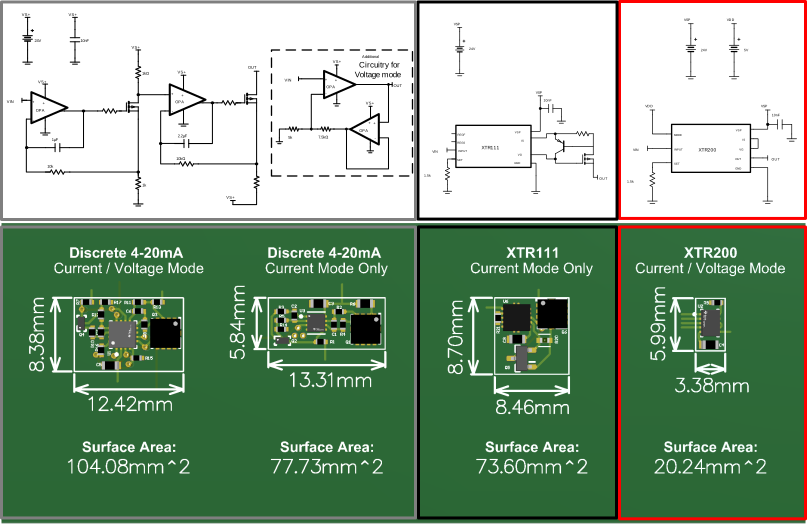 Figure 2 Design size comparison
Figure 2 shows that XTR200 saves over 70% of board space compared to the discrete design and previous generation devices such as the XTR111. The discrete designs use typical small-size quad and dual operational amplifiers, 0402 package resistors, and a P-Channel MOSFET. Previous generation XTRs such as the XTR111 require external circuitry (transistors Q5, Q6) for functionality that add to total board space and complexity. In contrast, XTR200 provides a small design footprint to optimize board space while maintaining excellent performance. Decoupling capacitors and SET resistors are included in the XTR design, but other input and output signal chain devices and error flag components are left out in the size comparison.
Application and end equipments
XTR200 can be used in a wide variety of end equipments outside of field transmitters for 4-20mA loops. Common end equipments include but not limited to field transmitters, programmable logic controllers (PLCs), data acquisition systems, and server power supplies.
This device is well suited for:
- 4-20mA current and 0-10V voltage output 3-wire transmitters
- Current monitoring in server power supplies (Modular Hardware System-Common Redundant Power Supplies [M-CRPS])
- Current source for sensor excitation:
- RTD sensors
- IEPE vibration sensors
- Wheatstone bridge sensors
Learn more about how the XTR200 can help reduce space and improve performance while simplifying the bill of materials (BOM), and start evaluating with the following resources:
Learn More
- XTR200 Data sheet
- Learn how to use XTR200 in M-CRPS current monitoring systems
- Reference frequently asked questions about 4-20mA current loop transmitters in our E2E FAQs.
- Learn about 4-20mA transmitters in our Precision Labs series
Evaluate the Design
For additional assistance, ask questions to TI engineers on the TI E2E Amplifiers Support Forum.