SNIS159H August 1999 – December 2017 LM35
PRODUCTION DATA.
- 1 Features
- 2 Applications
- 3 Description
- 4 Revision History
- 5 Pin Configuration and Functions
-
6 Specifications
- 6.1 Absolute Maximum Ratings
- 6.2 ESD Ratings
- 6.3 Recommended Operating Conditions
- 6.4 Thermal Information
- 6.5 Electrical Characteristics: LM35A, LM35CA Limits
- 6.6 Electrical Characteristics: LM35A, LM35CA
- 6.7 Electrical Characteristics: LM35, LM35C, LM35D Limits
- 6.8 Electrical Characteristics: LM35, LM35C, LM35D
- 6.9 Typical Characteristics
- 7 Detailed Description
- 8 Application and Implementation
- 9 Power Supply Recommendations
- 10Layout
- 11Device and Documentation Support
- 12Mechanical, Packaging, and Orderable Information
Package Options
Refer to the PDF data sheet for device specific package drawings
Mechanical Data (Package|Pins)
- D|8
- NDV|3
- LP|3
- NEB|3
Thermal pad, mechanical data (Package|Pins)
Orderable Information
8 Application and Implementation
NOTE
Information in the following applications sections is not part of the TI component specification, and TI does not warrant its accuracy or completeness. TI’s customers are responsible for determining suitability of components for their purposes. Customers should validate and test their design implementation to confirm system functionality.
8.1 Application Information
The features of the LM35 make it suitable for many general temperature sensing applications. Multiple package options expand on it's flexibility.
8.1.1 Capacitive Drive Capability
Like most micropower circuits, the LM35 device has a limited ability to drive heavy capacitive loads. Alone, the LM35 device is able to drive 50 pF without special precautions. If heavier loads are anticipated, isolating or decoupling the load with a resistor is easy (see Figure 12). The tolerance of capacitance can be improved with a series R-C damper from output to ground (see Figure 13).
When the LM35 device is applied with a 200-Ω load resistor as shown in Figure 16, Figure 17, or Figure 19, the device is relatively immune to wiring capacitance because the capacitance forms a bypass from ground to input and not on the output. However, as with any linear circuit connected to wires in a hostile environment, performance is affected adversely by intense electromagnetic sources (such as relays, radio transmitters, motors with arcing brushes, and SCR transients), because the wiring acts as a receiving antenna and the internal junctions act as rectifiers. For best results in such cases, a bypass capacitor from VIN to ground and a series R-C damper, such as 75 Ω in series with 0.2 or 1 μF from output to ground, are often useful. Examples are shown in Figure 13, Figure 24, and Figure 25.
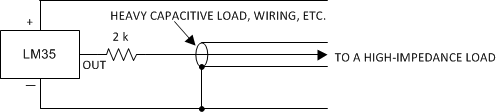 Figure 12. LM35 with Decoupling from Capacitive Load
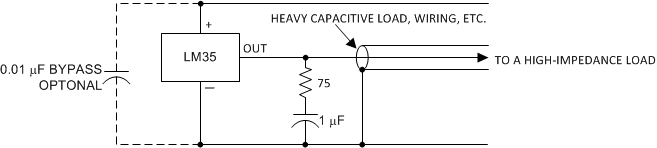 Figure 13. LM35 with R-C Damper
8.2 Typical Application
8.2.1 Basic Centigrade Temperature Sensor
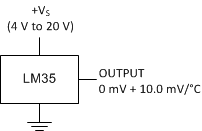 Figure 14. Basic Centigrade Temperature Sensor (2 °C to 150 °C)
8.2.1.1 Design Requirements
Table 1. Design Parameters
| PARAMETER | VALUE | |||
|---|---|---|---|---|
| Accuracy at 25°C | ±0.5°C | |||
| Accuracy from –55 °C to 150°C | ±1°C | |||
| Temperature Slope | 10 mV/°C | |||
8.2.1.2 Detailed Design Procedure
Because the LM35 device is a simple temperature sensor that provides an analog output, design requirements related to layout are more important than electrical requirements. For a detailed description, refer to the Layout.
8.2.1.3 Application Curve
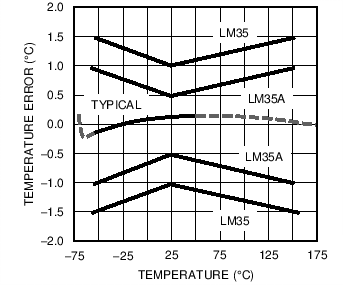 Figure 15. Accuracy vs Temperature (Ensured)
8.3 System Examples
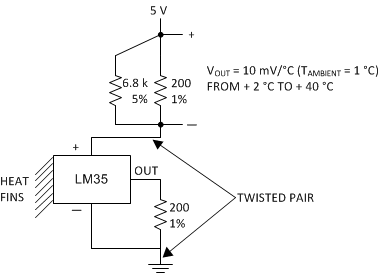 Figure 16. Two-Wire Remote Temperature Sensor
(Grounded Sensor)
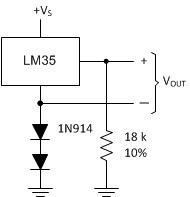 Figure 18. Temperature Sensor, Single Supply
(−55° to +150°C)
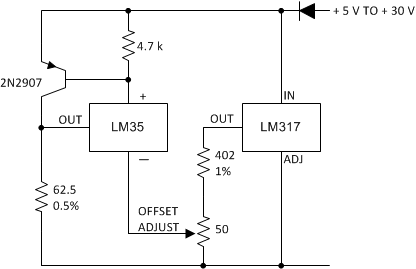 Figure 20. 4-To-20 mA Current Source
(0°C to 100°C)
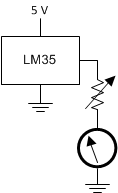 Figure 22. Centigrade Thermometer
(Analog Meter)
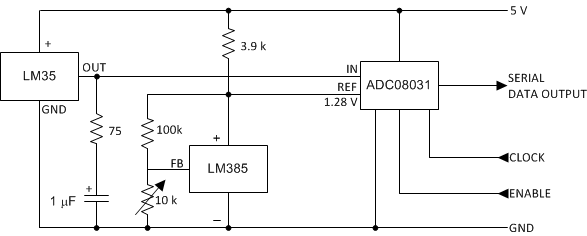 Figure 24. Temperature to Digital Converter
(Serial Output)
(128°C Full Scale)
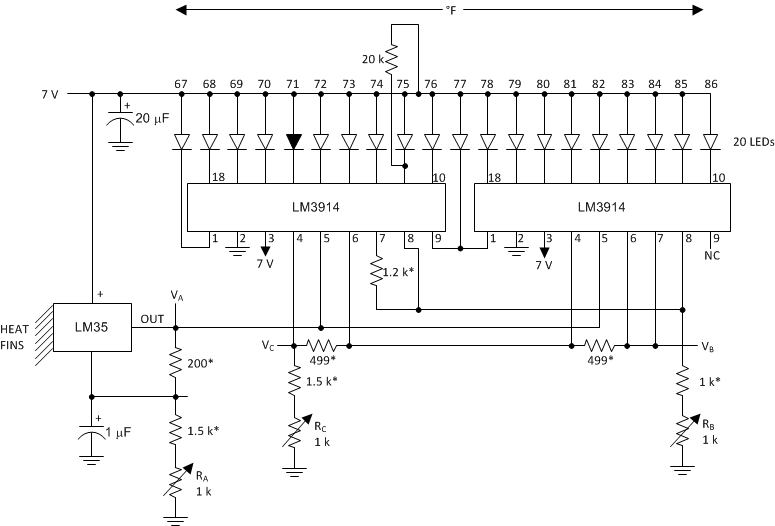
| *=1% or 2% film resistor | ||
| Trim RB for VB = 3.075 V | ||
| Trim RC for VC = 1.955 V | ||
| Trim RA for VA = 0.075 V + 100 mV/°C ×Tambient | ||
| Example, VA = 2.275 V at 22°C |
(Dot Mode)
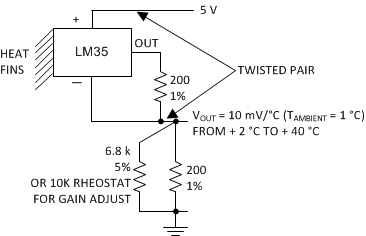 Figure 17. Two-Wire Remote Temperature Sensor
(Output Referred to Ground)
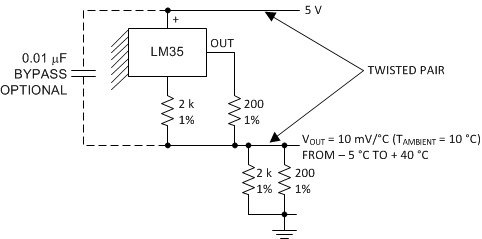 Figure 19. Two-Wire Remote Temperature Sensor
(Output Referred to Ground)
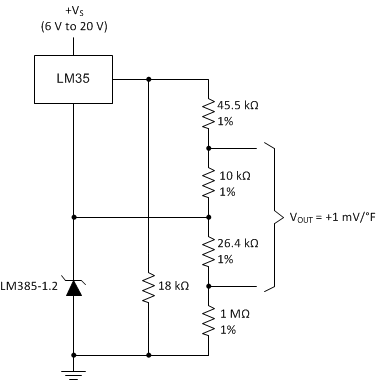 Figure 21. Fahrenheit Thermometer
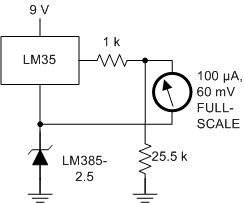 Figure 23. Fahrenheit Thermometer, Expanded Scale Thermometer
(50°F to 80°F, for Example Shown)
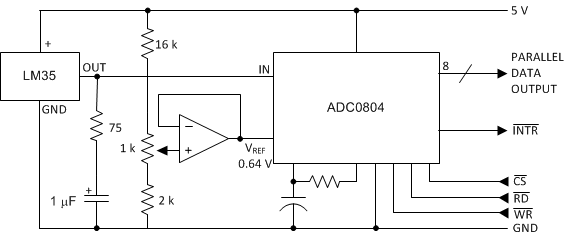 Figure 25. Temperature to Digital Converter
(Parallel TRI-STATE Outputs for Standard Data Bus to μP Interface)
(128°C Full Scale)
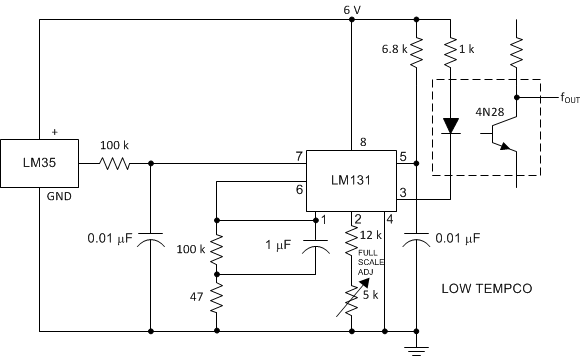 Figure 27. LM35 With Voltage-To-Frequency Converter and Isolated Output
(2°C to 150°C; 20 to 1500 Hz)