SNVSBA0E February 2020 – October 2025 LM61480-Q1 , LM61495-Q1 , LM62460-Q1
PRODUCTION DATA
- 1
- 1 Features
- 2 Applications
- 3 Description
- 4 Device Comparison Table
- 5 Pin Configuration and Functions
- 6 Specifications
-
7 Detailed Description
- 7.1 Overview
- 7.2 Functional Block Diagram
- 7.3
Feature Description
- 7.3.1 Output Voltage Selection
- 7.3.2 Enable EN Pin and Use as VIN UVLO
- 7.3.3 SYNC/MODE Uses for Synchronization
- 7.3.4 Clock Locking
- 7.3.5 Adjustable Switching Frequency
- 7.3.6 RESET Output Operation
- 7.3.7 Internal LDO, VCC UVLO, and BIAS Input
- 7.3.8 Bootstrap Voltage and VCBOOT-UVLO (CBOOT Pin)
- 7.3.9 Adjustable SW Node Slew Rate
- 7.3.10 Spread Spectrum
- 7.3.11 Soft Start and Recovery From Dropout
- 7.3.12 Overcurrent and Short-Circuit Protection
- 7.3.13 Hiccup
- 7.3.14 Thermal Shutdown
- 7.4 Device Functional Modes
-
8 Application and Implementation
- 8.1 Application Information
- 8.2
Typical Application
- 8.2.1 Design Requirements
- 8.2.2
Detailed Design Procedure
- 8.2.2.1 Choosing the Switching Frequency
- 8.2.2.2 Setting the Output Voltage
- 8.2.2.3 Inductor Selection
- 8.2.2.4 Output Capacitor Selection
- 8.2.2.5 Input Capacitor Selection
- 8.2.2.6 BOOT Capacitor
- 8.2.2.7 BOOT Resistor
- 8.2.2.8 VCC
- 8.2.2.9 CFF and RFF Selection
- 8.2.2.10 RSPSP Selection
- 8.2.2.11 RT Selection
- 8.2.2.12 RMODE Selection
- 8.2.2.13 External UVLO
- 8.2.2.14 Maximum Ambient Temperature
- 8.2.3 Application Curves
- 8.3 Power Supply Recommendations
- 8.4 Layout
- 9 Device and Documentation Support
- 10Revision History
- 11Mechanical, Packaging, and Orderable Information
Package Options
Mechanical Data (Package|Pins)
- RPH|16
Thermal pad, mechanical data (Package|Pins)
- RPH|16
Orderable Information
8.2.2.14 Maximum Ambient Temperature
As with any power conversion device, the LM6x4xx-Q1 dissipates internal power while operating. The effect of this power dissipation is to raise the internal temperature of the converter above ambient temperature. The internal die temperature (TJ) is a function of the following:
- Ambient temperature
- Power loss
- Effective thermal resistance, RθJA of the device
- PCB layout
where
- η = efficiency
- TA = ambient temperature
- TJ = junction temperature
- RθJA = the effective thermal resistance of the IC junction to the air, mainly through the PCB
The effective RθJA is a critical parameter and depends on many factors (just to mention a few of the most critical parameters:
- Power dissipation
- Air temperature
- Airflow
- PCB area
- Copper heat-sink area
- Number of thermal vias under or near the package
- Adjacent component placement
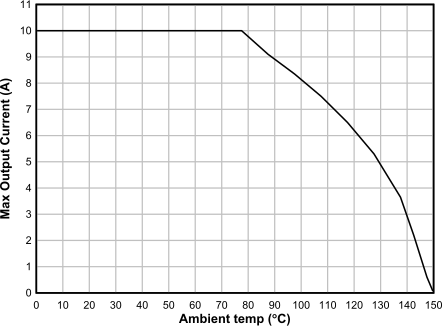
| VIN = 13.5 V | VOUT = 5 V | |
| ƒSW = 400 kHz | RθJA = 22°C/W |

| VIN = 13.5 V | VOUT = 5 V | |
| ƒSW = 2.2 MHz | RθJA = 22°C/W |
Use the following resources as a guide to excellent thermal PCB design and estimating RθJA for a given application environment:
- Thermal Design by Insight not Hindsight application note
- A Guide to Board Layout for Best Thermal Resistance for Exposed Pad Packages application note
- Semiconductor and IC Package Thermal Metrics application note
- Thermal Design Made Simple with LM43603 and LM43602 application note
- PowerPAD™ Thermally Enhanced Package application note
- PowerPAD™ Made Easy application note
- Using New Thermal Metrics application note