SLVS521I July   2004  – February 2025 LP2981 , LP2981A

PRODUCTION DATA  

  1.   1
  2. Features
  3. Applications
  4. Description
  5. Pin Configuration and Functions
  6. Specifications
    1. 5.1 Absolute Maximum Ratings
    2. 5.2 ESD Ratings
    3. 5.3 Recommended Operating Conditions
    4. 5.4 Thermal Information
    5. 5.5 Electrical Characteristics
    6. 5.6 Typical Characteristics
  7. Detailed Description
    1. 6.1 Overview
    2. 6.2 Functional Block Diagrams
    3. 6.3 Feature Description
      1. 6.3.1 Output Enable
      2. 6.3.2 Dropout Voltage
      3. 6.3.3 Current Limit
        1. 6.3.3.1 Current Limit (Legacy Chip)
        2. 6.3.3.2 Current Limit (New Chip)
      4. 6.3.4 Undervoltage Lockout (UVLO)
      5. 6.3.5 Thermal Shutdown
      6. 6.3.6 Output Pulldown
    4. 6.4 Device Functional Modes
      1. 6.4.1 Normal Operation
      2. 6.4.2 Dropout Operation
      3. 6.4.3 Disabled
  8. Application and Implementation
    1. 7.1 Application Information
      1. 7.1.1 Recommended Capacitor Types
        1. 7.1.1.1 Recommended Capacitors (Legacy Chip)
          1. 7.1.1.1.1 Tantalum Capacitors
          2. 7.1.1.1.2 Ceramic Capacitors
          3. 7.1.1.1.3 Aluminum Capacitors
        2. 7.1.1.2 Recommended Capacitors (New Chip)
      2. 7.1.2 Input and Output Capacitor Requirements
        1. 7.1.2.1 Input Capacitor
        2. 7.1.2.2 Output Capacitor
          1. 7.1.2.2.1 Output Capacitor (Legacy Chip)
          2. 7.1.2.2.2 Output Capacitor (New Chip)
      3. 7.1.3 Estimating Junction Temperature
      4. 7.1.4 Power Dissipation (PD)
      5. 7.1.5 Reverse Current
    2. 7.2 Typical Application
      1. 7.2.1 Design Requirements
      2. 7.2.2 Detailed Design Procedure
        1. 7.2.2.1 ON and OFF Input Operation
      3. 7.2.3 Application Curves
    3. 7.3 Power Supply Recommendations
    4. 7.4 Layout
      1. 7.4.1 Layout Guidelines
      2. 7.4.2 Layout Example
  9. Device and Documentation Support
    1. 8.1 Device Nomenclature
    2. 8.2 Documentation Support
      1. 8.2.1 Related Documentation
    3. 8.3 Receiving Notification of Documentation Updates
    4. 8.4 Support Resources
    5. 8.5 Trademarks
    6. 8.6 Electrostatic Discharge Caution
    7. 8.7 Glossary
  10. Revision History
  11. 10Mechanical, Packaging, and Orderable Information

Package Options

Mechanical Data (Package|Pins)
Thermal pad, mechanical data (Package|Pins)
Orderable Information

Application Curves

LP2981 LP2981A 5V,
                        3.3μF ESR Curves (Legacy Chip)
VOUT = 5V, COUT = 3.3μF
Figure 7-3 5V, 3.3μF ESR Curves (Legacy Chip)
LP2981 LP2981A 3.0V, 3.3μF ESR Curves (Legacy Chip)
VOUT = 3.0V, COUT = 3.3μF
Figure 7-5 3.0V, 3.3μF ESR Curves (Legacy Chip)
LP2981 LP2981A Line
                        Transient Response (New Chip)
VOUT = 3.3V, IL = 100mA
Figure 7-7 Line Transient Response (New Chip)
LP2981 LP2981A Load
                        Transient Response (New Chip)
VOUT = 3.3V, COUT = 2.2μF
Figure 7-9 Load Transient Response (New Chip)
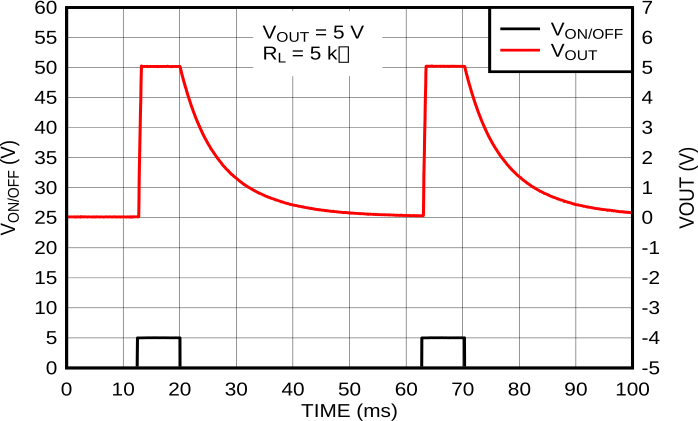
LP2981 LP2981A Turn-Off Waveform (New Chip)
VOUT = 5V, RL = 5kΩ
Figure 7-11 Turn-Off Waveform (New Chip)
LP2981 LP2981A 5V,
                        10μF ESR Curves (Legacy Chip)
VOUT = 5V, CL = 10μF
Figure 7-4 5V, 10μF ESR Curves (Legacy Chip)
LP2981 LP2981A 3.0V, 10μF ESR Curves (Legacy Chip)
VOUT = 3.0V, CL = 10μF
Figure 7-6 3.0V, 10μF ESR Curves (Legacy Chip)
LP2981 LP2981A Line
                        Transient Response (New Chip)
VOUT = 3.3V, IL = 1mA
Figure 7-8 Line Transient Response (New Chip)
LP2981 LP2981A Turn-On Waveform (New Chip)
VOUT = 3.3V, RL = 3.3kΩ
Figure 7-10 Turn-On Waveform (New Chip)