SBOSAK7C December 2024 – November 2025 OPA2383 , OPA383 , OPA4383
PRODUCTION DATA
- 1
- 1 Features
- 2 Applications
- 3 Description
- 4 Pin Configuration and Functions
- 5 Specifications
- 6 Detailed Description
- 7 Application and Implementation
- 8 Device and Documentation Support
- 9 Revision History
- 10Mechanical, Packaging, and Orderable Information
Package Options
Refer to the PDF data sheet for device specific package drawings
Mechanical Data (Package|Pins)
- DGK|8
Thermal pad, mechanical data (Package|Pins)
Orderable Information
3 Description
The OPA383, OPA2383, and OPA4383 (OPAx383) family of precision amplifiers offers state-of-the-art performance. With zero-drift technology, the OPAx383 offset voltage and offset drift provide unparalleled long-term stability. With a ultra-low 65µA of quiescent current, the OPAx383 are able to achieve 2.5MHz of bandwidth, a broadband noise of 32nV/√Hz, and a 1/f noise at 650nVPP. These specifications are crucial to achieve extremely-high precision and no degradation of linearity in 16-bit to 24-bit analog to digital converters (ADCs). The OPAx383 feature flat bias current over temperature; therefore, little to no calibration is needed in high input impedance applications over temperature.
All versions are specified over the industrial temperature range of –40°C to +125°C.
| PART NUMBER | CHANNEL COUNT | PACKAGE(1) | PACKAGE SIZE |
|---|---|---|---|
| OPA383 | Single | DBV (SOT-23, 5) | 2.9mm × 2.8mm |
| DCK (SC70, 5)(2) | 2.0mm × 2.1mm | ||
| OPA2383 | Dual | D (SOIC, 8)(2) | 4.9mm × 6.0mm |
| DGK (VSSOP, 8) | 3.0mm × 4.9mm | ||
| OPA4383 | Quad | PW (TSSOP, 14) | 5.0mm × 6.4mm |
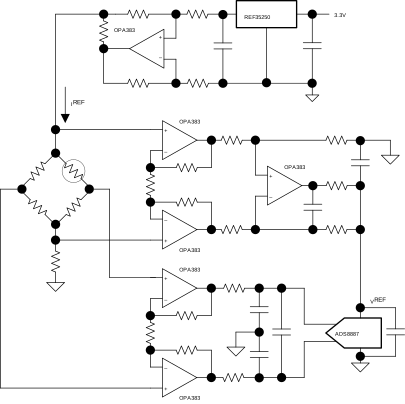 The OPA383 as a
Bridge Sensor Front End
The OPA383 as a
Bridge Sensor Front End Ultra-Low Input Offset Voltage