SNLS787 September   2025 TDP2004-Q1

PRODUCTION DATA  

  1.   1
  2. 1Features
  3. 2Applications
  4. 3Description
  5. 4Pin Configuration and Functions
  6. 5Specifications
    1. 5.1 Absolute Maximum Ratings
    2. 5.2 ESD Ratings
    3. 5.3 Recommended Operating Conditions
    4. 5.4 Thermal Information
    5. 5.5 DC Electrical Characteristics
    6. 5.6 High Speed Electrical Characteristics
    7. 5.7 SMBUS/I2C Timing Charateristics
    8. 5.8 Typical Characteristics
    9. 5.9 Typical Jitter Characteristics
  7. 6Detailed Description
    1. 6.1 Overview
    2. 6.2 Functional Block Diagram
    3. 6.3 Feature Description
      1. 6.3.1 RX Equalization Control Settings
      2. 6.3.2 Flat-Gain
      3. 6.3.3 Cross Point
    4. 6.4 Device Functional Modes
      1. 6.4.1 Active Mode
      2. 6.4.2 Standby Mode
    5. 6.5 Programming
      1. 6.5.1 Pin mode
        1. 6.5.1.1 Five-Level Control Inputs
      2. 6.5.2 SMBUS/I2C Register Control Interface
        1. 6.5.2.1 Shared Registers
        2. 6.5.2.2 Channel Registers
      3. 6.5.3 SMBus/I2C Controller Mode Configuration (EEPROM Self Load)
  8. 7Application and Implementation
    1. 7.1 Application Information
    2. 7.2 Typical Applications
      1. 7.2.1 DP2.1 Main Link Signal Conditioning
        1. 7.2.1.1 Design Requirements
        2. 7.2.1.2 Detailed Design Procedure
        3. 7.2.1.3 Application Curves
      2. 7.2.2 USB-C Cross Point Mux with Signal Conditioner
    3. 7.3 Power Supply Recommendations
    4. 7.4 Layout
      1. 7.4.1 Layout Guidelines
      2. 7.4.2 Layout Example
  9. 8Device and Documentation Support
    1. 8.1 Receiving Notification of Documentation Updates
    2. 8.2 Support Resources
    3. 8.3 Trademarks
    4. 8.4 Electrostatic Discharge Caution
    5. 8.5 Glossary
  10. 9Mechanical, Packaging, and Orderable Information

Package Options

Mechanical Data (Package|Pins)
Thermal pad, mechanical data (Package|Pins)
Orderable Information

Application Curves

The TDP2004-Q1 is a linear redriver that can be used to extend channel reach of a DP link. The redriver can help to pass compliance by removing ISI deterministic jitter at data rates up to 20Gbps (UHBR20) for DP2.1. Figure 7-3 - Figure 7-6 shows a typical DP 2.1 Tx compliance channel setup along with compliance Eye Diagrams at TP3_EQ with or without redriver. The comparison of eye diagrams show that TDP2004-Q1 can provide signal conditioning by extending horizontal and vertical eye openings that makes a failing eye to pass.

TDP2004-Q1 A
                                                Typical 20Gbps (UHBR20) DP 2.1 Tx Compliance Channel
                                                Setup With No RedriverFigure 7-3 A Typical 20Gbps (UHBR20) DP 2.1 Tx Compliance Channel Setup With No Redriver
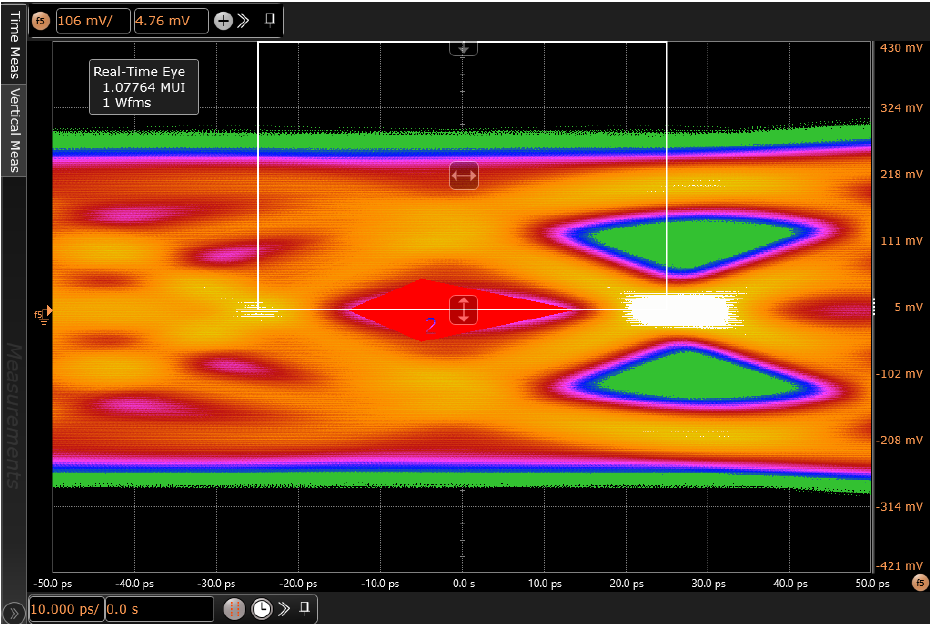
TDP2004-Q1 DP 2.1
                                                Tx Compliance Eye Diagram at TP3_EQ With No
                                                RedriverFigure 7-5 DP 2.1 Tx Compliance Eye Diagram at TP3_EQ With No Redriver
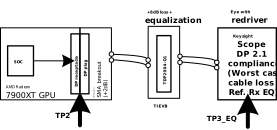
TDP2004-Q1 A
                                                Typical 20Gbps (UHBR20) DP 2.1 Tx Compliance Channel
                                                Setup With RedriverFigure 7-4 A Typical 20Gbps (UHBR20) DP 2.1 Tx Compliance Channel Setup With Redriver
TDP2004-Q1 DP 2.1
                                                Tx Compliance Eye Diagram at TP3_EQ With TDP2004-Q1 for Signal
                                                ConditioningFigure 7-6 DP 2.1 Tx Compliance Eye Diagram at TP3_EQ With TDP2004-Q1 for Signal Conditioning