SLOS154C December 1995 – July 2025 TLC27L1 , TLC27L1A
PRODUCTION DATA
- 1
- 1 Features
- 2 Applications
- 3 Description
- 4 Pin Configuration and Functions
-
5 Specifications
- 5.1 Absolute Maximum Ratings
- 5.2 Dissipation Ratings
- 5.3 Recommended Operating Conditions
- 5.4 Electrical Characteristics, C Suffix
- 5.5 Operating Characteristics, VDD = 5V, C Suffix
- 5.6 Operating Characteristics, VDD = 10V, C Suffix
- 5.7 Electrical Characteristics, I Suffix
- 5.8 Operating Characteristics, VDD = 5V, I Suffix
- 5.9 Operating Characteristics, VDD = 10V, I Suffix
- 5.10 Typical Characteristics
- 6 Parameter Measurement Information
- 7 Application and Implementation
- 8 Device and Documentation Support
- 9 Revision History
- 10Mechanical, Packaging, and Orderable Information
Package Options
Refer to the PDF data sheet for device specific package drawings
Mechanical Data (Package|Pins)
- D|8
- P|8
Thermal pad, mechanical data (Package|Pins)
Orderable Information
7.1.2 Input Characteristics
The TLC27L1 is specified with a minimum and a maximum input voltage that, if exceeded at either input, possibly causes the device to malfunction. Exceeding this specified range is a common problem, especially in single-supply operation. The lower range limit includes the negative rail, while the upper range limit is specified at VDD − 1V at TA = 25°C and at VDD − 1.5V at all other temperatures.
The use of the polysilicon-gate process and the careful input circuit design gives the legacy TLC27L1 very good input offset voltage drift characteristics relative to conventional metal-gate processes. Offset voltage drift in CMOS devices is highly influenced by threshold voltage shifts caused by polarization of the phosphorus dopant implanted in the oxide. Placing the phosphorus dopant in a conductor (such as a polysilicon gate) alleviates the polarization problem, thus reducing threshold voltage shifts by more than an order of magnitude. The offset voltage drift with time is calculated to be typically 0.1μV/month, including the first month of operation.
The legacy TLC27L1 previously offered external input-offset null control. Migration from the legacy 150mm LinCMOS process to a 300mm diameter wafer process has brought associated improvements to input offset voltage precision, eliminating the need for the offset adjustment or "bias select" pins. These pins are non-internally-connected on new silicon devices, and can be left floating or biased to a fixed voltage. The new silicon also features improved slew rate, supply-voltage rejection ratio, and voltage noise. However, this change does introduce a new crossover region, where shifts in input offset (typically 300µV–400µV) occur as the input common-mode voltage approaches the VDD rail. Figure 7-3 and Figure 7-4 plot the mean and standard deviation of this characteristic at various temperatures for a 10V supply.
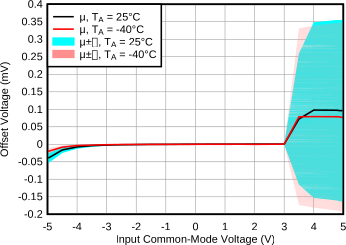 Figure 7-3 Offset Voltage vs Input Common-mode
Voltage
Figure 7-3 Offset Voltage vs Input Common-mode
Voltage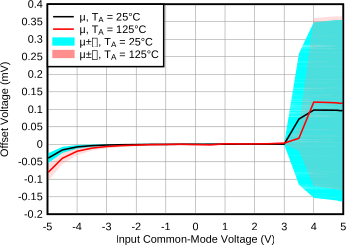 Figure 7-4 Offset Voltage vs Input Common-mode
Voltage
Figure 7-4 Offset Voltage vs Input Common-mode
VoltageBecause of the extremely high input impedance and resulting low bias-current requirements, the TLC27L1 is an excellent choice for low-level signal processing. However, leakage currents on printed-circuit boards and sockets sometimes easily exceed bias-current requirements and cause a degradation in device performance. As best practice, include guard rings around inputs (similar to those of Figure 6-4 in the Parameter Measurement Information section). Drive these guards from a low-impedance source at the same voltage level as the common-mode input (see Figure 7-5).