SNOSDJ3A May 2024 – July 2025 TLV1812-EP , TLV1822-EP
PRODUCTION DATA
- 1
- 1 Features
- 2 Applications
- 3 Description
- Pin Configuration and Functions
- 4 Specifications
- 5 Typical Characteristics
- 6 Detailed Description
-
7 Application and Implementation
- 7.1 Application Information
- 7.2 Typical Applications
- 7.3 Power Supply Recommendations
- 7.4 Layout
- 8 Device and Documentation Support
- 9 Revision History
- 10Mechanical, Packaging, and Orderable Information
Package Options
Mechanical Data (Package|Pins)
- DDF|8
Thermal pad, mechanical data (Package|Pins)
Orderable Information
7.2.4 Time Delay Generator
The circuit shown in Figure 7-13 provides output signals at a prescribed time interval from a time reference and automatically resets the output low when the input returns to 0V. This is useful for sequencing a "power on" signal to trigger a controlled start-up of power supplies.
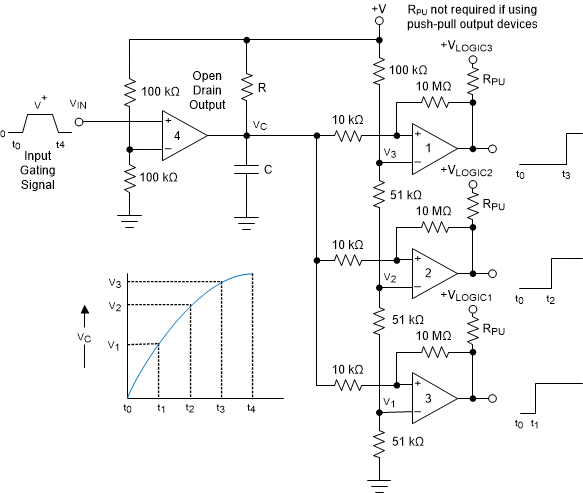 Figure 7-13 Time Delay Generator
Consider the case of VIN = 0. The output of comparator 4 is also at ground, "shorting" the capacitor and holding the capacitor at 0V. This implies that the outputs of comparators 1, 2, and 3 are also at 0V. When an input signal is applied, the output of open drain comparator 4 goes High-Z and C charges exponentially through R. This is indicated in the graph. The output voltages of comparators 1, 2, and 3 switch to the high state in sequence when VC rises above the reference voltages V1, V2 and V3. A small amount of hysteresis has been provided by the 10kΩ and 10MΩ resistors to insure fast switching when the RC time constant is chosen to give long delay times. A good starting point is R = 100kΩ and C = 0.01µF to 1µF.
All outputs immediately go low when VIN falls to 0V, due to the comparator output going low and immediately discharging the capacitor.
Comparator 4 must be a open-drain type output (TLV1822-EP), whereas comparators 1 though 3 can be either open drain or push-pull output, depending on system requirements. RPU is not required for push-pull output devices.