SBOSA45D February 2022 – January 2025 TMP1826
PRODUCTION DATA
- 1
- 1 Features
- 2 Applications
- 3 Description
- 4 Description (cont.)
- 5 Device Comparison
- 6 Pin Configuration and Functions
- 7 Specifications
-
8 Detailed Description
- 8.1 Overview
- 8.2 Functional Block Diagram
- 8.3
Feature Description
- 8.3.1 Power Up
- 8.3.2 Power Mode Switch
- 8.3.3 Bus Pullup Resistor
- 8.3.4 Temperature Results
- 8.3.5 Temperature Offset
- 8.3.6 Temperature Alert
- 8.3.7 Standard Device Address
- 8.3.8 Flexible Device Address
- 8.3.9 CRC Generation
- 8.3.10 Functional Register Map
- 8.3.11 User Memory Map
- 8.3.12 Bit Communication
- 8.3.13 Bus Speed
- 8.3.14 NIST Traceability
- 8.4
Device Functional Modes
- 8.4.1 Conversion Modes
- 8.4.2 Alert Function
- 8.4.3
1-Wire® Interface Communication
- 8.4.3.1 Bus Reset Phase
- 8.4.3.2 Address Phase
- 8.4.3.3
Function Phase
- 8.4.3.3.1 CONVERTTEMP (44h)
- 8.4.3.3.2 WRITE SCRATCHPAD-1 (4Eh)
- 8.4.3.3.3 READ SCRATCHPAD-1 (BEh)
- 8.4.3.3.4 COPY SCRATCHPAD-1 (48h)
- 8.4.3.3.5 WRITE SCRATCHPAD-2 (0Fh)
- 8.4.3.3.6 READ SCRATCHPAD-2 (AAh)
- 8.4.3.3.7 COPY SCRATCHPAD-2 (55h)
- 8.4.3.3.8 READ EEPROM (F0h)
- 8.4.3.3.9 GPIO WRITE (A5h)
- 8.4.3.3.10 GPIO READ (F5h)
- 8.4.4 NVM Operations
- 8.5
Programming
- 8.5.1 Single Device Temperature Conversion and Read
- 8.5.2 Multiple Device Temperature Conversion and Read
- 8.5.3 Register Scratchpad-1 Update and Commit
- 8.5.4 Single Device EEPROM Programming and Verify
- 8.5.5 Single Device EEPROM Page Lock Operation
- 8.5.6 Multiple Device IO Read
- 8.5.7 Multiple Device IO Write
- 8.6
Register Map
- 8.6.1 Temperature Result LSB Register (Scratchpad-1 offset = 00h) [reset = 00h]
- 8.6.2 Temperature Result MSB Register (Scratchpad-1 offset = 01h) [reset = 00h]
- 8.6.3 Status Register (Scratchpad-1 offset = 02h) [reset = 3Ch]
- 8.6.4 Device Configuration-1 Register (Scratchpad-1 offset = 04h) [reset = 70h]
- 8.6.5 Device Configuration-2 Register (Scratchpad-1 offset = 05h) [reset = 80h]
- 8.6.6 Short Address Register (Scratchpad-1 offset = 06h) [reset = 00h]
- 8.6.7 Temperature Alert Low LSB Register (Scratchpad-1 offset = 08h) [reset = 00h]
- 8.6.8 Temperature Alert Low MSB Register (Scratchpad-1 offset = 09h) [reset = 00h]
- 8.6.9 Temperature Alert High LSB Register (Scratchpad-1 offset = 0Ah) [reset = F0h]
- 8.6.10 Temperature Alert High MSB Register (Scratchpad-1 offset = 0Bh) [reset = 07h]
- 8.6.11 Temperature Offset LSB Register (Scratchpad-1 offset = 0Ch) [reset = 00h]
- 8.6.12 Temperature Offset MSB Register (Scratchpad-1 offset = 0Dh) [reset = 00h]
- 8.6.13 IO Read Register [reset = F0h]
- 8.6.14 IO Configuration Register [reset = 00h]
- 9 Application and Implementation
- 10Device and Documentation Support
- 11Revision History
- 12Mechanical, Packaging, and Orderable Information
Package Options
Mechanical Data (Package|Pins)
Thermal pad, mechanical data (Package|Pins)
- NGR|8
Orderable Information
8.3.8.4 Combined IO and Resistor Address
In the combined IO and resistor address mode, the IO0 and IO1 pins are used along with the resistor connected between ADDR pin and ground. Figure 8-7 shows the 8-bit address with the lower 4 bits decoded from the resistor connected, followed by 2 bits decoded from the IO0 and IO1 pins which can be connected to either VDD/SDQ for logic '1' or GND for logic '0', which is overlaid on the contents of the short address register. TI recommends to use a 20 KΩ resistor to be placed between the IO and VDD/SDQ to prevent a supply shot in case the IO pin is accidentally set to zero in output mode.
After having FLEX_ADDR_MODE as '00b', the host must set the bits as '11b' in the device configuration-2 register which enables the device to sample the ADDR pin to identify the resistor connected, followed by sampling of the IO0 and IO1 to configure the short address. If the bit field value has already been updated in the non-volatile storage, then the device shall automatically latch the pins, run the resistor decoder, and update the value in the short address register on power up.
The host controller must place the device in shut down mode and idle the bus for tRESDET, for the device to decode the resistor address.
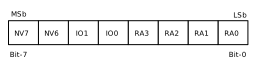 Figure 8-7 Combined IO and Resistor
Address
Figure 8-7 Combined IO and Resistor
AddressThis mode is useful when the application requires placing up to 64 devices on a single PCB, as the mode allows for easy expansion using a combined approach of IO and resistor decoding while enabling IO2 and IO3 to function as general-purpose input and output pins. This mode can also be used for position identification as no two devices can have the same short address.