SLVSJ11 August   2025 UCC57132 , UCC57138

PRODUCTION DATA  

  1.   1
  2. Features
  3. Applications
  4. Description
  5. Pin Configuration and Functions
  6. Specifications
    1. 5.1 Absolute Maximum Ratings
    2. 5.2 ESD Ratings
    3. 5.3 Recommended Operating Conditions
    4. 5.4 Thermal Information
    5. 5.5 Electrical Characteristics
    6. 5.6 Switching Characteristics
    7. 5.7 Timing Diagrams
    8. 5.8 Typical Characteristics
  7. Detailed Description
    1. 6.1 Overview
    2. 6.2 Functional Block Diagram
    3. 6.3 Feature Description
      1. 6.3.1 Input Stage
      2. 6.3.2 Enable/Fault (EN/FLT)
      3. 6.3.3 Driver Stage
      4. 6.3.4 Overcurrent (OC) Protection
      5. 6.3.5 Thermal Shutdown
    4. 6.4 Device Functional Modes
  8. Applications and Implementation
    1. 7.1 Application Information
    2. 7.2 Typical Application
      1. 7.2.1 Driving MOSFET/IGBT/SiC MOSFET
        1. 7.2.1.1 Design Requirements
        2. 7.2.1.2 Detailed Design Procedure
          1. 7.2.1.2.1 VDD Undervoltage Lockout
          2. 7.2.1.2.2 Power Dissipation
        3. 7.2.1.3 Application Curves
    3. 7.3 Power Supply Recommendations
    4. 7.4 Layout
      1. 7.4.1 Layout Guidelines
      2. 7.4.2 Layout Example
      3. 7.4.3 Thermal Consideration
  9. Device and Documentation Support
    1. 8.1 Third-Party Products Disclaimer
    2. 8.2 Receiving Notification of Documentation Updates
    3. 8.3 Support Resources
    4. 8.4 Trademarks
    5. 8.5 Electrostatic Discharge Caution
    6. 8.6 Glossary
  10. Revision History
  11. 10Mechanical, Packaging, and Orderable Information

Package Options

Refer to the PDF data sheet for device specific package drawings

Mechanical Data (Package|Pins)
  • D|8
Thermal pad, mechanical data (Package|Pins)
Orderable Information

Driver Stage

The device has a ±3A peak drive strength and is suitable for driving Si MOSFET/IGBT/SiC. The driver features an important safety function wherein, when the input pins are in a floating condition, the output is held in the LOW state. The driver has rail-to-rail output by implementing an NMOS pull-up with intrinsic bootstrap gate drive. Under DC conditions, a PMOS is used to keep OUT tied to VDD as shown in the following figure. The low pullup impedance of the NMOS results in strong drive strength during the turn-on transient, which shortens the charging time of the input capacitance of the power semiconductor and reduces the turn on switching loss.
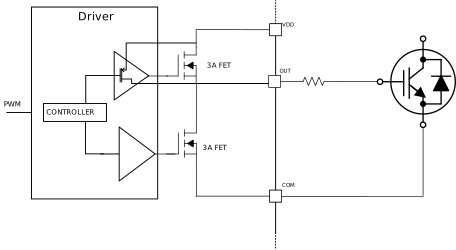
UCC57132 UCC57138 Gate Driver
                                        Output StageFigure 6-3 Gate Driver Output Stage