SLVUCI5A April 2023 – June 2025 AM6526 , AM6528 , AM6548 , TPS6594-Q1
- 1
- PDN-0C User's Guide for Powering AM65x with the TPS6594-Q1 PMIC
- Trademarks
- 1Introduction
- 2Device Versions
- 3Processor Connections
- 4Supporting Functional Safety Systems
-
5Static NVM Settings
- 5.1 Application-Based Configuration Settings
- 5.2 Device Identification Settings
- 5.3 BUCK Settings
- 5.4 LDO Settings
- 5.5 VCCA Settings
- 5.6 GPIO Settings
- 5.7 Finite State Machine (FSM) Settings
- 5.8 Interrupt Settings
- 5.9 POWERGOOD Settings
- 5.10 Miscellaneous Settings
- 5.11 Interface Settings
- 5.12 Watchdog Settings
- 6Pre-Configurable Finite State Machine (PFSM) Settings
- 7Application Examples
- 8References
- 9Revision History
3.2 Control Mapping
Figure 3-2 shows the digital control signal mapping between processor and PMIC devices. Connections from the TPS6594-Q1 PMICs to the processor provide error monitoring, processor reset, processor wake up, and system low-power modes.
The digital connections shown in Figure 3-2 allow system features including 'MCU-only, MCU Safety Island' and Retention modes, and functional safety up to SIL-3.
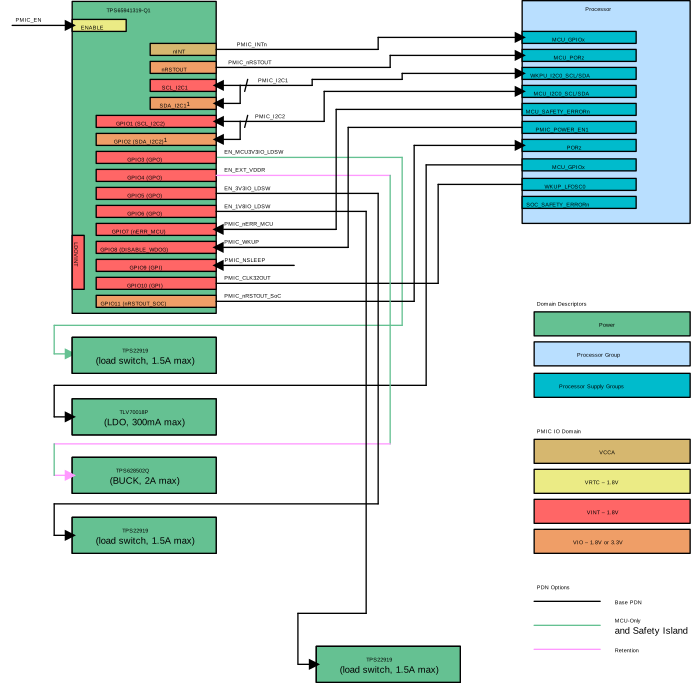 Figure 3-2 TPS6594-Q1 Digital
Connections
Figure 3-2 TPS6594-Q1 Digital
Connections- PMIC IO can have distinct power domains for input and output functionality. The SDA function for I2C1 and I2C2 use the VINT voltage domain as an input and the VIO voltage domain as an output. Refer to the device data sheet for a complete description.
- GPIO8 is configured as the DISABLE_WDOG pin. When the PMIC sets nRSTOUT, the logic level of GPIO8 is latched into the WD_PWRHOLD bit. If low, then the watchdog enters the long window and the processor must service the WDOG before the long window expires or the PMIC performs a warm reset of the processor. Once the WDOG is serviced, then the control of the WDOG can be maintained through the I2C2 and the GPIO8 can be repurposed for WKUP1 or WKUP2. WKUP1 and WKUP2 are not functional from LP_STANDBY.
- GPIO9, NSLEEP1 or NSLEEP2, is not connected to the processor and is not part of the PDN. If the customer chooses to use this GPIO, the function must be defined at runtime.
| PDN Signal | Pullup Power Rail |
|---|---|
| PMIC_INTn | VDD_MCUIO_3V3 |
| PMIC_nRSTOUT | VDA_MCU_1V8 |
| PMIC_nRSTOUT_SOC | VDA_MCU_1V8 |
| PMIC_I2C1 | VDD_MCUIO_3V3 |
| PMIC_I2C2 | VDD_MCUIO_3V3 |
Use Table 3-3 as a guide to understand GPIO assignments required for each PDN system feature. If the feature listed is not required, the digital connection can be removed; however, the GPIO pin is still configured per NVM defined default function shown. After the processor has booted up, the processor can reconfigure unused GPIOs to support new functions. Reconfiguration of the GPIO function is possible as long as that function is only needed after boot and default function does not cause any conflicts with normal operations (for example, two outputs driving same net).
| Device | GPIO Mapping | System Features(1) | |||||
|---|---|---|---|---|---|---|---|
| PMIC Pin | NVM Function | PDN Signals | Functional Safety | Active SoC | MCU - Only MCU-Safety Island | Retention | |
| TPS65941319-Q1 | nPWRON/ ENABLE | Enable | PMIC_ENABLE | R | R | ||
| INT | INT | PMIC_INTn | R | ||||
| nRSTOUT | nRSTOUT | PMIC_nRSTOUT | R | R | R | ||
| SCL_I2C1 | SCL_I2C1 | PMIC_I2C1(2) | R | ||||
| SDA_I2C1 | SDA_I2C1 | ||||||
| GPIO_1 | SCL_I2C2 | PMIC_I2C2 | R | ||||
| GPIO_2 | SDA_I2C2 | ||||||
| GPIO_3 | GPO | EN_MCU3V3IO_LDSW | R | ||||
| GPIO_4 | GPO | EN_EXT_VDDR | R | O | |||
| GPIO_5 | GPO | EN_3V3IO_LDSW | R | ||||
| GPIO_6 | GPO | EN_1V8IO_LDSW | R | ||||
| GPIO_7 | nERR_MCU | PMIC_nERR_MCU | R | ||||
| GPIO_8 | DISABLE_WDOG(3) | PMIC_WKUP | R | ||||
| GPIO_9 | GPI | PMIC_nSLEEP | |||||
| GPIO_10 | GPI | PMIC_CLK32OUT | |||||
| GPIO_11 | nRSTOUT_SOC | PMIC_nRSTOUT_SoC | R | ||||