SBAA678 April 2025 ADS8588H , ADS8588S , ADS8598H , ADS8598S , ADS9810 , ADS9811 , ADS9813 , ADS9815 , ADS9817
Introduction
One challenge in the tester industry is meeting the demand for a high number of test channels without significantly increasing tester time, size, or cost. Although there are multiple types of semiconductor testers, also called automated test equipment (ATE), within most testers are three main cards: a voltage or current measurement card (V/I card), a pin electronics card (PE card), and a device power supply card (DPS card). This application brief focuses on the architecture, and the function of these three cards in an ATE system.
Voltage or Current Measurement Card
 Figure 1 Voltage or Current (V/I) Measurement Card Block Diagram
Voltage or Current Measurement Card Function:
The voltage or current (V/I) measurement card is usually the most accurate card on a tester and is used to assess precise DC characteristics of device under test (DUT) pins. All or some of the components on the card can be integrated into a single chip, or implemented discretely. The integrated chip is referred to as a parametric measurement unit (PMU) chip, such as the TSMU818A030, an 8-channel, 18-bit, 30V, 100mA output, high-capacitive-drive PMU. One V/I card can have numerous channels to test the pins on the DUT, and one tester can have more than one V/I card. The V/I card is capable of forcing a stable voltage or current source to a DUT and selecting appropriate amplifiers is crucial to verify precision reliability. The ADC on the card senses the electrical responses from the DUT, in the form of current or voltage measurements, to evaluate and characterize the DUT.
PMUs generally have four quadrants of operation, as shown below:
 Figure 2 PMU Four Quadrants of Operation
The PMU is capable of the following modes: force voltage (FV), force current (FI), measure voltage (MV), and measure current (MI). The forced voltage and current levels are set by precision DACs and range setting resistors which are usually set with a digital interface. The combination of DACs and range setting resistors allows the V/I card to achieve precise control in voltage and current force.
A precision ADC digitizes the analog measurement output of the PMU to make sure the DUT meets expected device DC specifications. To correctly measure the sense output of the PMU, the ADC must have sufficient input range and performance, such as the same or better resolution or INL compared to the PMU. The ADS9813, an 18-bit, 8-channel, 2MSPS/CH, simultaneous sampling ADC with 0.001% total unadjusted error (TUE), is a good fit for this application. Refer to the Precision ADCs for Measuring Analog Outputs of Parametric Measurement Unit (PMU) application brief.
Voltage or Current Measurement Card Architecture:
An analog control loop makes sure the forced voltage or current using precision DACs and a force amplifier is stable and precise. When current is forced, programmable voltage clamps are used to protect against voltage transients, and when voltage is forced, programmable current clamps are used to protect against current transients. The forced voltage or current is measured across variable range-setting shunt resistors. The voltage drop across the shunt is then amplified by instrumentation amplifiers (INAs) and this sense output is used to complete the analog control loop. For more about precision amplifier selection, refer to the How to Select Precision Amplifiers for Semiconductor Testers application brief.
For further monitoring, a precision ADC also measures the voltage or current sense output. The voltage or current sense measurements can be multiplexed to the same ADC input channel, or the measurements can be routed to individual ADC input channels. If using a multiplexer, then the ADC needs to have sufficient bandwidth to accurately capture the change in PMU sense signals as the multiplexer output switches. One excellent choice of ADC is the ADS9813, with wide bandwidth inputs up to 400kHz. The high channel density of the ADS9813 enables more PMU units to run in parallel, reducing test time and cost. The ability of the ADS9813 to simultaneously sample the input signal is useful in measurements sensitive to the phase delay between input channels caused by sequential sampling. The integrated complete analog front-end of the ADS9813 device features overvoltage input clamps, 1MΩ input impedance, independently programmable gain amplifiers (PGA), programmable low-pass filters (LPF), and ADC input drivers. The ADC also has a low-drift precision reference and an integrated input buffer for external references. These features reduce the size of the signal chain on a semiconductor tester card such as the V/I card, and the lack of additional external components reduces the error contribution between the PMU output and ADC input.
For increased accuracy, the PMU and ADC sections of the card need to share a common reference voltage. A shared reference voltage means noise in the PMU reference path is reflected in the ADC reference path, which cancels out the noise. The inputs, outputs, and IO levels of various components on the card, such as DACs and ADCs are usually configured and evaluated using an FPGA or ASIC. As a result, the interfaces of these components must be compatible with an FPGA or ASIC.
Device Power Supply Card
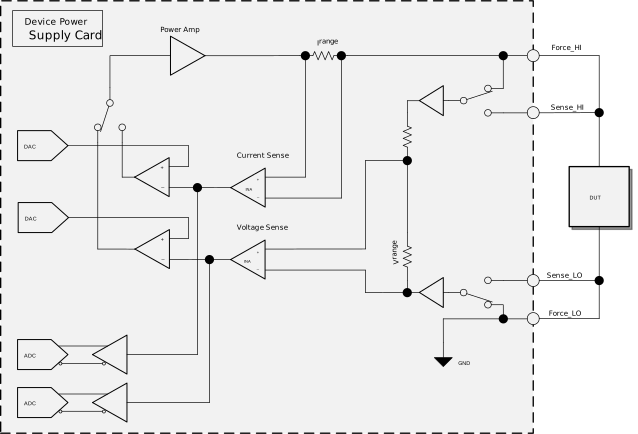 Figure 3 Device Power Supply (DPS) Card Block Diagram
Device Power Supply Card Function:
The device power supply (DPS) card is similar to the V/I card, except the DPS card has the ability to drive higher current for a DUT with larger load capacitance, like 10µF or higher. A DPS card is a specialized power supply that provides the necessary voltage to the DUT power supply pins. A DPS card has two lines which connect to the DUT: a force line, which provides the power, and a sense line, which monitors the power applied. A DPS card can operate in two different modes: force voltage (FV) and force current (FI). In FI, the DPS acts as a current source for the DUT and feeds current until the desired voltage level is reached. Usually, there are built in programmable safety limits which clamp the voltage if the voltage exceeds a set value. This protects the DUT from damage in the event the desired voltage level is never reached. In FV, the DPS acts as a voltage source for the DUT. Similar to FI, there are usually programmable safety limits built into the DPS card to make sure the current does not exceed certain limits and potentially damage the DUT.
Device Power Supply Card Architecture:
Most DPS cards in use today use an analog control loop to control the voltage and current. However, an analog control loop commonly suffers from long settling time or ringing of the signal since the analog control loops are compensated for a wide range of complex loads. Digital control loops can be used to mitigate these issues. For more information on digital control loops, refer to the Low Latency Signal-Chains for Digital Control Loops with ADS9219 application brief.
A typical analog control loop in a DPS card includes components shown in Device Power Supply (DPS) Card Block Diagram. Precision DACs drive the control loop to force the DC level for the current and voltage. The DACs need to be low noise, low drift, and have a fast settling time to maintain an accurate and fast response time for the loop. The DAC11001B from Texas Instruments is commonly used in this application. Within the loop, there is a switch present that allows change from FV to FI. Amplifiers are present in the system to force the current and voltage that is then read by an ADC. The ADC present in the system is not in the loop and is only used for precision measurements of the sense paths. The ADCs measure the voltage and current from outside the loop to report on the status to the processor. The ADCs need to be high-resolution, have high DC precision, and exhibit low drift, such as the ADS8598H, an 18-bit, 8-channel, 500kSPS/CH, simultaneous sampling ADC with ±2.0 LSB typical INL and the next-generation ADS9813.
Pin Electronics Card
 Figure 4 Pin Electronics (PE) Card Block Diagram
Pin Electronics Card Function:
A pin electronics (PE) card performs a variety of basic functional testing on the pins of a DUT. Of all three cards, the PE card is usually the most numerous in a tester. The PE card performs open and short testing to confirm that the voltage and current clamps on the DUT pins are functional. For example, the ESD diodes on the supply pins also need to be tested. The PE card also performs AC parametric tests and DC parametric tests, although these DC tests are less precise than those performed by the V/I card. AC parametric tests involve measuring DUT timing characteristics such as setup or hold times and read and write times. DC parametric tests involve measuring, for example, the I/O pin VOH, VOL, VIL, VIH and supply pin current and voltage levels. All of these tests make sure of comprehensive evaluation and characterization of electronic devices.
Pin Electronics Card Architecture:
A PE card has many components including a driver, comparator, load, per-pin PMUs, DACs, and ADCs. Each of these components play a role in the different functional tests. The driver delivers precise voltage and current signals to the DUT, enabling functional testing over various conditions. The comparator compares the DUT's output to a reference, assessing performance by detecting discrepancies. The comparator can be a differential or window comparator and the output is a logic value that goes to an FPGA or ASIC for evaluation. The load, which can be active or passive, simulates real-world operating conditions by applying a controlled load to the DUT, facilitating accurate performance evaluations. A passive load usually has a switch which enables selection of different resistive terminations to the DUT. An active load is a programmable load where the sink and source current ca be set using the DACs on the card. The PE card also contains per-pin parametric measurement units (PPMUs) which are similar to PMUs, but measure electrical parameters like voltage and current with lower accuracy and resolution. DACs generate precise analog voltages from digital inputs, which are essential for setting reference levels and controlling other components within the PE card. ADCs convert analog signals from the DUT into digital data for analysis, enabling accurate monitoring and assessment of the DUT's analog outputs.
Often, there are many PPMUs on a PE card, and these PPMUs do not have high accuracy requirements for voltage and current measurements like that of a PMU on a V/I card since the PE card only performs basic tests. As a result, multiple PPMUs on a PE card can be multiplexed and monitored using a single, multichannel ADC with sufficient bandwidth to settle between measurements, as described in the Precision ADCs for Measuring Analog Outputs of PMUs application brief. One such ADC is the ADS9813 with wide bandwidth inputs, up to 400kHz.
Conclusion
As the demand for semiconductors continues to grow, the importance of reliable and accurate testing equipment continues to increase. The V/I card, DPS card and PE card play critical roles in testing equipment, providing precise and controlled testing of the DUT pins. However, one challenge manufacturers face is increasing the number of tester channels per card without increasing the tester time, size, or cost. Fortunately, Texas Instruments offers remarkable designs to this challenge allowing manufacturers to design and develop more efficient and effective testing solutions.
Table 1 shows related devices.
| Device | Description |
|---|---|
| ADS9813 | 18-bit, 8-channel, 2MSPS, CH, simultaneous sampling ADC |
| ADS8598H | 18-Bit 500kSPS 8-Channel Simultaneous-Sampling ADC With Bipolar Inputs on a Single Supply |
| TSMU818A030 | 8-channel, 18-bit, 30V, 100mA output, high-capacitive-drive PMU |
| DAC11001B | High-grade, 20-bit, monotonic DAC with ultra-low noise, low glitch and exceptional THD performance |
| OPA593 | 85V, 100µV wide-bandwidth (10MHz) high-output-current precision operational amplifier |
| PGA849 | Low-noise wide-bandwidth precision programmable-gain amplifier |
| INA849 | Ultra-low noise (1nV/√Hz), high-speed (28MHz, 35V/μs) precision (35μV) instrumentation amplifier |