SLUAB19 May 2025 LM25180-Q1 , LM5155-Q1 , SN6507-Q1 , UCC14240-Q1
- 1
- Abstract
- Trademarks
- 1Introduction
- 2Centralized Isolated Bias Power Supply Architecture
- 3Semi-Distributed Isolated Bias Power Supply Architecture
- 4Bias Power Supply Using DC-DC Converter Module
- 5Isolated Bias Power Supply Using Gate Driver to Drive the Transformer
- 6Redundancy in the Isolated Bias Power Supply Architecture
- 7Summary
- 8Terminology
2 Centralized Isolated Bias Power Supply Architecture
In this architecture, a single-stage isolated bias power supply architecture is used in which an isolated bias power supply device is directly connected to the low-voltage battery. This connection supports a wide input voltage range and works in closed-loop operation. This kind of architecture can be realized using a single or multiple device depending on the power rating. A multi-winding transformer is used to give isolated output to the different isolated gate drivers in the primary side. The low-side gate drivers share the same ground can be supplied power using the same transformer output winding.
Figure 2-1 shows how one isolated device with multi-winding transformers are used for DC-DC primary stage isolated bias supply. Low-side isolated gate drivers share the power supply from same output winding of the transformer; whereas, each high-side isolated gate driver has a separate output winding of the transformer. A sepic converter is used to get a regulated 12V or 15V or so forth voltage rail used for non-isolated gate drivers and other subsystems like active clamp circuit and so forth at the secondary side. A wide Vin buck converter directly connected with LV battery is used to generate 5V non-isolated power supply. Rather than connecting with LV battery directly, it is also possible to use the output of sepic converter as input for this buck converter. The 5V output voltage rail is used as input to the dual buck converter to generate 3.3V and 1.2V voltage rails to supply power to the microcontroller. This is based on the assumption that microcontroller is located at LV battery side and sharing same ground with LV battery. This 5V rail can be used for other devices at secondary side like CAN, sensors and isolators, and so forth.
 Figure 2-1 Centralized Architecture using Discrete Non-isolated Devices
Figure 2-2 shows the use of PMIC in the power supply. Rather than using the discrete approach of wide Vin buck and dual buck, a functional safety compliant PMIC can be used to supply the power to the microcontroller. Texas Instruments offers the following functional safety compliant PMIC devices, which can be a preferred choice to use in the bias power supply architecture mentioned in Figure 2-2:
- PMIC: TPS65386x-Q1 (ASIL-D), TPS65036x-Q1 (ASIL-B)
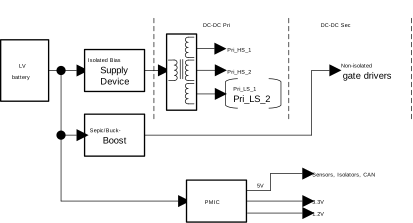 Figure 2-2 Centralized Architecture Using PMIC
The following topologies and associated devices can be used as the preferred choice for the centralized bias power supply architecture:
- Flyback controller: LM5155x-Q1, LM5156x-Q1, LM34xx-Q1
- Flyback converter: LM518x-Q1, LM2518x-Q1
- Push-pull converter: SN6507-Q1
- SEPIC: LM5155x-Q1, LM5156x-Q1, LM5157x-Q1, LM5158x-Q1
- Buck-boost : TPS55287x-Q1, LM51xx-Q1
- Wide Vin buck: LMR60440-Q1, LM61440-Q1
- Dual buck: TPS62441-Q1
Different topologies for the isolated bias power supply come with certain advantages and trade-offs. A flyback device can help to achieve advantages like high efficiency, high load regulation, and high line regulation accuracy for a wide voltage input range. The tightly coupled flyback transformer design has low leakage inductance but this design comes with the trade-off of having comparatively higher parasitic capacitance across the isolation barrier of the transformer. Appropriate measures in the EMI filter design are sometimes needed to suppress the EMI and common mode current due to the parasitic capacitance of the transformer. The push-pull device provides good efficiency, high CMTI, lower EMI, and so forth. An extra inductor is needed for the push-pull device in the output side to do the duty cycle control for wide input voltage range operation.