SLYA078A February 2024 – August 2025 TMAG5170D-Q1
4 Magnet Sensor Placement
For the designs presented in this application report, aside from the enclosure that houses the shifter sensing system, there are two constraints that dictate the relative placement between magnet and sensor. These constraints are the device noise floor and the max sensing range. The goal is to get the largest field detected by the device to be a little less than the max sensing value for optimizing the signal to noise ratio. However, that can be impossible, so quantifying the error associated with different peak field strengths can be useful for gauging whether the magnet is close enough or strong enough for the desired mechanical-magnetic implementation. For the diametric approach where the peak Bx and By fields are expected to be nearly equal, Figure 4-1 shows an estimation of what the max error can be for one sigma magnetic noise of 185μT. Figure 4-1 and all subsequent plots in this section were extrapolated from simulations done in Texas Instruments Magnetic Sense Simulator (TIMSS).
 Figure 4-1 Error Vs. Peak Field Strength
for Diametric Approach
Figure 4-1 Error Vs. Peak Field Strength
for Diametric ApproachWith the results observed in Figure 4-1, there is some guidance for determining what size and grade of magnet as well as what reasonable distance or air gap can be between magnet and the device. For gauging the impact of the distance between the magnet and device denoted by air-gap in Figure 4-2, Figure 4-3 shows an N42, 12.7mm diameter, 3.175mm thick the peak field values measured by the TMAG5170 for any z-offset from the magnet origin within -8mm and -2.5mm.
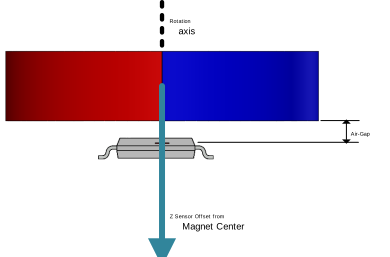 Figure 4-2 Sensor Z-offset Sweep
Diagram
Figure 4-2 Sensor Z-offset Sweep
Diagram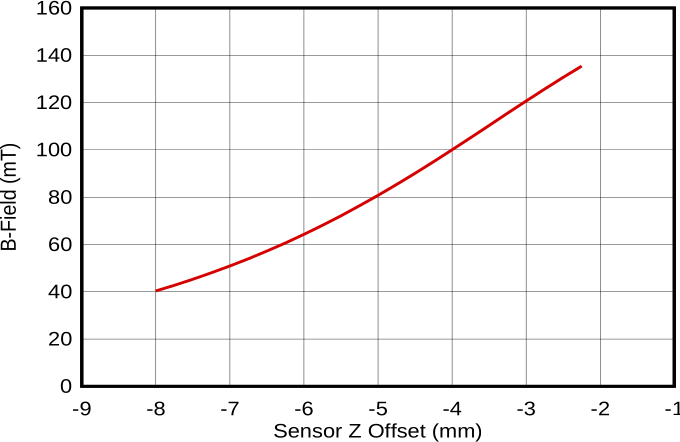 Figure 4-3 Max Bx or By Field Versus
Sensor Z offset
Figure 4-3 Max Bx or By Field Versus
Sensor Z offsetFor gauging the impact of magnet size, Figure 4-4 shows what kind of field values can be observed for an N42, 3.175mm thick, with diameters ranging from 2mm to 20mm with an air gap of 7mm from the sensor.
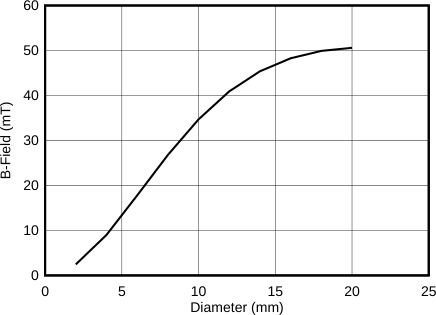 Figure 4-4 Max Bx or By Field Versus Magnet Diameter
From Figure 4-1 a minimum of about 15mT is needed to have an error of 1° or less per the device noise floor. Figure 4-3 shows that for larger air-gaps between the magnet and device, the expected signal amplitude decreases; however, for the magnet size chosen in the placement region of interest the amplitude appears to have at least roughly double the what is required for error under 1°. Lastly, Figure 4-4 shows that for the desired offset of 7mm, a magnet with as small as a 5.4mm diameter can potentially be used for 1° error if only considering error from noise.
As noise is not the only source of error, some analysis with sweeping offsets per manufacturing and assembly tolerances is recommended. Figure 4-5 indicates that smaller diameters are less forgiving in error for the same offset. Based on a large group of simulation data not shown, offsets less than 10% of the magnet diameter length frequently appear to provide less than 1° error. As for magnet thickness, Figure 4-6 suggests that only a slight change in angle error is observed for different thicknesses.
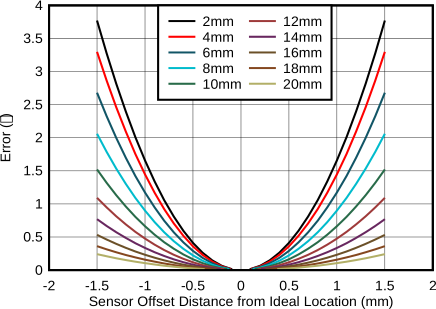 Figure 4-5 Diameter Sweep
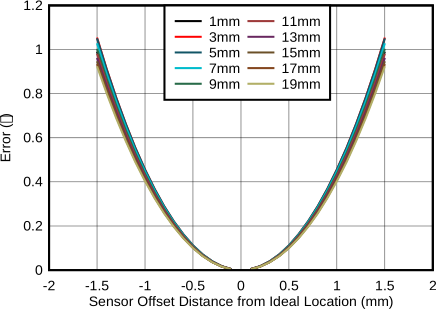 Figure 4-6 Thickness Sweep