SLYA078A February 2024 – August 2025 TMAG5170D-Q1
1 Introduction
End users typically expect E-shifters to be robust, tactile, and requiring minimal dexterity to operate. From a contract auto manufacturers perspective, the design needs to satisfy functional safety requirements and the underlying design needs to be flexible and precise enough to be possibly packaged up and reused in several different car models. After satisfying these fundamental objectives, there is the desire to minimize cost, power, and design size.
This document shows a design process for a possible version of the E-shifter with the TMAG5170D, a multi-sensor device designed specifically for the redundancy desired in systems requiring functional safety. The featured stacked die in the package reducing the spacing between sensing elements reduces the error between sensors. Additionally, the lower wake-up and sleep modes provide the E-shifter designer some opportunity to minimize power consumption.
Figure 1-1 summarizes the design flow presented in this document.
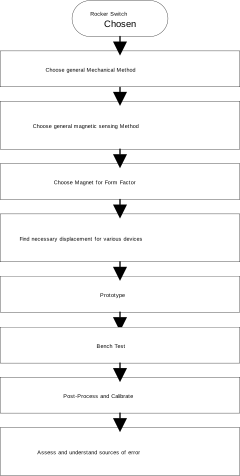 Figure 1-1 Development Flow