SLYA090B September 2024 – August 2025 TMAG5133 , TMAG5134 , TMAG5233
1.2 Hall-Effect Sensors
The Hall-effect was discovered by Edwin Hall. Hall discovered that when a current is passed through a conductor that has a magnetic field applied orthogonally, that the Lorentz force can cause a measurable voltage potential across the conductor.
The Lorentz force arises from a charged particle moving through an electromagnetic field as shown in Figure 1-4 and described in Equation 1.
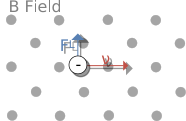 Figure 1-4 Lorentz Force
Considering this behavior when driving a current through a magnetic field, we observe the Hall-effect as shown in Figure 1-5.
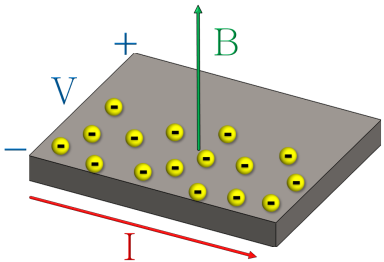 Figure 1-5 Hall-effect
When a conductive Hall-element is biased with a current and placed in a magnetic field, there is a linear change in the voltage which is produced across the conductor orthogonal to the current. This is particularly useful in generating a number of output formats that aid in tracking the position of a source magnet.
Of particular note here is the switch format. When amplified and driven into a comparator structure like that in Figure 1-6, this voltage can be used to produce a binary output response demonstrated in Figure 1-7. The device can be set to target a variety of operate and release thresholds (commonly referred to a BOP and BRP respectively), and can be set to sample at various intervals to limit current consumption.
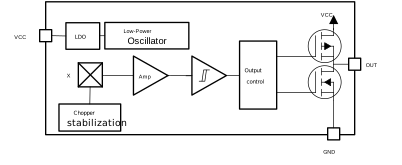 Figure 1-6 TMAG5233 Block Diagram
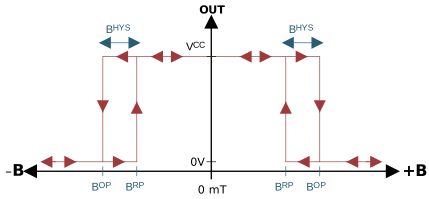 Figure 1-7 Omnipolar Switch Output
This technology is easily integrated into semiconductor processes. Traditionally, the Hall-element has been constructed with a sensitivity which is normal to the PCB surface and detect the Z-component of the B-Field vector similar to Figure 1-8, but newer devices are also able to implement in-plane sensing elements which detect a horizontal vector component in either the X or Y directions. This sensitivity is shown in Figure 1-9.
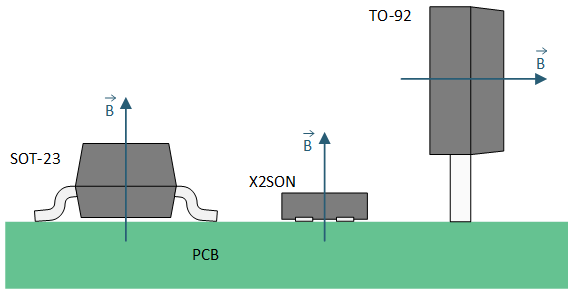 Figure 1-8 DRV5032 Vertical Sensitivity
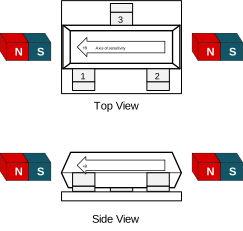 Figure 1-9 TMAG5233 In-plane Sensitivity
Similar to how electric currents flow through paths of least resistance, magentic fields naturally concentrate in materials that minimally impede their propogation (low reluctance). Flux concentrators are low reluctance structures designed to provide a low-loss pathway for magnetic fields. By strategically employing flux concentrators, engineers can effectively guide and manipulate magnetic fields to meet specific design requirements.
Devices like the TMAG5134 incorporate flux concentrators directly in their design to enhance the sensitivity of its Hall elements. These in-package concentrators create a low reluctance path that directs and focuses magnetic fields onto the integrated Hall sensors. Notably, flux concentrators operate passively, consuming no power while increasing sensitivity to achieve thresholds as low as ±1mT.