SLYT865 March 2025 LMG3422R030 , LMV797 , SN74LV1T125 , TLV713P-Q1 , TMS320F280033
3 Proposed re-rush current control method
Figure 3 illustrates the proposed low-cost re-rush current control method. There are two differences compared to Figure 1. First, RT has moved from the AC side to the DC side. Second, a metal-oxide semiconductor field-effect transistor (MOSFET), Q5, has replaced the traditional mechanical relay. The reason to choose a solid-state relay is that you need to rapidly turn the relay on and off, and a mechanical relay is too slow for this purpose. Also, because the MOSFET cannot turn off the AC voltage, it is put on the DC side. The inrush current limit works the same as the traditional method. The first time that the input voltage is applied to the PSU, RT will limit the inrush current. Once the inrush current passes, Q5 turns on and RT is bypassed.
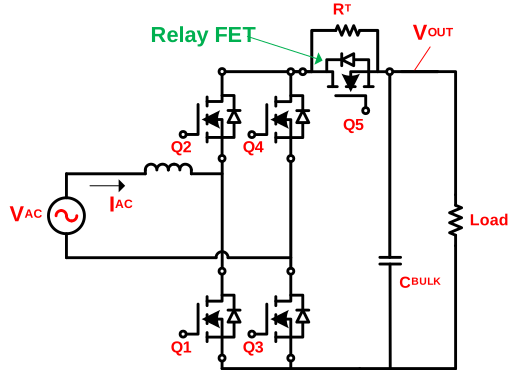 Figure 3 The proposed re-rush current
limit hardware structure.
Figure 3 The proposed re-rush current
limit hardware structure.Figure 4 illustrates the proposed re-rush current control method. VAC is the PFC input voltage, VOUT is the PFC output voltage, and IAC is the input current. Q1 and Q2 are high-frequency switches that work as either a PFC boost switch or a synchronous switch alternatively in each AC half cycle. The AC line drops for a period of 10ms and then comes back at its peak while the PFC operates at full load. This is the worst case for AC voltage dropout.
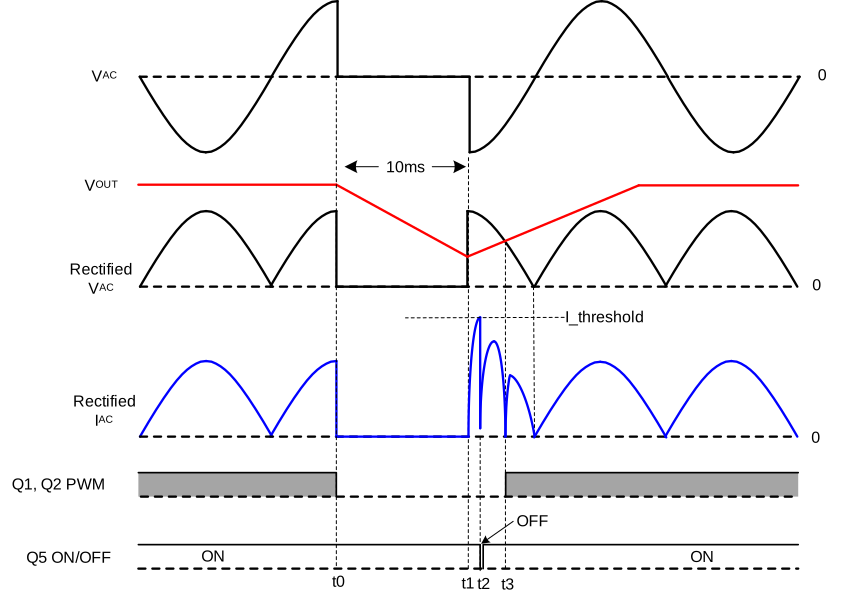 Figure 4 The proposed AC drop and
re-rush current limit control algorithm.
Figure 4 The proposed AC drop and
re-rush current limit control algorithm.This is the proposed re-rush current control method:
- At t0: Upon detection of an AC voltage drop, Q1 and Q2 turn off. You must also turn off both the PFC voltage and current loops because if the voltage loop and current loop keep running, their integrators will accumulate. When the AC voltage comes back and PFC turns on, a large PWM duty cycle will then be present, resulting in a large current spike that may damage the power supply.
- Once the current loop is turned off, reset it to 0 and clear its integrator history. If you do not clear the integrator, when the AC voltage comes back and PFC turns on, PFC will turn on with the same PWM duty cycle before the AC voltage drop, and it may not be the appropriate duty cycle. For example, if the AC voltage dropout occurs at zero crossing, the PWM duty cycle is almost 100%. If the AC voltage comes back at the AC peak without a cleared current-loop integrator, an almost 100% duty cycle will occur at the AC peak and generate a large current spike, which could damage the power supply. For the voltage loop, once it turns off, freeze it to keep its internal value. The voltage loop output represents the load and is used for current loop-reference generation; therefore, you want to keep its value so that the load does not change during AC dropout.
- At t1: The AC voltage returns. Because VAC > VOUT, a generated re-rush current will charge the bulk capacitor. Q1 and Q2 remain off.
- At t2: The re-rush current exceeds a programmable threshold and trips a relay Q5 turnoff event. The re-rush current is then limited by RT when Q5 is off, and its magnitude rapidly drops. Relay Q5 only turns off for a very short period of time (for example, 10µs), then turns on again. Once Q5 turns on, the re-rush current rises again until it exceeds the threshold. This process repeats until the re-rush current never exceeds the limit again. Figure 5 shows the flow chart for this process.
- At t3: VAC < VOUT. Now it is time to turn on PFC. Set the voltage loop reference equal to the instantaneous VOUT value at t3, then turn on the voltage loop. After that, gradually increase the voltage loop reference until it reaches the normal setpoint. For the current loop, first calculate a duty cycle D = (VOUT – VAC)/VOUT and inject it into the current loop such that the current loop output starts from the calculated D when the current loop is on. Then turn on the current loop. Finally, turn on Q1 and Q2 to allow PFC normal operation.
 Figure 5 Flowchart of the proposed
relay on and off control algorithm.
Figure 5 Flowchart of the proposed
relay on and off control algorithm.This process repeats until VOUT exceeds VAC.