SNLA465 January 2025 DP83TC817S-Q1 , DP83TC818S-Q1 , DP83TG721S-Q1
- 1
- Abstract
- Trademarks
- 1The Role of Time Sensitive Networking in Automotive Applications
- 2Generalized Precision Time Protocol Algorithm Overview
- 3Methods of Implementing gPTP: Timestamping Location
- 4Fixed Latency and Recovered Clock Modes
- 5Event Triggers and Monitors
- 6Simplified gPTP Integration
- 7Conclusion
- 8References
1 The Role of Time Sensitive Networking in Automotive Applications
Modern vehicles use a variety of sensors that require precise synchronization, the level of synchronization required is application specific
One simple example is opening the trunk automatically using motors. To verify that the trunk opens smoothly, the left and right motors need to operate simultaneously. Since motors can be controlled by Pulse Width Modulation (PWM) signals, the motors can operate simultaneously with synchronous PWM inputs. The role of IEEE 802.1AS is to help generate the synchronous PWM waveforms. The synchronization accuracy requirement for this application can be in milliseconds.
Another good application for time synchronization is car audio systems. For high quality spatial audio experience, the front and rear multiple speaker’s audio playback needs to be fully synchronized. This can be achieved by synchronizing the audio play back ECUs and Central Signal Processing/mixer responsible for generating the audio streams for playback. IEEE 802.1AS can be used to achieve the time synchronization between front, rear amplifiers and Central Signal Processors and compensate for the varying path delays. Signal processors transmit audio packets while embedding the presentation time, the time at which audio packets need to be played out on audio amplifiers. The audio amplifier, despite different path delays, plays out the audio packets at the same synchronized time. The typical synchronization accuracy required for this application is in microseconds.
A very good application of precise time synchronization is ADAS sensor synchronization. These sensors (radar, LiDAR, camera) are physically distributed across the car to sense the varying environment variables (obstruction, speed of nearby object, and so forth). The scanned information is provided to ADAS compute to make holistic understanding of 360° view of the car. The tighter the data from these sensor is synchronized, the better the ADAS compute is able to detect and handle real obstructions. To operate the radar synchronously, each radar sensor shall initiate the scan of the environment (chirp) at the same time (nanosecond accuracy). Timing mismatch can lead to blurring in the final image. Each radar sensor can receive a synchronous pulse per second (PPS) reference input to chirp at the same time. The role of IEEE 802.1AS is to help generate the synchronous PPS signal.
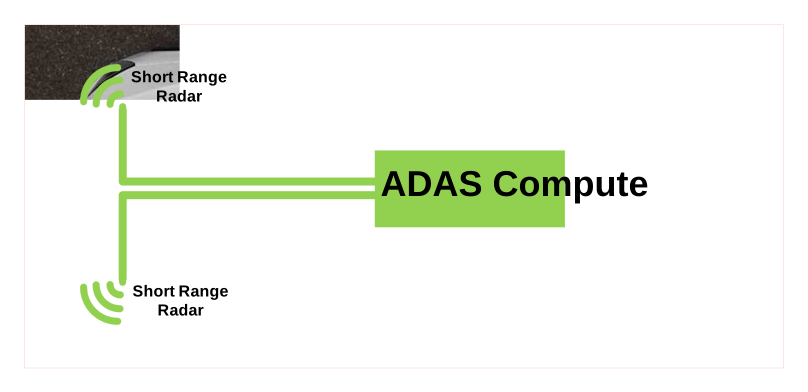 Figure 1-1 Extended Aperture Radar
Example
Figure 1-1 Extended Aperture Radar
ExampleWhether the application requires generating waveforms or transmitting timestamps over a time sensitive network- all nodes must operate based on a synchronized reference clock. IEEE 802.1AS defines the procedure and protocol to implement the synchronized reference clock. However, the accuracy of time synchronization is dependent on the hardware architecture implementing the 802.1AS. In the following sections, an overview of IEEE 802.1AS procedures is provided along with some of the architecture choices used by TI Ethernet PHY to achieve precise time synchronization.