SNLS647I December   2019  – August 2025 DP83826E , DP83826I

PRODUCTION DATA  

  1.   1
  2. Features
  3. Applications
  4. Description
  5. Mode Comparison Tables
  6. Pin Configuration and Functions (ENHANCED Mode)
  7. Pin Configuration and Functions (BASIC Mode)
  8. Specifications
    1. 7.1 Absolute Maximum Ratings
    2. 7.2 ESD Ratings
    3. 7.3 Recommended Operating Conditions
    4. 7.4 Thermal Information
    5. 7.5 Electrical Characteristics
    6. 7.6 Timing Requirements
    7. 7.7 Timing Diagrams
    8. 7.8 Typical Characteristics
  9. Detailed Description
    1. 8.1 Overview
    2. 8.2 Functional Block Diagram
    3. 8.3 Feature Description
      1. 8.3.1  Auto-Negotiation (Speed/Duplex Selection)
      2. 8.3.2  Auto-MDIX Resolution
      3. 8.3.3  Energy Efficient Ethernet
        1. 8.3.3.1 EEE Overview
        2. 8.3.3.2 EEE Negotiation
      4. 8.3.4  EEE for Legacy MACs Not Supporting 802.3az
      5. 8.3.5  Wake-on-LAN Packet Detection
        1. 8.3.5.1 Magic Packet Structure
        2. 8.3.5.2 Magic Packet Example
        3. 8.3.5.3 Wake-on-LAN Configuration and Status
      6. 8.3.6  Low Power Modes
        1. 8.3.6.1 Active Sleep
        2. 8.3.6.2 IEEE Power-Down
        3. 8.3.6.3 Deep Power Down State
      7. 8.3.7  RMII Repeater Mode
      8. 8.3.8  Clock Output
      9. 8.3.9  Media Independent Interface (MII)
      10. 8.3.10 Reduced Media Independent Interface (RMII)
      11. 8.3.11 Serial Management Interface
        1. 8.3.11.1 Extended Register Space Access
        2. 8.3.11.2 Write Address Operation
        3. 8.3.11.3 Read Address Operation
        4. 8.3.11.4 Write (No Post Increment) Operation
        5. 8.3.11.5 Read (No Post Increment) Operation
        6. 8.3.11.6 Example Write Operation (No Post Increment)
      12. 8.3.12 100BASE-TX
        1. 8.3.12.1 100BASE-TX Transmitter
          1. 8.3.12.1.1 Code-Group Encoding and Injection
          2. 8.3.12.1.2 Scrambler
          3. 8.3.12.1.3 NRZ to NRZI Encoder
          4. 8.3.12.1.4 Binary to MLT-3 Converter
        2. 8.3.12.2 100BASE-TX Receiver
      13. 8.3.13 10BASE-Te
        1. 8.3.13.1 Squelch
        2. 8.3.13.2 Normal Link Pulse Detection and Generation
        3. 8.3.13.3 Jabber
        4. 8.3.13.4 Active Link Polarity Detection and Correction
      14. 8.3.14 Loopback Modes
        1. 8.3.14.1 Near-end Loopback
        2. 8.3.14.2 MII Loopback
        3. 8.3.14.3 PCS Loopback
        4. 8.3.14.4 Digital Loopback
        5. 8.3.14.5 Analog Loopback
        6. 8.3.14.6 Far-End (Reverse) Loopback
      15. 8.3.15 BIST Configurations
      16. 8.3.16 Cable Diagnostics
        1. 8.3.16.1 Time Domain Reflectometry (TDR)
      17. 8.3.17 Fast Link-Drop Functionality
      18. 8.3.18 LED and GPIO Configuration
    4. 8.4 Programming
      1. 8.4.1 Hardware Bootstraps Configuration
        1. 8.4.1.1 Bootstrap Configurations (ENHANCED Mode)
        2. 8.4.1.2 Strap Configuration (BASIC Mode)
    5. 8.5 Register Maps
      1. 8.5.1 DP83826 Registers
  10. Application and Implementation
    1. 9.1 Application Information
    2. 9.2 Typical Applications
      1. 9.2.1 Twisted-Pair Interface (TPI) Network Circuit
      2. 9.2.2 Transformer Recommendations
      3. 9.2.3 Capacitive DC Blocking
      4. 9.2.4 Design Requirements
        1. 9.2.4.1 Clock Requirements
          1. 9.2.4.1.1 Oscillator
          2. 9.2.4.1.2 Crystal
      5. 9.2.5 Detailed Design Procedure
        1. 9.2.5.1 MII Layout Guidelines
        2. 9.2.5.2 RMII Layout Guidelines
        3. 9.2.5.3 MDI Layout Guidelines
      6. 9.2.6 Application Curves
    3. 9.3 Power Supply Recommendations
    4. 9.4 Layout
      1. 9.4.1 Layout Guidelines
        1. 9.4.1.1 Signal Traces
        2. 9.4.1.2 Return Path
        3. 9.4.1.3 Transformer Layout
        4. 9.4.1.4 Metal Pour
        5. 9.4.1.5 PCB Layer Stacking
          1. 9.4.1.5.1 Layout Example
  11. 10Device and Documentation Support
    1. 10.1 Related Documentation
    2. 10.2 Receiving Notification of Documentation Updates
    3. 10.3 Support Resources
    4. 10.4 Trademarks
    5. 10.5 Electrostatic Discharge Caution
    6. 10.6 Glossary
  12. 11Revision History
  13. 12Mechanical, Packaging, and Orderable Information

RMII Repeater Mode

The DP83826 device provides the option to enable RMII back-to-back repeater mode functionality to extend cable reach. Two DP83826 devices can be connected in RMII repeater mode without need of any external configuration. The DP83826 provides a hardware strap to configure the CRS_DV pin of RMII interface to RX_DV pin for back-to-back operation. Figure 8-2 and Figure 8-3 show the RMII pin connections that enables the device to operate in repeater mode.

DP83826E DP83826I RMII Repeater Mode: Leader-Follower Figure 8-2 RMII Repeater Mode: Leader-Follower
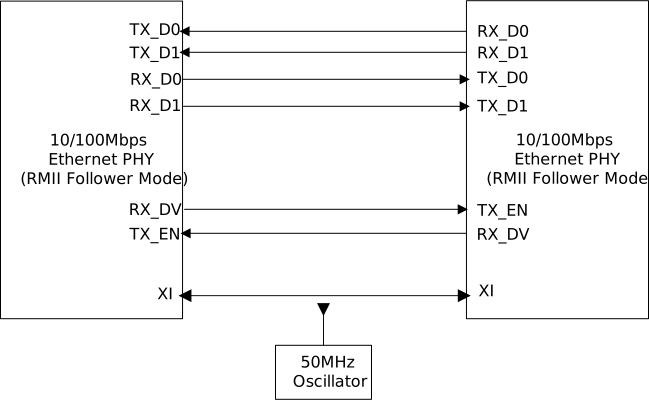
DP83826E DP83826I RMII Repeater Mode:
                                                  Follower-Follower Figure 8-3 RMII Repeater Mode: Follower-Follower