SBAS334D November 2004 – July 2016 DAC5675A
PRODUCTION DATA.
- 1 Features
- 2 Applications
- 3 Description
- 4 Revision History
- 5 Description Continued
- 6 Pin Configuration and Functions
- 7 Specifications
- 8 Detailed Description
- 9 Application and Implementation
- 10Power Supply Recommendations
- 11Layout
- 12Device and Documentation Support
- 13Mechanical, Packaging, and Orderable Information
Package Options
Mechanical Data (Package|Pins)
- PHP|48
Thermal pad, mechanical data (Package|Pins)
- PHP|48
Orderable Information
7 Specifications
7.1 Absolute Maximum Ratings
over operating free-air temperature range (unless otherwise noted)(1)| MIN | MAX | UNIT | ||
|---|---|---|---|---|
| Supply voltage range | AVDD (2) | –0.3 | +3.6 | V |
| DVDD (3) | –0.3 | +3.6 | V | |
| AVDD to DVDD | –0.7 | +0.7 | V | |
| Voltage between AGND and DGND | –0.3 | +0.5 | V | |
| CLK, CLKC(2) | –0.3 | AVDD + 0.3 | V | |
| Digital input D[13:0]A, D[13:0]B(3), SLEEP | –0.3 | DVDD + 0.3 | V | |
| IOUT1, IOUT2(2) | –1.0 | AVDD + 0.3 | V | |
| EXTIO, BIAS(2) | –1.0 | AVDD + 0.3 | V | |
| Peak input current (any input) | 20 | mA | ||
| Peak total input current (all inputs) | -30 | mA | ||
| Operating free-air temperature range, TA | –40 | +85 | °C | |
| Storage temperature range | –65 | +150 | °C | |
(1) Stresses above those listed under Absolute Maximum Ratings may cause permanent damage to the device. Exposure outside of absolute maximum conditions for extended periods may degrade device reliability. These are stress ratings only, and functional operation of the device at these or any other conditions beyond those indicated under recommended operating conditions is not implied. Exposure to absolute-maximum-rated conditions for extended periods may affect device reliability.
(2) Measured with respect to AGND.
(3) Measured with respect to DGND.
7.2 ESD Ratings
| VALUE | UNIT | |||
|---|---|---|---|---|
| V(ESD) | Electrostatic discharge | Human-body model (HBM), per ANSI/ESDA/JEDEC JS-001(1) | ±1000 | V |
| Charged-device model (CDM), per JEDEC specification JESD22-C101(2) | ±250 | |||
(1) JEDEC document JEP155 states that 500-V HBM allows safe manufacturing with a standard ESD control process.
(2) JEDEC document JEP157 states that 250-V CDM allows safe manufacturing with a standard ESD control process.
7.3 Recommended Operating Conditions
over operating free-air temperature range (unless otherwise noted)| MIN | NOM | MAX | UNIT | ||
|---|---|---|---|---|---|
| Supplies | |||||
| AVDD | 3.15 | 3.3 | 3.6 | V | |
| DVDD | 3.15 | 3.3 | 3.6 | V | |
| I(AVDD) | Analog supply current | 115 | mA | ||
| I(DVDD) | Digital supply current | 85 | mA | ||
| Analog Output | |||||
| IO(FS) | Full-scale output current | 2 | 20 | mA | |
| Output compliance range | AVDD -1 | AVDD + 0.3 | V | ||
| Clock Interface (CLK, CLKC) | |||||
| CLKINPUT Frequency | 400 | MHz | |||
| |CLK – CLKC| | 0.4 | 0.8 | VPP | ||
| Clock duty cycle | 40% | 60% | |||
| VCM | Common-mode voltage range | 1.6 | 2 | 2.4 | V |
7.4 Thermal Information
| THERMAL METRIC(1) | DAC5675A | UNIT | |
|---|---|---|---|
| PHP (HTQFP) | |||
| 48 PINS | |||
| RθJA | Junction-to-ambient thermal resistance | 31.3 | °C/W |
| RθJC(top) | Junction-to-case (top) thermal resistance | 13.0 | °C/W |
| RθJB | Junction-to-board thermal resistance | 10.9 | °C/W |
| ψJT | Junction-to-top characterization parameter | 0.3 | °C/W |
| ψJB | Junction-to-board characterization parameter | 10.9 | °C/W |
| RθJC(bot) | Junction-to-case (bottom) thermal resistance | 0.9 | °C/W |
(1) For more information about traditional and new thermal metrics, see the SPRA953Semiconductor and IC Package Thermal Metrics application report.
7.5 DC Electrical Characteristics
Over operating free-air temperature range. Typical values at +25°C, AVDD = 3.3V, DVDD = 3.3V, IO(FS) = 20mA, unless otherwise noted.| PARAMETER | TEST CONDITIONS | MIN | TYP | MAX | UNIT | |
|---|---|---|---|---|---|---|
| Resolution | 14 | Bit | ||||
| DC Accuracy(1) | ||||||
| INL | Integral nonlinearity | TMIN to TMAX | –4 | ±1.5 | 4 | LSB |
| DNL | Differential nonlinearity | –2 | ±0.6 | 2 | LSB | |
| Monotonicity | Monotonic 12b Level | |||||
| Analog Output | ||||||
| IO(FS) | Full-scale output current | 2 | 20 | mA | ||
| Output compliance range | AVDD = 3.15V to 3.45V, IO(FS) = 20mA | AVDD – 1 | AVDD +0.3 | V | ||
| Offset error | 0.01 | %FSR | ||||
| Gain error | Without internal reference | –10 | 5 | 10 | %FSR | |
| With internal reference | –10 | 2.5 | 10 | %FSR | ||
| Output resistance | 300 | kΩ | ||||
| Output capacitance | 5 | pF | ||||
| Reference Output | ||||||
| V(EXTIO) | Reference voltage | 1.17 | 1.23 | 1.29 | V | |
| Reference output current(2) | 100 | nA | ||||
| Reference Input | ||||||
| V(EXTIO) | Input reference voltage | 0.6 | 1.2 | 1.25 | V | |
| Input resistance | 1 | MΩ | ||||
| Small-signal bandwidth | 1.4 | MHz | ||||
| Input capacitance | 100 | pF | ||||
| Temperature Coefficients | ||||||
| Offset drift | 12 | ppm of FSR/°C | ||||
| Δ V(EXTIO) | Reference voltage drift | ±50 | ppm/°C | |||
| Power Supply | ||||||
| AVDD | Analog supply voltage | 3.15 | 3.3 | 3.6 | V | |
| DVDD | Digital supply voltage | 3.15 | 3.3 | 3.6 | V | |
| I(AVDD) | Analog supply current(3) | 115 | mA | |||
| I(DVDD) | Digital supply current(3) | 85 | mA | |||
| PD | Power dissipation | Sleep mode | 18 | mW | ||
| PD | Power dissipation | AVDD = 3.3V, DVDD = 3.3V | 660 | 900 | mW | |
| APSRR | Analog and digital power- supply rejection ratio | AVDD = 3.15V to 3.45V | –0.5 | ±0.1 | 0.5 | %FSR/V |
| DPSRR | –0.5 | ±0.1 | 0.5 | %FSR/V | ||
(1) Measured differential at IOUT1 and IOUT2; 25Ω to AVDD.
(2) Use an external buffer amplifier with high impedance input to drive any external load.
(3) Measured at fCLK = 400MSPS and fOUT = 70MHz.
7.6 AC Electrical Characteristics
Over operating free-air temperature range. Typical values at +25°C, AVDD = 3.3V, DVDD = 3.3V, IO(FS) = 20mA, differential transformer-coupled output, 50Ω doubly-terminated load, unless otherwise noted.| PARAMETER | TEST CONDITIONS | MIN | TYP | MAX | UNIT | |
|---|---|---|---|---|---|---|
| Analog Output | ||||||
| fCLK | Output update rate | 400 | MSPS | |||
| ts(DAC) | Output setting time to 0.1% | Transition: code x2000 to x23FF | 12 | ns | ||
| tPD | Output propagation delay | 1 | ns | |||
| tr(IOUT) | Output rise time, 10% to 90% | 300 | ps | |||
| tf(IOUT) | Output fall time, 90% to 10% | 300 | ps | |||
| Output noise(1) | IOUTFS = 20mA | 55 | pA/√Hz | |||
| IOUTFS = 2mA | 30 | pA/√Hz | ||||
| AC Linearity | ||||||
| THD | Total harmonic distortion | fCLK = 100MSPS, fOUT = 19.9MHz | 73 | dBc | ||
| fCLK = 160MSPS, fOUT = 41MHz | 72 | dBc | ||||
| fCLK = 200MSPS, fOUT = 70MHz | 68 | dBc | ||||
| fCLK = 400MSPS, fOUT = 20.1MHz | 72 | dBc | ||||
| fCLK = 400MSPS, fOUT = 70MHz | 71 | dBc | ||||
| fCLK = 400MSPS, fOUT = 140MHz | 58 | dBc | ||||
| SFDR | Spurious-free dynamic range to Nyquist | fCLK = 100MSPS, fOUT = 19.9MHz | 73 | dBc | ||
| fCLK = 160MSPS, fOUT = 41MHz | 73 | dBc | ||||
| fCLK = 200MSPS, fOUT = 70MHz | 70 | dBc | ||||
| fCLK = 400MSPS, fOUT = 20.1MHz | 73 | dBc | ||||
| fCLK = 400MSPS, fOUT = 70MHz | 74 | dBc | ||||
| fCLK = 400MSPS, fOUT = 140MHz | 60 | dBc | ||||
| SFDR | Spurious-free dynamic range within a window, 5MHz span | fCLK = 100MSPS, fOUT = 19.9MHz | 88 | dBc | ||
| fCLK = 160MSPS, fOUT = 41MHz | 87 | dBc | ||||
| fCLK = 200MSPS, fOUT = 70MHz | 82 | dBc | ||||
| fCLK = 400MSPS, fOUT = 20.1MHz | 87 | dBc | ||||
| fCLK = 400MSPS, fOUT = 70MHz | 82 | dBc | ||||
| fCLK = 400MSPS, fOUT = 140MHz | 75 | dBc | ||||
| ACPR | Adjacent channel power ratio WCDMA with 3.84MHz BW, 5MHz channel spacing | fCLK = 122.88MSPS, IF = 30.72MHz(2) | 73 | dB | ||
| fCLK = 245.76MSPS, IF = 61.44MHz(3) | 71 | dB | ||||
| fCLK = 399.32MSPS, IF = 153.36MHz(4) | 65 | dB | ||||
| IMD | Two-tone intermodulation to Nyquist (each tone at -6dBfs) | fCLK = 400MSPS, fOUT1 = 70MHz, fOUT2 = 71MHz |
73 | dBc | ||
| fCLK = 400MSPS, fOUT1 = 140MHz, fOUT2 = 141MHz |
62 | dBc | ||||
| Four-tone intermodulation, 15MHz span, missing center tone (each tone at -16dBfs) | fCLK = 156MSPS, fOUT = 15.6, 15.8, 16.2, 16.4MHz | 82 | dBc | |||
| fCLK = 400MSPS, fOUT = 68.1, 69.3, 71.2, 72MHz | 74 | dBc | ||||
(1) Noise averaged up to 400MHz when operating at 400MSPS.
(2) See Figure 9.
(3) See Figure 10.
(4) See Figure 12
7.7 Digital Specifications
Over operating free-air temperature range. Typical values at +25°C, AVDD = 3.3V, DVDD = 3.3V, unless otherwise noted.| PARAMETER | TEST CONDITIONS | MIN | TYP | MAX | UNIT | |
|---|---|---|---|---|---|---|
| LVDS Interface: nodes D[13:0]A, D[13:0]B | ||||||
| VITH+ | Positive-going differential input voltage threshold | See LVDS min/max threshold voltages table | 100 | mV | ||
| VITH- | Negative-going differential input voltage threshold | -100 | mV | |||
| ZT | Internal termination impedance | 90 | 110 | 132 | Ω | |
| CI | Input capacitance | 2 | pF | |||
| CMOS Interface (SLEEP): | ||||||
| VIH | High-level input voltage | 2 | 3.3 | V | ||
| VIL | Low-level input voltage | 0 | 0.8 | V | ||
| IIH | High-level input current | –100 | 100 | µA | ||
| IIL | Low-level input current | –10 | 10 | µA | ||
| Input capacitance | 2 | pF | ||||
| Clock Interface (CLK, CLKC): | ||||||
| |CLK-CLKC| | Clock differential input voltage | 0.4 | 0.8 | VPP | ||
| Clock duty cycle | 40% | 60% | ||||
| VCM | Common-mode voltage range | 2 ±20% | V | |||
| Input resistance | Node CLK, CLKC | 670 | Ω | |||
| Input capacitance | Node CLK, CLKC | 2 | pF | |||
| Input resistance | Differential | 1.3 | kΩ | |||
| Input capacitance | Differential | 1 | pF | |||
| Timing | ||||||
| tSU | Input setup time | 1.5 | ns | |||
| tH | Input hold time | 0 | ns | |||
| tDD | Digital delay time (DAC latency) | 3 | clk | |||
7.8 Operational Characteristics(1)
Over operating free-air temperature range, AVDD = 3.3V, DVDD = 3.3V, IO(FS) = 20mA, unless otherwise noted.| APPLIED VOLTAGES |
RESULTING DIFFERENTIAL INPUT VOLTAGE |
RESULTING COMMON-MODE INPUT VOLTAGE |
LOGICAL BIT BINARY EQUIVALENT |
COMMENT | |
|---|---|---|---|---|---|
| VA [V] | VB [V] | VA,B [mV] | VCOM [V] | ||
| 1.25 | 1.15 | 100 | 1.2 | 1 | Operation with minimum differential voltage (±100mV) applied to the complementary inputs versus common-mode range |
| 1.15 | 1.25 | –100 | 1.2 | 0 | |
| 2.4 | 2.3 | 100 | 2.35 | 1 | |
| 2.3 | 2.4 | –100 | 2.35 | 0 | |
| 0.1 | 0 | 100 | 0.05 | 1 | |
| 0 | 0.1 | –100 | 0.05 | 0 | |
| 1.5 | 0.9 | 600 | 1.2 | 1 | Operation with maximum differential voltage (±600mV) applied to the complementary inputs versus common-mode range |
| 0.9 | 1.5 | –600 | 1.2 | 0 | |
| 2.4 | 1.8 | 600 | 2.1 | 1 | |
| 1.8 | 2.4 | –600 | 2.1 | 0 | |
| 0.6 | 0 | 600 | 0.3 | 1 | |
| 0 | 0.6 | –600 | 0.3 | 0 | |
(1) Specifications subject to change.
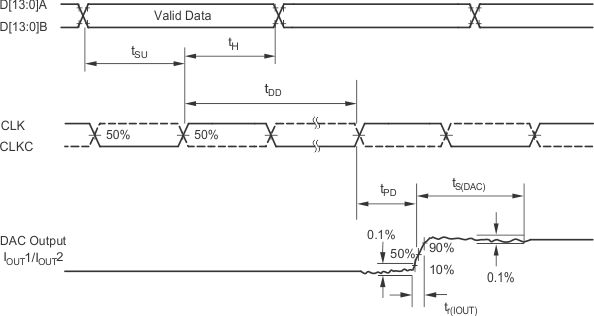 Figure 1. Timing Diagram
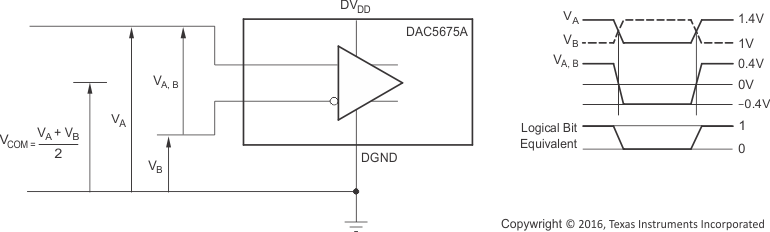 Figure 2. LVDS Timing Test Circuit and Input Test Levels
7.9 Typical Characteristics
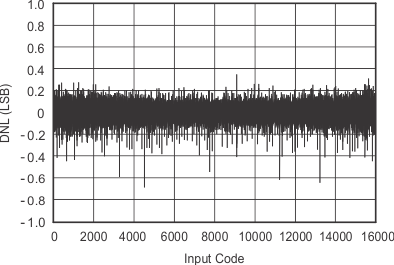 Figure 3. Differential Non-Linearity (DNL) vs Input Code
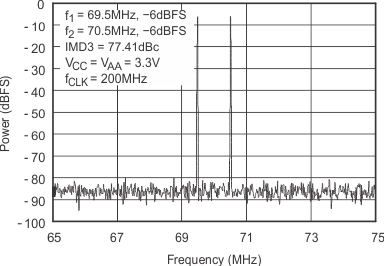 Figure 5. Two-Tone IMD (Power) vs Frequency
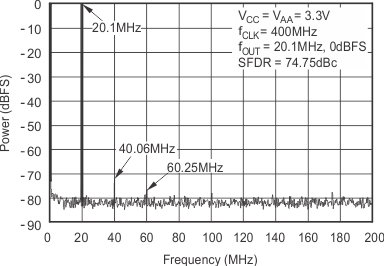 Figure 7. Single-Tone Spectrum Power vs Frequency
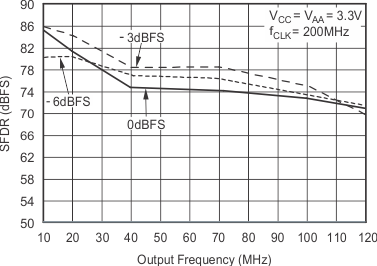 Figure 9. Spurious-Free Dynamic Range vs Frequency
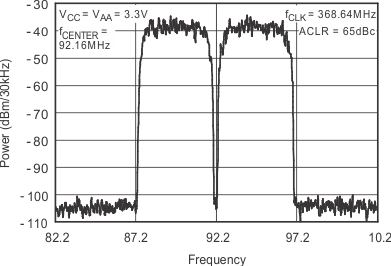 Figure 11. W-CDMA TM1 Dual Carrier Power vs Frequency
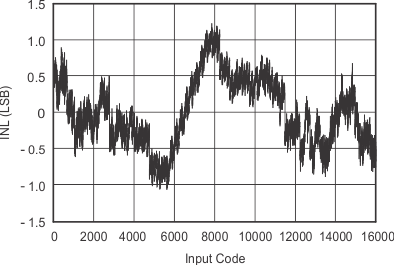 Figure 4. Integral Non-Linearity (INL) vs Input Code
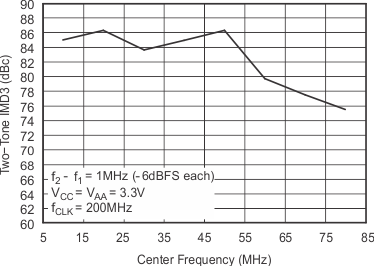 Figure 6. Two-Tone IMD3 vs Frequency
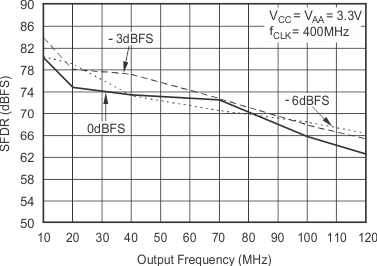 Figure 8. Spurious-Free Dynamic Range vs Frequency
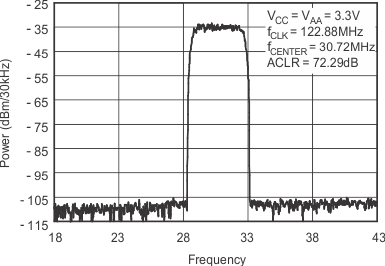 Figure 10. W-CDMA TM1 Single Carrier Power vs Frequency
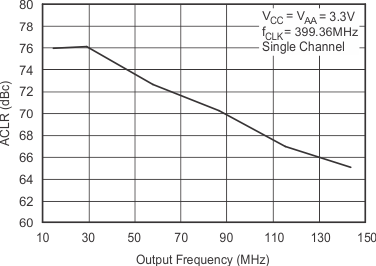 Figure 12. W-CDMA TM1 Single Carrier ACLR vs Output Frequency