SLVSGZ1C May   2024  – February 2025 DRV8161 , DRV8162

PRODUCTION DATA  

  1.   1
  2. Features
  3. Applications
  4. Description
  5. Device Comparison Table
  6. Pin Configuration and Functions
  7. Specification
    1. 6.1 Absolute Maximum Ratings
    2. 6.2 ESD Ratings
    3. 6.3 Recommended Operating Conditions
    4. 6.4 Thermal Information 1pkg
    5. 6.5 Electrical Characteristics
    6. 6.6 Timing Diagrams
  8. Detailed Description
    1. 7.1 Overview
    2. 7.2 Functional Block Diagram
    3. 7.3 Feature Description
      1. 7.3.1 Gate Drivers
        1. 7.3.1.1 PWM Control Modes
          1. 7.3.1.1.1 2-pin PWM Mode
          2. 7.3.1.1.2 1-pin PWM Mode
          3. 7.3.1.1.3 Independent PWM Mode
        2. 7.3.1.2 Gate Drive Architecture
          1. 7.3.1.2.1 Tickle Charge Pump (TCP)
          2. 7.3.1.2.2 Deadtime and Cross-Conduction Prevention (Shoot through protection)
      2. 7.3.2 Pin Diagrams
        1. 7.3.2.1 Four Level Input Pin (CSAGAIN)
        2. 7.3.2.2 Digital output nFAULT (DRV8162, DRV8162L)
        3. 7.3.2.3 Digital InOut nFAULT/nDRVOFF (DRV8161)
        4. 7.3.2.4 Multi-level inputs (IDRIVE1 and IDRIVE2)
        5. 7.3.2.5 Multi-level digital input (VDSLVL)
        6. 7.3.2.6 Multi-level digital input DT/MODE
      3. 7.3.3 Low-Side Current Sense Amplifiers
        1. 7.3.3.1 Bidirectional Current Sense Operation
      4. 7.3.4 Gate Driver Shutdown Sequence (nDRVOFF)
        1. 7.3.4.1 nDRVOFF Diagnostic
      5. 7.3.5 Gate Driver Protective Circuits
        1. 7.3.5.1 GVDD Undervoltage Lockout (GVDD_UV)
        2. 7.3.5.2 MOSFET VDS Overcurrent Protection (VDS_OCP)
        3. 7.3.5.3 Thermal Shutdown (OTSD)
  9. Application and Implementation
    1. 8.1 Application Information
    2. 8.2 Typical Application
      1. 8.2.1 Typical Application with DRV8161
      2. 8.2.2 Typical Application with DRV8162 and DRV8162L
      3. 8.2.3 External Components
    3. 8.3 Layout
      1. 8.3.1 Layout Guidelines
    4. 8.4 Power Supply Recommendations
      1. 8.4.1 Bulk Capacitance Sizing
  10. Device and Documentation Support
    1. 9.1 Device Support
    2. 9.2 Documentation Support
      1. 9.2.1 Related Documentation
    3. 9.3 Receiving Notification of Documentation Updates
    4. 9.4 Support Resources
    5. 9.5 Trademarks
    6. 9.6 Electrostatic Discharge Caution
    7. 9.7 Glossary
    8. 9.8 Community Resources
  11. 10Revision History
  12. 11Mechanical, Packaging, and Orderable Information

Package Options

Mechanical Data (Package|Pins)
Thermal pad, mechanical data (Package|Pins)
Orderable Information

Gate Driver Shutdown Sequence (nDRVOFF)

When nDRVOFF is driven low, the gate driver goes into shutdown, overriding signals on inputs pins INH/IN and INL/EN. nDRVOFF bypasses the digital control logic inside the device, and is connected directly to the gate driver output. This pin provides a mechanism for externally monitored faults to disable gate driver by directly bypassing an external controller or the internal control logic. When DRV816x detects the nDRVOFF pin is driven low, the device disables the gate driver and puts the gate driver into pulldown mode. The gate driver shutdown sequence proceeds as shown in Figure 7-17. When the gate driver initiates the shutdown sequence, the active driver pulldown is applied at IDRVN_SD current for the tDRVN_SD time.
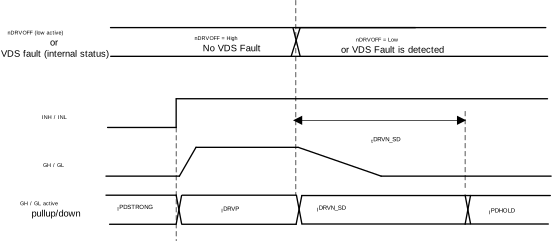
DRV8161 DRV8162 Gate Driver Shutdown Sequence Figure 7-17 Gate Driver Shutdown Sequence