SNVSCU2B August 2024 – August 2025 LM5137-Q1
PRODUCTION DATA
- 1
- 1 Features
- 2 Applications
- 3 Description
- 4 Related Products
- 5 Pin Configuration and Functions
- 6 Specifications
-
7 Detailed Description
- 7.1 Overview
- 7.2 Functional Block Diagram
- 7.3
Feature Description
- 7.3.1 Input Voltage Range (VIN)
- 7.3.2 Bias Supply Regulator (VCC, BIAS1/VOUT1, VDDA)
- 7.3.3 Precision Enable (EN1, EN2)
- 7.3.4 Switching Frequency (RT)
- 7.3.5 Pulse Frequency Modulation and Synchronization (PFM/SYNC)
- 7.3.6 Synchronization Out (SYNCOUT)
- 7.3.7 Dual Random Spread Spectrum (DRSS)
- 7.3.8 Configurable Soft Start (RSS)
- 7.3.9 Output Voltage Setpoints (FB1, FB2)
- 7.3.10 Error Amplifier and PWM Comparator (FB1, FB2, COMP1, COMP2)
- 7.3.11 Inductor Current Sense (ISNS1+, BIAS1/VOUT1, ISNS2+, VOUT2)
- 7.3.12 Minimum Controllable On-Time
- 7.3.13 100% Duty Cycle Capability
- 7.3.14 MOSFET Gate Drivers (HO1, HO2, LO1, LO2)
- 7.3.15 Output Configurations (CNFG)
- 7.4 Device Functional Modes
-
8 Application and Implementation
- 8.1 Application Information
- 8.2
Typical Applications
- 8.2.1
Design 1 – Dual 5V and 3.3V, 20A Buck Regulator for 12V
Automotive Battery Applications
- 8.2.1.1 Design Requirements
- 8.2.1.2
Detailed Design Procedure
- 8.2.1.2.1 Custom Design With WEBENCH® Tools
- 8.2.1.2.2 Custom Design With Excel Quickstart Tool
- 8.2.1.2.3 Inductor Calculations
- 8.2.1.2.4 Shunt Resistors
- 8.2.1.2.5 Ceramic Output Capacitors
- 8.2.1.2.6 Ceramic Input Capacitors
- 8.2.1.2.7 Feedback Resistors
- 8.2.1.2.8 Input Voltage UVLO Resistors
- 8.2.1.2.9 Compensation Components
- 8.2.1.3 Application Curves
- 8.2.2 Design 2 – Two-Phase, Single-Output Synchronous Buck Regulator for Automotive ADAS Applications
- 8.2.3 Design 3 – 12V, 20A, 400kHz, Two-Phase Buck Regulator for 48V Automotive Applications
- 8.2.1
Design 1 – Dual 5V and 3.3V, 20A Buck Regulator for 12V
Automotive Battery Applications
- 8.3 Power Supply Recommendations
- 8.4 Layout
- 9 Device and Documentation Support
- 10Revision History
- 11Mechanical, Packaging, and Orderable Information
Package Options
Mechanical Data (Package|Pins)
- RHA|36
Thermal pad, mechanical data (Package|Pins)
- RHA|36
Orderable Information
7.3.15.3 Single-Output Multiphase Operation
A multiphase (three or four phases) regulator requires two LM5137-Q1 controllers, as illustrated in Figure 7-9.
Configure the first controller (CNTRL1) as a primary and the second controller (CNTRL2) as a secondary. To configure the second controller, connect a 90.kΩ resistor from CNFG to AGND. This connection disables both feedback error amplifiers of the secondary controller, placing them in a high-impedance state.
- Connect the COMP1 and COMP2 pins together on both primary and secondary controllers
- Connect SYNCOUT from the primary to PFM/SYNC of the secondary controller
- Connect the RSS pins of the both controllers
- Connect all the outputs together
- Tie FB2 (primary controller) and FB2 (secondary controller) to GND
- If PFM mode operation is required, connect FB1 of the secondary controller to PFM/SYNC of the primary controller. Otherwise, connect FB1 to GND.
- Only PG1 of the primary is applicable. PG2 as well as the PG1/2 of the second controller can remain open circuit or connect to GND.
See the Benefits of a Multiphase Buck Converter white paper and Multiphase Buck Design From Start to Finish application report for more information.
| RCNFG | PRIMARY, SECONDARY | DRSS | INDEPENDENT OR INTERLEAVED OUTPUTS |
|---|---|---|---|
| 41.2kΩ | Primary | OFF | Interleaved |
| 54.9kΩ | Primary | DRSS1 | Interleaved |
| 71.5kΩ | Primary | DRSS2 | Interleaved |
| 90.9kΩ | Secondary | N/A | Interleaved |
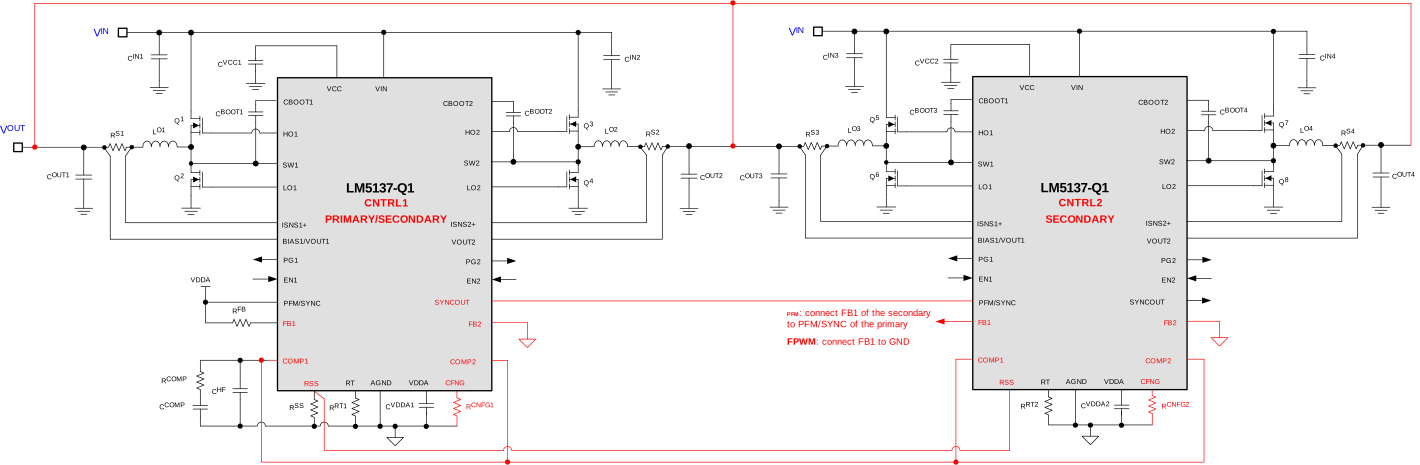 Figure 7-9
LM5137-Q1 Multiphase Regulator Schematic Configured
for Single-Output Interleaved Operation
Figure 7-9
LM5137-Q1 Multiphase Regulator Schematic Configured
for Single-Output Interleaved Operation