SNVSCU2B August 2024 – August 2025 LM5137-Q1
PRODUCTION DATA
- 1
- 1 Features
- 2 Applications
- 3 Description
- 4 Related Products
- 5 Pin Configuration and Functions
- 6 Specifications
-
7 Detailed Description
- 7.1 Overview
- 7.2 Functional Block Diagram
- 7.3
Feature Description
- 7.3.1 Input Voltage Range (VIN)
- 7.3.2 Bias Supply Regulator (VCC, BIAS1/VOUT1, VDDA)
- 7.3.3 Precision Enable (EN1, EN2)
- 7.3.4 Switching Frequency (RT)
- 7.3.5 Pulse Frequency Modulation and Synchronization (PFM/SYNC)
- 7.3.6 Synchronization Out (SYNCOUT)
- 7.3.7 Dual Random Spread Spectrum (DRSS)
- 7.3.8 Configurable Soft Start (RSS)
- 7.3.9 Output Voltage Setpoints (FB1, FB2)
- 7.3.10 Error Amplifier and PWM Comparator (FB1, FB2, COMP1, COMP2)
- 7.3.11 Inductor Current Sense (ISNS1+, BIAS1/VOUT1, ISNS2+, VOUT2)
- 7.3.12 Minimum Controllable On-Time
- 7.3.13 100% Duty Cycle Capability
- 7.3.14 MOSFET Gate Drivers (HO1, HO2, LO1, LO2)
- 7.3.15 Output Configurations (CNFG)
- 7.4 Device Functional Modes
-
8 Application and Implementation
- 8.1 Application Information
- 8.2
Typical Applications
- 8.2.1
Design 1 – Dual 5V and 3.3V, 20A Buck Regulator for 12V
Automotive Battery Applications
- 8.2.1.1 Design Requirements
- 8.2.1.2
Detailed Design Procedure
- 8.2.1.2.1 Custom Design With WEBENCH® Tools
- 8.2.1.2.2 Custom Design With Excel Quickstart Tool
- 8.2.1.2.3 Inductor Calculations
- 8.2.1.2.4 Shunt Resistors
- 8.2.1.2.5 Ceramic Output Capacitors
- 8.2.1.2.6 Ceramic Input Capacitors
- 8.2.1.2.7 Feedback Resistors
- 8.2.1.2.8 Input Voltage UVLO Resistors
- 8.2.1.2.9 Compensation Components
- 8.2.1.3 Application Curves
- 8.2.2 Design 2 – Two-Phase, Single-Output Synchronous Buck Regulator for Automotive ADAS Applications
- 8.2.3 Design 3 – 12V, 20A, 400kHz, Two-Phase Buck Regulator for 48V Automotive Applications
- 8.2.1
Design 1 – Dual 5V and 3.3V, 20A Buck Regulator for 12V
Automotive Battery Applications
- 8.3 Power Supply Recommendations
- 8.4 Layout
- 9 Device and Documentation Support
- 10Revision History
- 11Mechanical, Packaging, and Orderable Information
Package Options
Mechanical Data (Package|Pins)
- RHA|36
Thermal pad, mechanical data (Package|Pins)
- RHA|36
Orderable Information
7.3.3 Precision Enable (EN1, EN2)
The LM5137-Q1 has a precision enable circuit on each EN input. When the EN1 or EN2 voltage is greater than 1V, switching is enabled on the respective channel. If EN1 and EN2 are pulled below 0.5V, the LM5137-Q1 is in shutdown with an IQ of 3.6μA (typical) current consumption from VIN. When the EN1 or EN2 voltage is between 0.6V and 1V, the LM5137-Q1 is in standby mode with the VCC regulator active but the controller is not switching. The input quiescent current in standby mode is 260μA typical.
Enable the LM5137-Q1 with a EN1/2 voltage greater than 1V. However, many applications benefit from using a resistor divider RUV1 and RUV2, as shown in Figure 7-2, to establish a precision UVLO level. Add RUV3 in series to provide additional voltage hysteresis. Avoid leaving the EN1 and EN2 pins floating. Keep the EN1/2 voltage under 80V.
Use Equation 1 to calculate the UVLO resistors, where VIN(on) and VIN(off) are the required input voltage turn-on and turn-off thresholds.
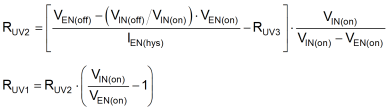
 Figure 7-2 Programmable Input Voltage UVLO Turn-On, Turn-Off