SNOS611F July 1999 – March 2025 LMC6041 , LMC6042 , LMC6044
PRODUCTION DATA
- 1
- 1Features
- 2Applications
- 3Description
- 4Pin Configuration and Functions
- 5Specifications
- 6Application and Implementation
- 7Device and Documentation Support
- 8Revision History
- 9Mechanical, Packaging, and Orderable Information
Package Options
Refer to the PDF data sheet for device specific package drawings
Mechanical Data (Package|Pins)
- D|8
- P|8
Thermal pad, mechanical data (Package|Pins)
Orderable Information
6.3.1.1 Printed-Circuit-Board Layout for High-Impedance Work
As a general rule, any circuit that must operate with less than 1000pA of leakage current requires special layout of the printed circuit board (PCB). To take advantage of the ultra-low input current of the LMC604x, typically 150fA, an excellent layout is essential. Fortunately, the techniques used to obtain low leakages are quite simple. First, do not ignore the surface leakage of the PCB, even though the leakage current can sometimes appear acceptably low, because under conditions of high humidity, dust, or contamination, the surface leakage can be appreciable.
To minimize the effect of any surface leakage, lay out a ring of foil completely surrounding the LMC604x inputs and the terminals of capacitors, diodes, conductors, resistors, relay terminals, and anything else connected to the inputs of the op amp (see also Figure 6-14). To have a significant effect, place guard rings on both the top and bottom of the PCB. Then, connect the foil to a voltage that is at the same voltage as the amplifier inputs, because no leakage current can flow between two points at the same potential. For example, a PCB trace-to-pad resistance of 1012, which is normally considered a very large resistance, can leak 5pA if the trace is a 5V bus adjacent to the pad of the input. This leakage can cause a 250 times degradation from the actual performance of the LMC604x. However, if a guard ring is held within 5mV of the inputs, then even a resistance of 1011Ω causes only 0.05pA of leakage current. See Figure 6-10 to Figure 6-12 for typical connections of guard rings for standard op-amp configurations
 Figure 6-10 Typical Connections of Guard
Rings: Inverting Amplifier
Figure 6-10 Typical Connections of Guard
Rings: Inverting Amplifier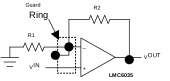 Figure 6-11 Typical Connections of Guard
Rings: Noninverting Amplifier
Figure 6-11 Typical Connections of Guard
Rings: Noninverting Amplifier Figure 6-12 Typical Connections of Guard
Rings: Follower
Figure 6-12 Typical Connections of Guard
Rings: FollowerIf laying out a PCB for the sake of just a few circuits is not practical, the following technique is even better than a guard ring. Do not insert the input pin of the amplifier into the PCB at all. Instead, bend the pin up in the air, and use only air as an insulator because air is an excellent insulator. In this case, you forgo some of the advantages of PCB construction, but the advantages are sometimes well worth the effort of using point-to-point up-in-the-air wiring. Figure 6-13 shows an example of air wiring.
