SLLSFT3 November 2025 MC121-Q1
ADVANCE INFORMATION
- 1
- 1 Features
- 2 Applications
- 3 Description
- 4 Pin Configuration and Functions
- 5 Specifications
-
6 Detailed Description
- 6.1 Overview
- 6.2 Functional Block Diagram
- 6.3 Feature Description
- 6.4 Device Functional Modes
- 6.5 Programming
- 7 Register Map
- 8 Application and Implementation
- 9 Device and Documentation Support
- 10Revision History
Package Options
Mechanical Data (Package|Pins)
- DYM|6
- DEZ|6
Thermal pad, mechanical data (Package|Pins)
Orderable Information
6.3.2.2 Current Limit
Current limit feature protects the motor from overcurrent operation during start-up, overload and stall conditions. When the motor phase current exceeds the ILIMIT threshold, the MC121-Q1 uses a cycle-by-cycle current limit scheme by turning off the high-side FET. ILIMIT_SEL sets the current limit threshold. The PWM_MODE bits set synchronous, asynchronous, or hybrid recirculation states for motor current during the current limiting OFF time, similar to the PWM OFF time described in Section 6.3.1.7.
If the motor current remains above the ILIMIT threshold at the start of the next PWM period, then the low-side FETs remain enabled for another PWM period. If the motor current drops below ILIMIT by the start of the next PWM period, the outputs return to the driving state determined by the commutation algorithm state machine as shown in Table 6-1.
Current limiting provides an upper limit to the motor torque by reducing the output PWM duty cycle when motor current is above the ILIMIT threshold. The current limit function takes priority over the PWM duty cycle determined by the commutation state machine. When the motor current drops below the ILIMIT threshold, the commutation state machine has full control of the output duty cycle. Figure 6-25and Figure 6-26 show example waveforms of the cycle-by-cycle current limiting scheme.
 Figure 6-25 Cycle-by-Cycle Current-Limit Operation
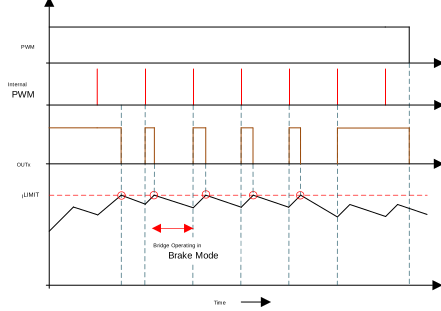 Figure 6-26 Cycle-by-Cycle Current-Limit Operation with 100% PWM Duty Cycle