SLLSFT3 November 2025 MC121-Q1
ADVANCE INFORMATION
- 1
- 1 Features
- 2 Applications
- 3 Description
- 4 Pin Configuration and Functions
- 5 Specifications
-
6 Detailed Description
- 6.1 Overview
- 6.2 Functional Block Diagram
- 6.3 Feature Description
- 6.4 Device Functional Modes
- 6.5 Programming
- 7 Register Map
- 8 Application and Implementation
- 9 Device and Documentation Support
- 10Revision History
Package Options
Mechanical Data (Package|Pins)
- DYM|6
- DEZ|6
Thermal pad, mechanical data (Package|Pins)
Orderable Information
6.3.1.3 Motor Start, Speed Change, and Stop
The MC121-Q1 implements a user configured two-slope ramp to reach the target output duty cycle (DOUT_TARGET in Figure 6-2) during motor start-up as shown in Figure 6-6. The two slope ramp (pre-start followed by soft start) enables a reliable start-up and reduces motor noise.
The MC121-Q1 enters the pre-start phase when the device exits standby mode, sleep mode, or fault mode. During the pre-start phase, the MC121-Q1 always uses square commutation to drive the motor. When PWM_RAMP_EN is set to 0x1, the output duty cycle (DOUT in Figure 6-2) increases linearly from starting duty cycle (DOUT_START x DOUT_MAX when speed loop is disabled and DOUT_START when speed loop is enabled) at the rate set by PWM_RAMP_SEL. When PWM_RAMP_EN is set to 0x0, then DOUT is updated directly by the DOUT_TARGET. The pre-start phase continues till four electrical cycles (eight Hall edges) are observed. When the fourth electrical cycle is completed, the device enters the soft start phase to ramp up DOUT to DOUT_TARGET; if DOUT has reached DOUT_TARGET by the end of pre-start phase, the soft start phase is skipped and device enters steady state directly. If the MC121-Q1 does not detect a Hall signal transition within tLRD, the device enters the locked rotor protection fault state. During start-up sequence, locked rotor detection time (tLRD_START) is user configured by LRD_TIME_STARTUP. During steady state, locked rotor detection time (tLRD_RUN) is fixed at 320ms. Hall offset (angle and time) is disabled during the pre-start phase.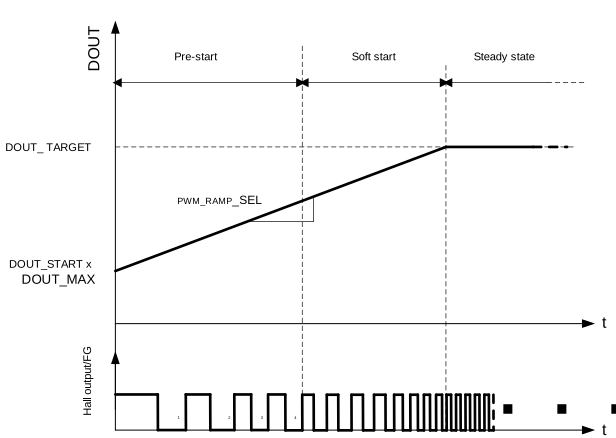 Figure 6-6 Output duty cycle during motor
start
Figure 6-6 Output duty cycle during motor
startDuring the soft start phase, DOUT is ramped at the rate set by the PWM_RAMP_SEL. In this phase, Hall offset and demagnetization are applied and MC121-Q1 uses the commutation scheme set by the COMMUTATION_MODE, SRISE, and SFALL bits. The soft start phase ends when DOUT reaches output duty or speed target.
Speed ChangeDuring motor operation, when DIN changes, the MC121-Q1 ramps the output duty cycle (DOUT in Figure 6-2) from previous target duty cycle (DOUT_TARGET_PREV) to the new target duty cycle (DOUT_TARGET) using user configured ramp rate. During acceleration (DOUT_TARGET > DOUT_TARGET_PREV), the ramp rate is set by PWM_RAMP_SEL and during deceleration (DOUT_TARGET < DOUT_TARGET_PREV), the ramp rate is either PWM_RAMP_SEL (when PWM_DECEL_SEL = 0x0) or 0.5 x PWM_RAMP_SEL (when PWM_DECEL_SEL = 0x1). PWM_DECEL_SEL = 0x1 provides a slower ramp during deceleration to avoid DC bus spikes due to regenerative energy push-back from motor. Figure 6-7 shows examples of DOUT increasing and decreasing according to PWM_RAMP_SEL.
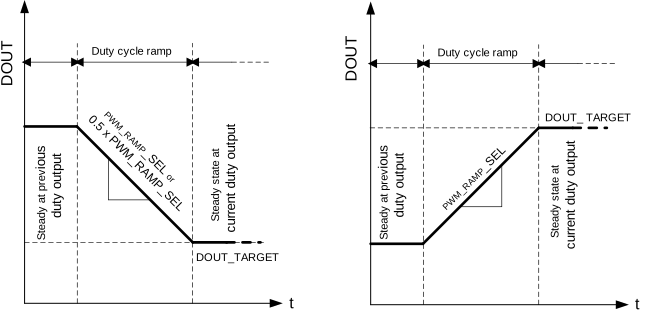 Figure 6-7 Duty Cycle Ramp
When a motor stop (DOUT_TARGET = 0%) is received, MC121-Q1 stops the motor based on RAMP_ON_STOP_DIS setting. When RAMP_ON_STOP_DIS is set to 0x1, all FETs are placed in Hi-Z on detecting motor stop (within tSTOP_DET). When RAMP_ON_STOP_DIS is set to 0x0, the device ramps down DOUT (at the rate set by PWM_DECEL_SEL) to zero followed by Hi-Z of all FETs. Once the FETs are in Hi-Z, depending on the STBY_EN and SLEEP_EN bits, MC121-Q1 continues in standby state or enters low-power sleep state. The motor stop sequence to enter sleep state when DIN is set to 0% as shown in Figure 6-8.
 Figure 6-8 Sleep Entry Sequence when DIN is set
to 0%
Figure 6-8 Sleep Entry Sequence when DIN is set
to 0%Setting the PWM_RAMP_EN bit to 0x0 disables the duty cycle ramp. Disabling the duty cycle ramp results in a step change in the DOUT (when DIN changes), that can result in high motor phase currents or DC bus voltage spikes. TI recommends setting PWM_RAMP_EN to 0x1 to avoid any current or voltage spikes.