SBOS940B May 2019 – December 2025 OPA818
PRODUCTION DATA
- 1
- 1 Features
- 2 Applications
- 3 Description
- 4 Device Comparison Table
- 5 Pin Configuration and Functions
- 6 Specifications
- 7 Detailed Description
- 8 Application and Implementation
- 9 Device and Documentation Support
- 10Revision History
- 11Mechanical, Packaging, and Orderable Information
Package Options
Refer to the PDF data sheet for device specific package drawings
Mechanical Data (Package|Pins)
- DBV|5
- DRG|8
Thermal pad, mechanical data (Package|Pins)
- DRG|8
Orderable Information
8.2.2 Noninverting Gain of 2 V/V
The OPA818 is typically stable in noise-gain configurations greater than 7 V/V when conventional feedback networks are used. The OPA818 is configurable in noise gains less than 7 V/V by using capacitors in the feedback path and between the inputs. This configuration maintains the desired gain at lower frequencies and increases the noise gain at higher frequencies such that the amplifier is stable. Configuration (a) in Figure 8-6 shows OPA818 configured in a gain of 2 V/V by using capacitors and resistors to shape the noise gain and achieve a phase margin of approximately 51° that is very close to the phase margin achieved for the conventional 7 V/V configuration (b) in Figure 8-6.
The key benefit of using a decompensated amplifier, such as the OPA818, at gains below the minimum stable gain is that designers can take advantage of the low noise and low distortion performance at power levels lower than those of comparable unity-gain stable architectures. The small-signal frequency response in Figure 8-6 shows flat ac performance beyond 100 MHz for a gain of 2 V/V configuration (a) in Figure 8-8, and by being in a lower gain configuration versus the minimum stable gain configuration of 7 V/V, the output-referred total noise is also lower (64 nV/√Hz at 100 MHz); see also Figure 8-8 compared to that at 166 nV/√Hz of configuration (b). Reducing the 10-pF input capacitor allows the system to achieve higher closed-loop bandwidth at the expense of increased peaking and reduced phase margin. Low-capacitance layout by minimizing trace lengths and removing planes under the traces and components connected to the inverting input is critical to minimize parasitic capacitance (see Layout Guidelines). Parasitic capacitance as small as 1 pF to 2 pF on the inverting input requires tweaking the noise-shaping component values to get flat frequency response and the desired phase margin. Configurations in Figure 8-6 do not take into account this parasitic capacitance but are considered for practical purposes. A 45° phase margin is generally acceptable, but anything less than 40° is not recommended to allow for component, PCB, and process tolerances. Details on the benefits of decompensated architectures are discussed in Using a decompensated op amp for improved performance.
 Figure 8-6 Noninverting Gain of 2 V/V and 7 V/V
Configurations
Figure 8-6 Noninverting Gain of 2 V/V and 7 V/V
Configurations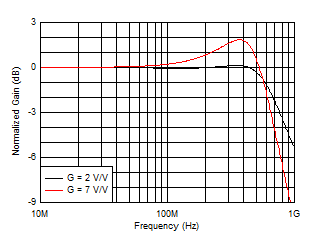 Figure 8-7 Small-Signal
Frequency Response in Gains of 2 V/V and 7 V/V Configurations of Figure 8-6
Figure 8-7 Small-Signal
Frequency Response in Gains of 2 V/V and 7 V/V Configurations of Figure 8-6 Figure 8-8 Output Noise in
Gains of 2 V/V and 7 V/V Configurations of Figure 8-6
Figure 8-8 Output Noise in
Gains of 2 V/V and 7 V/V Configurations of Figure 8-6