SLVSJH6B July   2025  – December 2025 TLV3214-Q1

PRODMIX  

  1.   1
  2. Features
  3. Applications
  4. Description
  5. Pin Configuration and Functions
    1. 4.1 Pin Configuration: TLV3211-Q1, TLV3221-Q1
    2. 4.2 Pin Configurations: TLV3212-Q1, TLV3222-Q1
    3. 4.3 Pin Configurations: TLV3214-Q1
  6. Specifications
    1. 5.1 Absolute Maximum Ratings
    2. 5.2 ESD Ratings
    3. 5.3 Recommended Operating Conditions
    4. 5.4 Thermal Information - Single
    5. 5.5 Thermal Information - Dual
    6. 5.6 Thermal Information - Quad
    7. 5.7 Electrical Characteristics
    8. 5.8 Switching Characteristics
    9. 5.9 Typical Characteristics
  7. Detailed Description
    1. 6.1 Overview
    2. 6.2 Functional Block Diagrams
    3. 6.3 Feature Description
    4. 6.4 Device Functional Modes
      1. 6.4.1 Inputs
        1. 6.4.1.1 Unused Inputs
      2. 6.4.2 Internal Hysteresis
      3. 6.4.3 Outputs
        1. 6.4.3.1 Push-Pull Output
        2. 6.4.3.2 Open Drain Output
      4. 6.4.4 ESD Protection
      5. 6.4.5 Power-On Reset (POR)
  8. Application and Implementation
    1. 7.1 Application Information
      1. 7.1.1 Basic Comparator Definitions
        1. 7.1.1.1 Operation
        2. 7.1.1.2 Propagation Delay
        3. 7.1.1.3 Overdrive Voltage
      2. 7.1.2 External Hysteresis
        1. 7.1.2.1 Inverting Comparator With Hysteresis
        2. 7.1.2.2 Non-Inverting Comparator With Hysteresis
    2. 7.2 Typical Applications
      1. 7.2.1 Low-Side Current Sensing
        1. 7.2.1.1 Design Requirements
        2. 7.2.1.2 Detailed Design Procedure
    3. 7.3 Power Supply Recommendations
    4. 7.4 Layout
      1. 7.4.1 Layout Guidelines
      2. 7.4.2 Layout Example
  9. Device and Documentation Support
    1. 8.1 Documentation Support
      1. 8.1.1 Related Documentation
    2. 8.2 Receiving Notification of Documentation Updates
    3. 8.3 Support Resources
    4. 8.4 Trademarks
    5. 8.5 Electrostatic Discharge Caution
    6. 8.6 Glossary
  10. Revision History
  11. 10Mechanical, Packaging, and Orderable Information

Package Options

Mechanical Data (Package|Pins)
Thermal pad, mechanical data (Package|Pins)
Orderable Information

Non-Inverting Comparator With Hysteresis

A non-inverting comparator with hysteresis requires a two-resistor network and a voltage reference (VREF) at the inverting input, as shown in Figure 7-5,

TLV3211-Q1 TLV3212-Q1 TLV3214-Q1 TLV3221-Q1 TLV3222-Q1 TLV321x-Q1 in a Non-Inverting Configuration With HysteresisFigure 7-5 TLV321x-Q1 in a Non-Inverting Configuration With Hysteresis

The equivalent resistor networks when the output is high and low are shown in Figure 7-6.
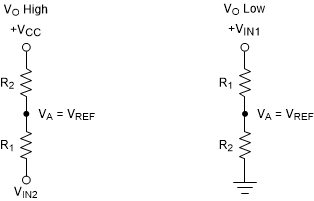
TLV3211-Q1 TLV3212-Q1 TLV3214-Q1 TLV3221-Q1 TLV3222-Q1 Non-Inverting Configuration Resistor NetworksFigure 7-6 Non-Inverting Configuration Resistor Networks

When VIN is less than VREF,, the output is low. For the output to switch from low to high, VIN must rise above the VIN1 threshold. Use Equation 4 to calculate VIN1.
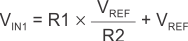
Equation 4. TLV3211-Q1 TLV3212-Q1 TLV3214-Q1 TLV3221-Q1 TLV3222-Q1

When VIN is greater than VREF, the output is high. For the comparator to switch back to a low state, VIN must drop below VIN2. Use Equation 5 to calculate VIN2.

Equation 5. TLV3211-Q1 TLV3212-Q1 TLV3214-Q1 TLV3221-Q1 TLV3222-Q1

The hysteresis of this circuit is the difference between VIN1 and VIN2, as shown in Equation 6.

Equation 6. TLV3211-Q1 TLV3212-Q1 TLV3214-Q1 TLV3221-Q1 TLV3222-Q1

For more information, please see Inverting comparator with hysteresis circuit and Non-Inverting Comparator With Hysteresis Circuit application notes.