SLVSDX0B October   2017  – November 2017 TPS23525

PRODUCTION DATA.  

  1. Features
  2. Applications
  3. Description
  4. Revision History
  5. Pin Configuration and Functions
  6. Specifications
    1. 6.1 Absolute Maximum Ratings
    2. 6.2 ESD Ratings
    3. 6.3 Recommended Operating Conditions
    4. 6.4 Thermal Information
    5. 6.5 Electrical Characteristics
    6. 6.6 Switching Characteristics
    7. 6.7 Typical Characteristics
  7. Parameter Measurement Information
    1. 7.1 Relationship between Sense Voltage, Gate Current, and Timer
  8. Detailed Description
    1. 8.1 Overview
    2. 8.2 Functional Block Diagram
    3. 8.3 Feature Description
      1. 8.3.1 Current Limit
        1. 8.3.1.1 Programming the CL Switch-Over Threshold
        2. 8.3.1.2 Programming CL1
        3. 8.3.1.3 Programming CL2
        4. 8.3.1.4 Computing the Fast Trip Threshold
      2. 8.3.2 Soft Start Disconnect
      3. 8.3.3 Timer
      4. 8.3.4 OR-ing
    4. 8.4 Device Functional Modes
      1. 8.4.1 OFF State
      2. 8.4.2 Insertion Delay State
      3. 8.4.3 Start-up State
      4. 8.4.4 Normal Operation State
  9. Application and Implementation
    1. 9.1 Application Information
    2. 9.2 Typical Application
      1. 9.2.1 Design Requirements
      2. 9.2.2 Detailed Design Procedure
        1. 9.2.2.1  Selecting RSNS
        2. 9.2.2.2  Selecting Soft Start Setting: CSS and CSS,VEE
        3. 9.2.2.3  Selecting VDS Switch Over Threshold
        4. 9.2.2.4  Timer Selection
        5. 9.2.2.5  MOSFET Selection and SOA Checks
        6. 9.2.2.6  Input Cap, Input TVS, and OR-ing FET selection
        7. 9.2.2.7  EMI Filter Consideration
        8. 9.2.2.8  Under Voltage and Over Voltage Settings
        9. 9.2.2.9  Choosing RVCC and CVCC
        10. 9.2.2.10 Power Good Interface to Downstream DC/DC
      3. 9.2.3 Application Curves
  10. 10Power Supply Recommendations
  11. 11Layout
    1. 11.1 Layout Guidelines
    2. 11.2 Layout Example
  12. 12Device and Documentation Support
    1. 12.1 Device Support
      1. 12.1.1 Third-Party Products Disclaimer
    2. 12.2 Documentation Support
      1. 12.2.1 Related Documentation
    3. 12.3 Receiving Notification of Documentation Updates
    4. 12.4 Community Resources
    5. 12.5 Trademarks
    6. 12.6 Electrostatic Discharge Caution
    7. 12.7 Glossary
  13. 13Mechanical, Packaging, and Orderable Information

Package Options

Mechanical Data (Package|Pins)
Thermal pad, mechanical data (Package|Pins)
Orderable Information

Application and Implementation

NOTE

Information in the following applications sections is not part of the TI component specification, and TI does not warrant its accuracy or completeness. TI’s customers are responsible for determining suitability of components for their purposes. Customers should validate and test their design implementation to confirm system functionality.

Application Information

The TPS23525 is a hot swap controller for –48-V applications and is used to manage inrush current and protect downstream circuitry and the upstream bus in case of fault conditions. The following key scenarios should be considered when designing a –48-V hot swap circuit:

  • Start Up.
  • Output of a hot swap is shorted to ground while the hot swap is on. This is often referred to as a Hot Short.
  • Powering up a board when the output and ground are shorted. This is usually called a start-into-short.
  • Input lightning surge. Here it is usually desired to avoid damage to downstream circuitry and to avoid system restarts.

These scenarios place a lot of stress on the hot swap MOSFET and the board designer should take special care to ensure that the MOSFET stays within it's Safe Operating Area (SOA) under all of these conditions. A detailed design example is provided below and the key equations are written out. Note that solving all of these equations by hand is cumbersome and can result in errors. Instead, TI recommends using the TPS2352X Design Calculator provided on the product page.

Typical Application

TPS23525 slvsdf9_tps23525_DesignExample.png Figure 12. Application Diagram for Design Example

Design Requirements

The table below summarizes the design parameters that must be known before designing a hot swap circuit. When charging the output capacitor through the hot swap MOSFET, the FET’s total energy dissipation equals the total energy stored in the output capacitor (1/2CV2). Thus both the input voltage and output capacitance will determine the stress experienced by the MOSFET. The maximum load power will drive the current limit and sense resistor selection. In addition, the maximum load current, maximum ambient temperature, and the thermal properties of the PCB (RθCA) will drive the selection of the MOSFET's RDSON and the number of MOSFETs used. RθCA is a strong function of the layout and the amount of copper that is connected to the drain of the MOSFET. Air cooling will also reduce RθCA substantially. Finally, it's important to know what transients the circuit has to pass in order to size up the input protection accordingly.

Table 1. Design Requirements for a –38 V to –60 V, 400-W Protection Circuit

DESIGN PARAMETER EXAMPLE VALUE
Input voltage range –38 V to –60 V
Maximum Load Power 400 W
Output Capacitance 660 µF
Location of Output Cap After EMI filter with ~5 µH of inductance.
Maximum Ambient Temperature 85°C
MOSFET RθCA (function of layout) 20°C/W
Pass “Hot-Short” on Output? Yes
Pass a “Start into short”? Yes
Is the load off until PG asserted? Yes
Max Input Inductance 10 µH
Level of IEC61000-4-5 to pass 2-kV Line to Line with 2-Ω series impedance
Pass Reverse Hook Up Yes

Detailed Design Procedure

Selecting RSNS

Before selecting RSNS, first compute the maximum load current. For this example the worst case load current happens at the minimum input voltage of 38 V. Thus the maximum current is 400 W/38 V = 10.5 A. To provide some margin, set the target current limit to 12 A and compute RSNS using equation below:

Equation 11. TPS23525 tps23523_equation11.gif

Use next available RSNS of 2 mΩ.

Selecting Soft Start Setting: CSS and CSS,VEE

First, compute the minimum inrush current where the timer will trip using equation below.

Equation 12. TPS23525 tps23523_equation12.gif

To avoid running the timer the inrush current needs to be sufficiently low. Target 0.4 A of inrush current to allow margin, and compute the target CSS using equation below.

Equation 13. TPS23525 tps23523_equation13.gif

Next choose, the next available CSS greater than 39.6 nF. For this example 43 nF was used, which assumes a 33 nF and 10 nF cap in parallel. This results in an inrush current of 0.37 A at max COUT (792 µF) and inrush current of 0.31 A at typical COUT (660 µF). Also it is recommended to add a capacitor between the soft start pin and VEE (CSS,VEE) to improve immunity to input voltage noise during soft start. It's recommended to chose a capacitor that's 3x larger than CSS. In this case a 150 nF capacitor was chosen.

Finally the start-up time at maximum input voltage can be computed using the equation below:

Equation 14. TPS23525 tps23523_equation14.gif

Selecting VDS Switch Over Threshold

The VDS threshold where the current limit switches from CL1 to CL2 can be programmed using RD. In general a higher threshold improves ability to ride through voltage steps, brown outs, and other transients. However, a larger setting can also expose the MOSFET to more stress, because the larger current limit is now allowed at higher VDS voltages. If there are no specific voltage step requirements, 20 V is a good starting point. Use the equation below to compute the target RD.

Equation 15. TPS23525 tps23523_equation15.gif

Timer Selection

The timer determines how long the hot swap can be in current limit before timing out and can be programmed using CTMR. In general a longer time out (TTO) improves ability to ride through voltage steps, brown outs, and other transients. However, a larger setting can also expose the MOSFET to more stress, because it takes longer for the FET to shut down during fault conditions. If there are no specific voltage step or transient requirements, 2 ms is a good starting point. Use the equation below to compute the target CTMR. Choose the next available capacitor value of 15 nF, which results in a 2.25 ms time out.

Equation 16. TPS23525 tps23523_equation16.gif

MOSFET Selection and SOA Checks

When selecting MOSFETs for the –48 V application the three key parameters are: VDS rating, RDSON, and safe operating area (SOA). For this application the CSD19535KTT was selected to provide a 100 V VDS rating, low RDSON, and sufficient SOA. After selecting the MOSFET, it is important to double check that it has sufficient SOA to handle the key stress scenarios: start-up, output Hot Short, and Start into Short. MOSFET's SOA is usually specified at a case temperature of 25°C and should be derated based on the maximum case temperature expected in the application. Compute the maximum case temperature using the equation below. Note that the RDSON will vary with temperature and solving the equation below could be a repetitive process. The CSD19535KTT, has a maximum 3.4 mΩ RDSON at room temperature and is ~1.5x higher at 100°C. N stands for the number of MOSFETs used in parallel.

Equation 17. TPS23525 tps23523_equation17.gif
Equation 18. TPS23525 tps23523_equation18.gif

Next the stress the MOSFET will experience during operation should be compared to the FETs capability. First, consider the power up. The inrush current with max COUT will be 0.37 A and the inrush will last for 129 ms. Note that the power dissipation of the FET will start at VIN,MAX × IINR and reduce to zero as the VDS of the MOSFET is reduced. The SOA curve of a typical MOSFET assume the same power dissipation for a given time. A conservative approach is to assume an equivalent power profile where PFET = VIN,MAX × IINR for t = Tstart-up /2. In this instance, the SOA can be checked by looking at a 60 V, 0.4 A, 64.5 ms pulse. Based on the SOA of the CSD19535KTT, it can handle 60 V, 1.8 A for 10 ms and it can handle 60 V, 1 A for 100 ms. The SOA at TC = 25°C for 64.5 ms can be extrapolated by approximating SOA vs time as a power function as shown in equations below:

Equation 19. TPS23525 tps23523_equation19.gif
Equation 20. TPS23525 tps23523_equation20.gif
Equation 21. TPS23525 tps23523_equation21.gif
Equation 22. TPS23525 tps23523_equation22.gif

Finally, the FET SOA needs to be derated based on the maximum case temperature as shown below. Note that the FET can handle 0.59 A, while it will have 0.37 A during start-up. Thus there is a lot of margin during this test condition.

Equation 23. TPS23525 tps23523_equation23.gif

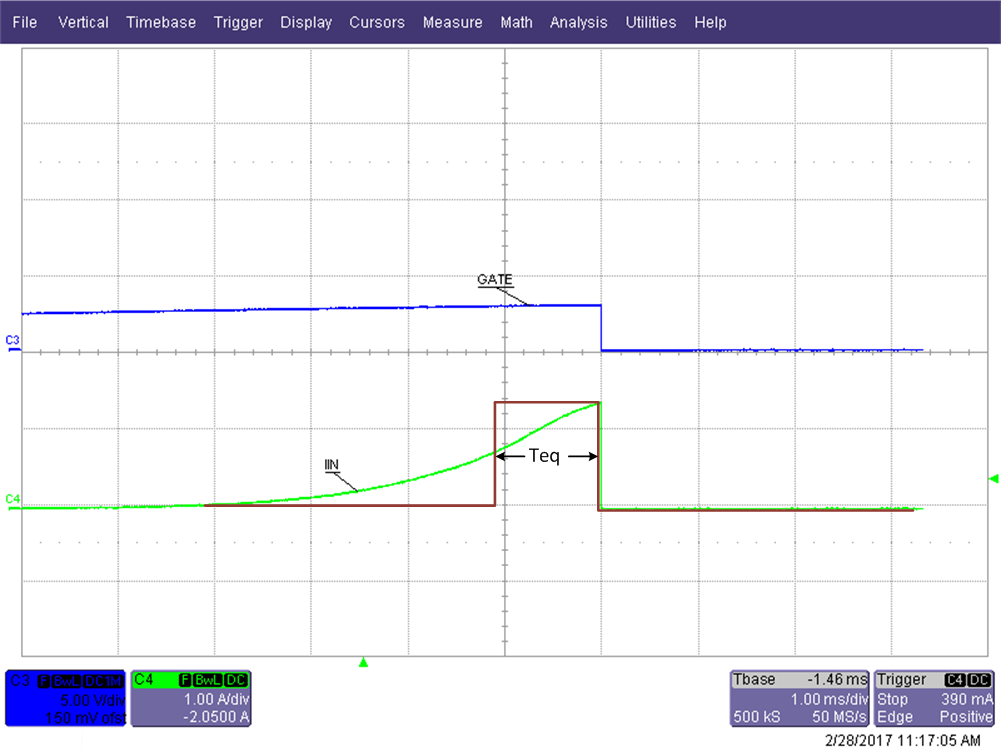
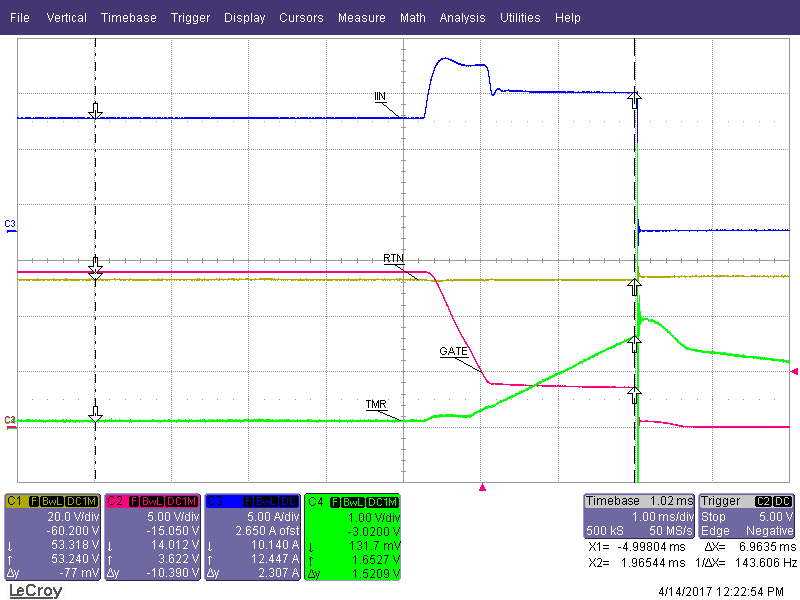
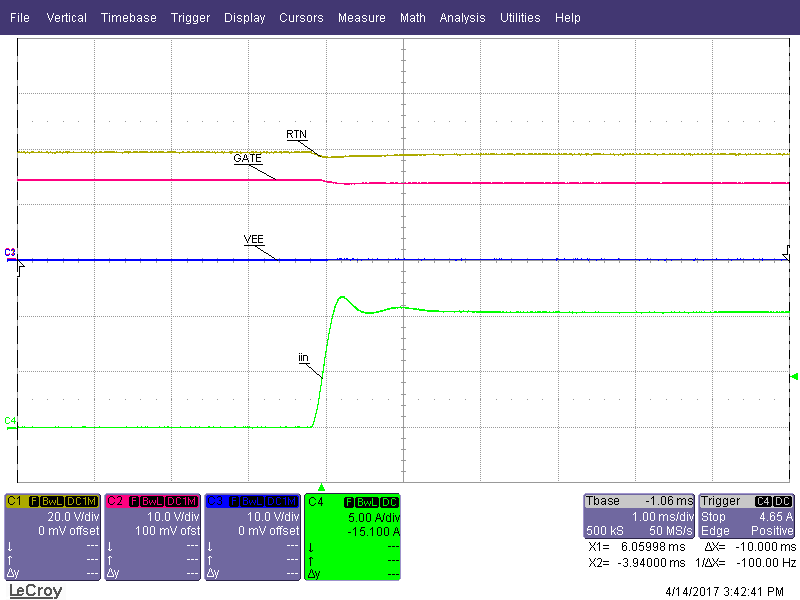
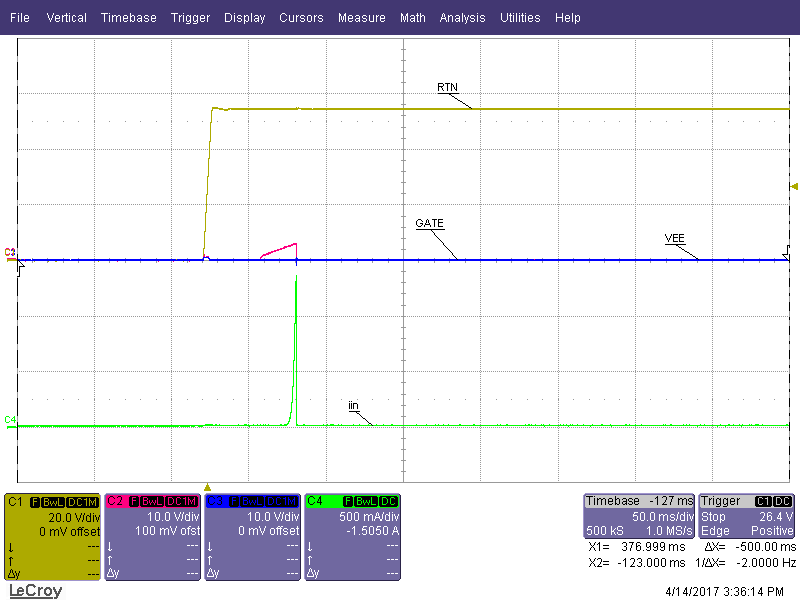
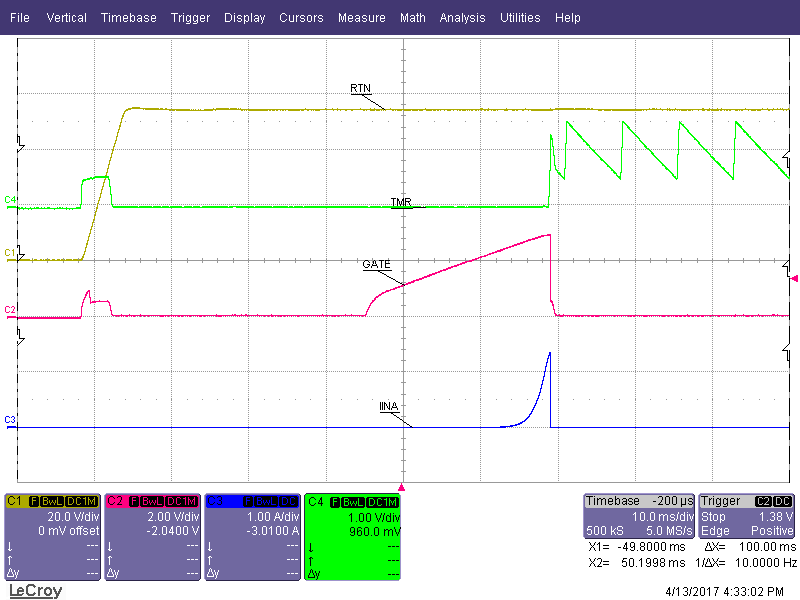
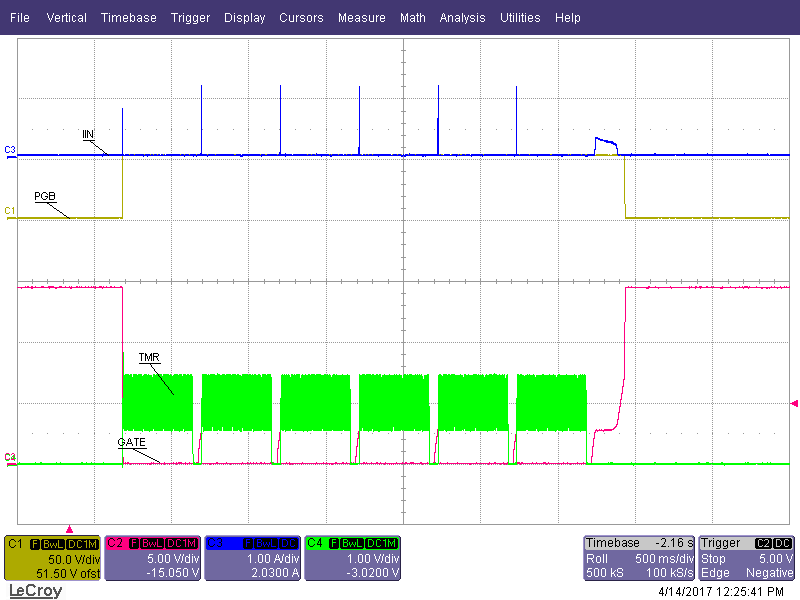
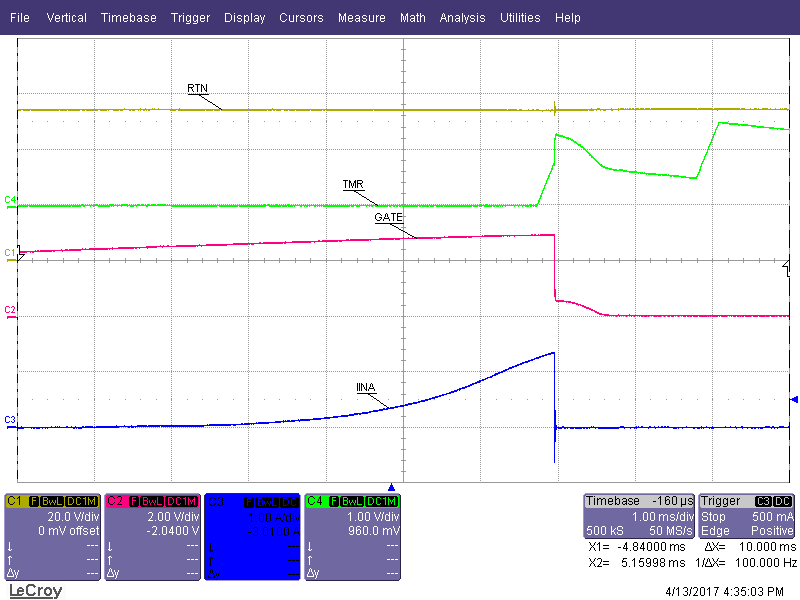
A similar approach should be taken to compute the FETs SOA capability during a Hot Short and start into short. As shown in the following figure, during a start into short the gate is coming up very slowly due to a large capacitance tied to the gate through the SS pin. Thus it is more stressful than a Hot Short and should be used for worst case SOA calculations. To compare the FET stress during start-up into short to the SOA curves the stress needs to be approximated as a square pulse as showing in the figure below. In this example, the stress is approximated with a 1.1 ms (Teq), 1.5 A, 60 V pulse. The FET can handle 6 A, 60 V for 1 ms and 1.8 A, 60 V for 10 ms. Using approximation and temp derating as shown earlier, the FET's capability can be computed as 3 A, 60 V, for 1.1 ms at 96°C. 3 A is significantly larger than 1.5 A implying good margin.

TPS23525 StartIntoShort.png Figure 13. Teq During a Start Into a Short

The final operating point to check is the operation with high current and VDS just below the VDS,SW threshold. In this example, the time out would be 1.1ms (one half of the time out at Vd = 0 V), the current will be 12.5 A, and the voltage would be 20 V. Looking up the SOA curve, the FET can handle 30 A, 20 V for 1 ms and 10 A, 20 V for 10 ms. Repeating previously shown approximations and temp derating, the FET's capability is computed to be 16 A, 20 V, for 1.1 ms at 96°C. Again this is below the worst case operating point of 12.5 A and 20 V suggesting good margin.

Input Cap, Input TVS, and OR-ing FET selection

This design example is sized for an application that needs to pass a 2 kV, 2Ω lightning strike per IEC61000-4-5. This equates to almost 1000 A of input current that needs to be clamped. In addition, the design needs to pass reverse hook up and thus the TVS needs to be bi directional. A ceramic transient voltage suppressor (2x B72540T6500S162) CT2220K50E2G was used to clamp this huge surge of current. According to it's datasheet it can clamp 500 A of current to 150 V. Note that the lightning strike can be positive or negative. The worst case voltage is dropped across the OR-ing FETs when the strike is positive (–48 V line goes above RTN). If the output of the OR-ing is –48 V and the input goes to +150 V that is a 200 V drop. Thus BSC320N20NS3 was chosen for the OR-ing FETs. This is a 200 V FET with a 32 mΩ RDSON at room temperature. 2 of these were used in parallel to minimize power loss and manage thermal. Finally a 0.1 µF input bypass cap is recommended.

EMI Filter Consideration

In this example it is assumed that the EMI filter is right after the hot swap and the bulk cap is after the EMI filter. The EMI filter adds significant inductance and needs to be accounted for. During a Hot Short, the inductor builds up significant current that needs to go somewhere after the FET opens. For that a free wheeling diode should be used along with a snubber. For this example a 150 V, SMA diode was used: STPS1150A. The snubber consisted of a 10-Ω resistor in series with a 1-µF ceramic capacitor. In addition a 0.1-µF ceramic cap was tied directly on the output.

Under Voltage and Over Voltage Settings

Both the threshold and hysteresis can be programmed for under voltage and over voltage protection. In general the rising UV threshold should be set sufficiently below the minimum input voltage and the falling OV threshold should be set sufficiently above the maximum input voltage to account for tolerances. For this example a rising UV threshold of 37 V and a falling UV threshold of 35 V was chosen as the target. First, choose RUV1 based on the 2 V UV hysteresis as shown below.

Equation 24. TPS23525 tps23523_equation24.gif

Once RUV1 is known RUV2 can be computed based on the target rising UV threshold as shown below.

Equation 25. TPS23525 tps23523_equation25.gif

The OV setting can be programmed in a similar fashion as shown in equations below.

Equation 26. TPS23525 tps23523_equation26.gif
Equation 27.
Equation 28. TPS23525 tps23523_equation27.gif

Optional filtering capacitors can be added to the UV and OV to improve immunity to noise and transients on the input bus. These should be tuned based on system requirements and input inductance. In this example place holders were added to the PCB, but the components were not populated.

Choosing RVCC and CVCC

The VCC is used as internal supply rail and is a shunt regulator. To ensure stability of internal loop a minimum of 0.1 µF is required for CVCC. To ensure reasonable power on time it is recommended to keep CVCC below 1 µF. RVCC should be sized in such a way to ensure that sufficient current is supplied to the IC at minimum operating voltage corresponding to the falling UV threshold. To allow for some margin it is recommended that the current through RVCC is at least 1.2x of IQ,MAX when RTN = Falling UV threshold and VCC = 10 V (minimum recommended operating voltage on VCC). For this example RVCC of 16.2 kΩ was used.

Power Good Interface to Downstream DC/DC

It's critical to keep the downstream DC/DC off while the hot swap is charging the bulk capacitor. This can be accomplished through the PGb pin. Note that the VEE of the hot swap and the DC/DC are different and the Power Good can not be directly tied to the EN or UV of the DC/DC. The application circuit below provides a simple way to control the downstream converter with the PGb pin of the hot swap.
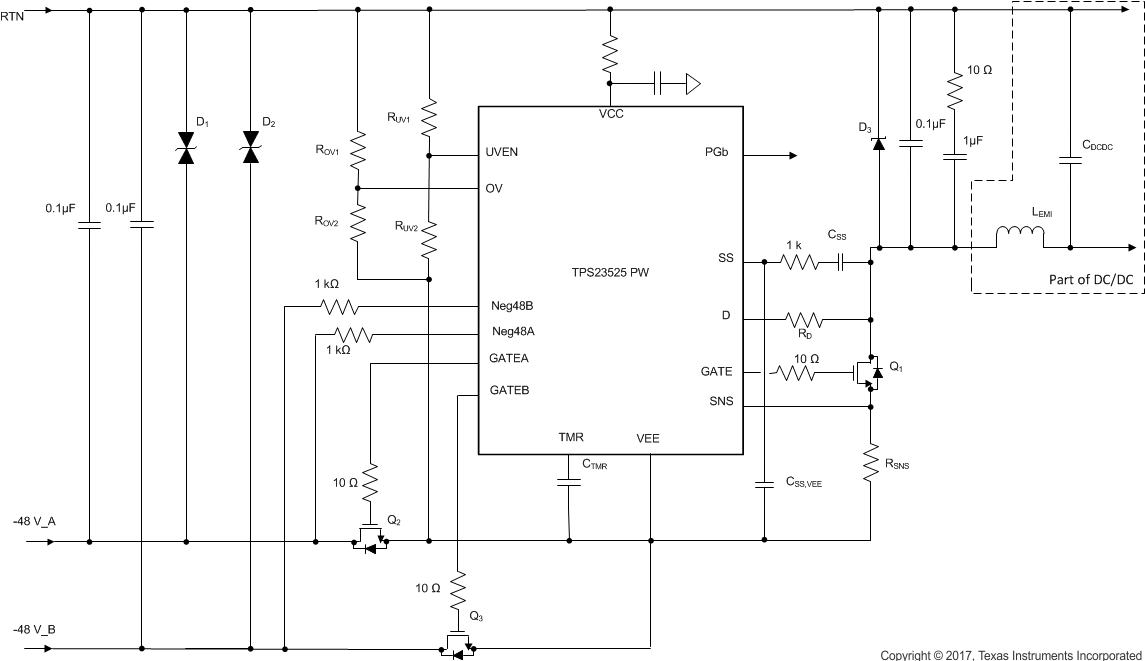
TPS23525 PGb_hook_up.png Figure 14. Interface to DC/DC
Application Curves

TPS23525 HotPlug_54V.png
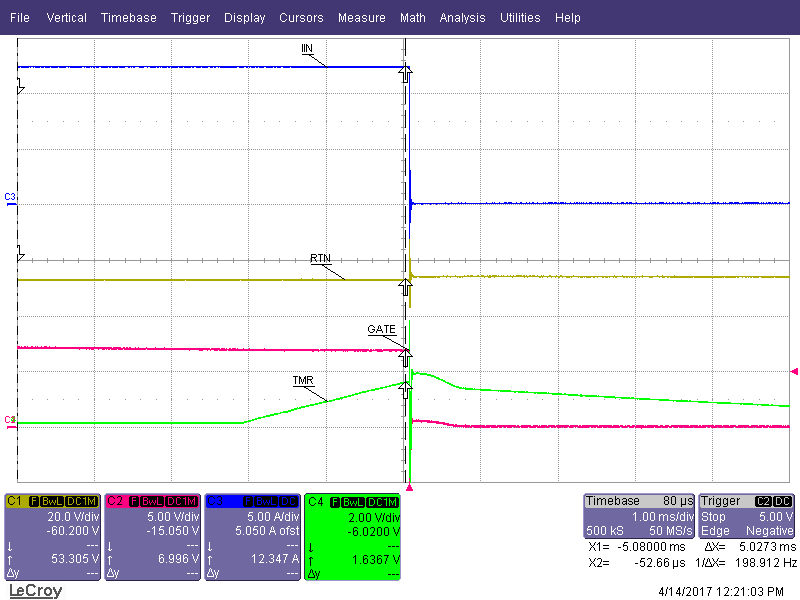
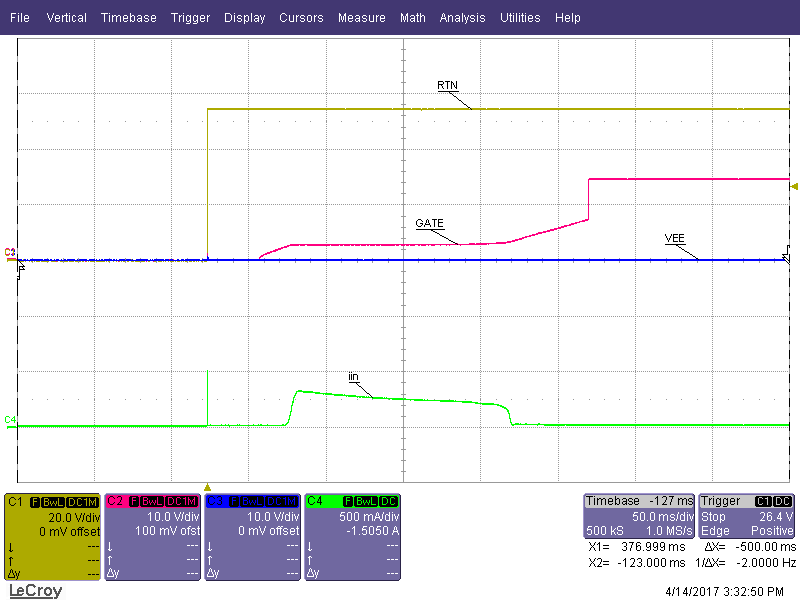
No Load, Scope GND = -48V_A
Figure 15. Start Up (Vin = 54 V)
TPS23525 HotPlug_38V.png
No Load, Scope GND = -48V_A
Figure 17. Start Up (Vin = 38 V)
TPS23525 HotPlug2_54V_54V.png
VinA = 54 V, VinB = 54 V, No Load, Scope GND = RTN
Figure 19. Hot Plug Channel A and B Together
TPS23525 HotPlug_After_5A.png
VinA = 54 V; VinB = 38 V, Scope GND = RTN, Iload = 5 A
Figure 21. Hot Plug A after B
TPS23525 HotPlug_After_5A3.png
VinA = 54 V; VinB = 38 V, Scope GND = RTN, Iload = 5 A
Figure 23. Hot Plug A after B
TPS23525 HotShort_after54V2.png
Scope GND = -48V_B, No Load, After Inductor
Figure 25. Output Hot Short (VinB = 54 V)
TPS23525 HotShort_after_54V2.png
Scope GND = -48V_B, 5A Load, Zoomed in
Figure 27. Output Hot Short (VinB = 54 V)
TPS23525 HotShort_after_60Va.png
Scope GND = -48V_B, 5-A Load, Zoomed In
Figure 29. Output Hot Short (VinB = 60 V)
TPS23525 LoadStepOC.png
Scope GND = -48V_A
Figure 31. Load Step Overcurrent
TPS23525 StartIntoShort2.png
Scope Gnd = -48V_A, Vin = 54 V
Figure 33. Start Into Short
TPS23525 BrownOut.png
Scope GND = -48V_A, Iload = 5 A
Figure 35. 1-ms Brown Out
TPS23525 SupplySwitch.png
VinB = 53 V, Iload = 5 A, Scope GND = RTN
Figure 37. Supply Switch Over (Raise VinA)
TPS23525 VinShortDual.png
VinA = 54.5 V; VinB = 54 V, Iload = 5 A, Scope GND=RTN
Figure 39. VinA Short
TPS23525 VinUnplug_Dual.png
VinA = 54.5 V; VinB = 54 V, Iload = 5 A, Scope GND=RTN
Figure 41. Unplug VinA
TPS23525 ReverseHP_single.png
VinB Floating
Figure 43. Plug in VinA backwards
TPS23525 UV_OV_Falling.png
Scope GND = -48V_A, No Load
Figure 45. Under Voltage and Over Voltage (Falling)
TPS23525 Neg2kV_LightningStrike2.png
Scope GND = RTN, 5-A load, Per IEC61000-4-5
Figure 47. -2 kV (2 Ω) Lightning Surge (zoomed in)
TPS23525 Pos2kV_LightningStrike2.png
Scope GND = RTN, 5-A load, Per IEC61000-4-5
Figure 49. +2 kV (2 Ω) Lightning Surge (zoomed in)
TPS23525 LargeL_HotShort.png
Lin = 20 µH, Scope GND = -48V_A
Figure 51. Hot Short (Vin = 54 V)
TPS23525 LargeL_LoadStep.png
Lin = 20 µH, Scope GND = -48V_A,
Figure 53. Load Step (0 A - 11 A)
TPS23525 LargeL_StartIntoShort.png
Lin = 20 µH, Scope GND = -48V_A
Figure 55. Start Into Short
TPS23525 HotPlug_54Va.png
No Load, Scope GND = -48V_A
Figure 16. Start Up (Vin = 54 V)
TPS23525 HotPlug_60V.png
No Load, Scope GND = -48V_A
Figure 18. Start Up (Vin = 60 V)
TPS23525 HotPlug2_54_5V_54V.png
VinA = 54.5 V, VinB = 54 V, No Load, Scope GND = RTN
Figure 20. Hot Plug Channel A and B Together
TPS23525 HotPlug_After_5A2.png
VinA = 54 V; VinB = 38 V, Scope GND = RTN, Iload = 5 A
Figure 22. Hot Plug A after B
TPS23525 HotPlug_After_NoLoad.png
VinA = 54.5 V; VinB = 54 V, Scope GND = RTN, No load
Figure 24. Hot Plug A after B
TPS23525 HotShort_after_54V.png
Scope GND = -48V_B, 5-A Load, After Inductor
Figure 26. Output Hot Short (VinB = 54 V)
TPS23525 HotShort_after_60V.png
Scope GND = -48V_B, 5-A Load
Figure 28. Output Hot Short (VinB = 60 V)
TPS23525 GradualOC.png
Scope GND = -48V_A
Figure 30. Gradual Over Current (VinA = 54 V)
TPS23525 StartIntoShort.png
Scope Gnd = -48V_A, Vin = 54 V
Figure 32. Start Into Short
TPS23525 RemoveShort.png
Scope Gnd = -48V_A, Vin = 54 V
Figure 34. Apply Short and Remove Short
TPS23525 BrownOut2.png
Scope GND = -48V_A, Iload = 5 A
Figure 36. 1-ms Brown Out
TPS23525 SupplySwitch2.png
VinB = 53 V (Raise VinA), Scope GND = RTN, Iload = 5 A
Figure 38. Supply Switch Over (zoomed in)
TPS23525 VinShortDual2.png
VinA = 54.5 V; VinB = 54 V, Iload = 5 A, Scope GND=RTN
Figure 40. VinA Short
TPS23525 ReverseHP_Dual.png
VinB = 60 V
Figure 42. Plug in VinA backwards
TPS23525 UV_OV_Rising.png
Scope GND = -48V_A, No Load
Figure 44. Under Voltage and Over Voltage (Rising)
TPS23525 Neg2kV_LightningStrike.png
Scope GND = RTN, 5-A load, Per IEC61000-4-5
Figure 46. -2 kV (2 Ω) Lightning Surge
TPS23525 Pos2kV_LightningStrike.png
Scope GND = RTN, 5-A load, Per IEC61000-4-5
Figure 48. +2 kV (2 Ω) Lightning Surge (zoomed in)
TPS23525 largeL_HotPlug.png
Lin = 20 µH, Scope GND = -48V_A
Figure 50. Start-Up (Vin = 54 V)
TPS23525 LargeL_HotShort38.png
Lin = 20 µH, Scope GND = -48V_A
Figure 52. Hot Short (Vin = 38 V)
TPS23525 LargeL_OC.png
Lin = 20 µH, Scope GND = -48V_A
Figure 54. Load Step Into Overcurrent
TPS23525 LargeL_BrownOut.png
Lin = 20 µH, Scope GND = -48V_A
Figure 56. 1-ms Brown Out