SLVSDU1K August 2018 – July 2025 TPS62810-Q1 , TPS62811-Q1 , TPS62812-Q1 , TPS62813-Q1
PRODUCTION DATA
- 1
- 1 Features
- 2 Applications
- 3 Description
- 4 Device Comparison Table
- 5 Pin Configuration and Functions
- 6 Specifications
- 7 Parameter Measurement Information
- 8 Detailed Description
- 9 Application and Implementation
- 10Device and Documentation Support
- 11Revision History
- 12Mechanical, Packaging, and Orderable Information
Package Options
Mechanical Data (Package|Pins)
- RWY|9
Thermal pad, mechanical data (Package|Pins)
- RWY|9
Orderable Information
3 Description
The TPS6281x-Q1 is family of pin-to-pin 1A, 2A, 3A, and 4A synchronous automotive step-down DC/DC converters. All devices offer high efficiency and ease of use. The TPS6281x-Q1 family is based on a peak current mode control topology. The TPS6281x-Q1 is designed for automotive applications such as infotainment and advanced driver assistance systems. Low resistive switches allow up to 4A continuous output current at high ambient temperature. The switching frequency is externally adjustable from 1.8MHz to 4MHz and can also be synchronized to an external clock in the same frequency range. In PWM/PFM mode, the TPS6281x-Q1 automatically enter power save mode at light loads to maintain high efficiency across the whole load range. The TPS6281x-Q1 provide 1% output voltage accuracy in PWM mode which helps design a power supply with high output voltage accuracy. The SS/TR pin allows setting the start-up time or forming tracking of the output voltage to an external source. This feature allows external sequencing of different supply rails and limiting the inrush current during start-up.
The TPS6281x-Q1 is available in a 3mm × 2mm VQFN package with wettable flanks.
| PART NUMBER(2) | PACKAGE(1) | BODY SIZE (NOM) |
|---|---|---|
| TPS62810-Q1 | RWY (VQFN, 9) | 3.00mm × 2.00mm |
| TPS62811-Q1 | ||
| TPS62812-Q1 | ||
| TPS62813-Q1 |
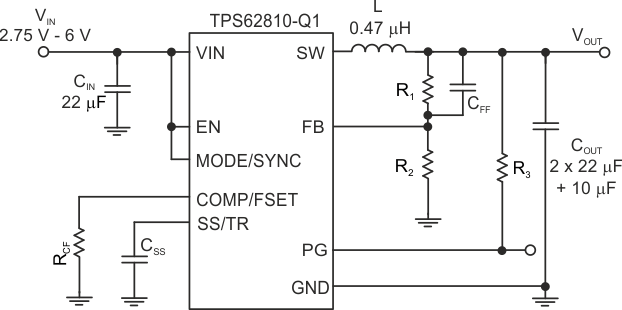 Simplified Schematic
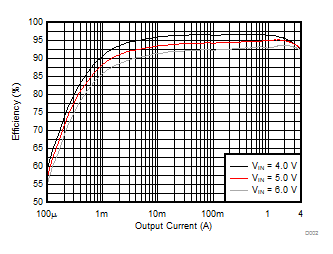 Efficiency vs Output Current; VOUT = 3.3V; PWM/PFM; fS = 2.25MHz