SDAA114 September 2025 AMC0311D , AMC0311D-Q1 , AMC0311R , AMC0311R-Q1 , AMC0311S , AMC0311S-Q1 , AMC0330D , AMC0330D-Q1 , AMC0330R , AMC0330R-Q1 , AMC0330S , AMC0330S-Q1 , AMC0336 , AMC0380D , AMC0380D-Q1 , AMC0380R , AMC0380R-Q1 , AMC0381D , AMC0381D-Q1 , AMC0381R , AMC0381R-Q1 , AMC1211-Q1 , AMC1311 , AMC1311-Q1 , AMC1350 , AMC1350-Q1 , AMC1351 , AMC1351-Q1 , AMC1411 , AMC1411-Q1 , AMC3311 , AMC3311-Q1 , AMC3330 , AMC3330-Q1
3.1 DC Characteristics
The error voltage VERR is not constant and varies with different operating conditions. Main contributor is the difference between the previous sampled voltage (VSH) and the driving voltage VOUT. Additionally, the input voltage, as well as temperature variations, component tolerances, and operation close to the voltage rails affect the error, making this difficult to calibrate.
 Figure 3-4 Transfer Function of the Signal Chain
With AMC0330D and TLV9001, tSMPL=425ns
Figure 3-4 Transfer Function of the Signal Chain
With AMC0330D and TLV9001, tSMPL=425nsFigure 3-4 shows the transfer function of the complete signal chain with AMC0330D and TLV9001-based difference amplifier. The X-axis represents the input voltage (VIN(AMC)) entering the isolation amplifier. The Y-axis represents the digital output (DOUT) of the ADC. Three different conditions of VSH are the values of the previously sampled channel. Graphically, the error is not significant and difficult to read from the plot. Figure 3-5 is a better plot that shows the negative effect of the VERR. The plot shows the system integral non-linearity (INL) over the analog input voltage range. Also, this is the error between the transfer function's best fit line and the real conversion reading. The plot reveals that the overall full-scale error varies up to 1.06% with regard to the residual voltage VSH.
Figure 3-6 shows the very same analysis for the faster OPA365-based difference amplifier. The test uses the same hardware with only the OPA365 replacing the TLV9001 operational amplifier. In this case, the total full-scale error variation is less than 0.26% which is 4 times improvement over the circuit with the TLV9001.
For completeness, Figure 3-7 represents signal chain that uses the single-ended variant of the isolated amplifier (AMC0330S). The marginal improvement over AMC0330D with the OPA365-based difference amplifier comes from the full integration of the amplifier on-chip. The high integration removes other error contributors coming from the discrete implementation of the difference amplifier.
As can be seen, the settling time of the amplifier that drives the ADC input affects the DC transfer function and linearity of the signal chain. In cases where the settling time of the amplifier is longer than the sampling time of the ADC, significant error is introduced to the measurement.
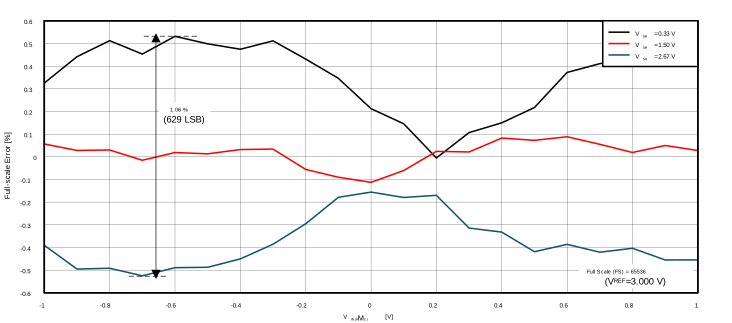 Figure 3-5 Integral Non-Linearity of the Signal
Chain With AMC0330D and TLV9001, tSMPL=425ns
Figure 3-5 Integral Non-Linearity of the Signal
Chain With AMC0330D and TLV9001, tSMPL=425ns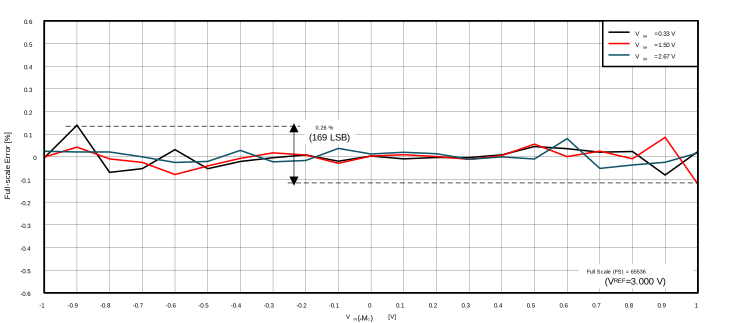 Figure 3-6 Integral Non-Linearity of the Signal
Chain With AMC0330D and OPA365, tSMPL=425ns
Figure 3-6 Integral Non-Linearity of the Signal
Chain With AMC0330D and OPA365, tSMPL=425ns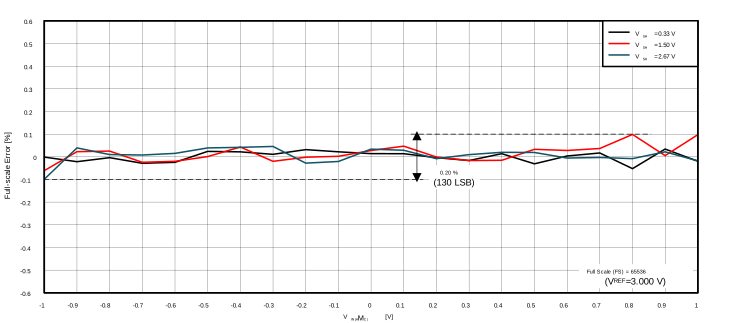 Figure 3-7 Integral Non-Linearity of the Signal
Chain With Single-Ended Output AMC0330S Amplifier, tSMPL=425ns
Figure 3-7 Integral Non-Linearity of the Signal
Chain With Single-Ended Output AMC0330S Amplifier, tSMPL=425ns