SLUUCO5A december 2022 – august 2023 BQ34Z100-R2
- 1
- Read This First
- 1 Introduction
-
2 Data Commands
- 2.1
Standard Data Commands
- 2.1.1
Control(): 0x00/0x01
- 2.1.1.1 CONTROL_STATUS: 0x0000
- 2.1.1.2 DEVICE TYPE: 0x0001
- 2.1.1.3 FW_VERSION: 0x0002
- 2.1.1.4 HW_VERSION: 0x0003
- 2.1.1.5 RESET_DATA: 0x0005
- 2.1.1.6 PREV_MACWRITE: 0x0007
- 2.1.1.7 CHEM ID: 0x0008
- 2.1.1.8 BOARD_OFFSET: 0x0009
- 2.1.1.9 CC_OFFSET: 0x000A
- 2.1.1.10 CC_OFFSET_SAVE: 0x000B
- 2.1.1.11 DF_VERSION: 0x000C
- 2.1.1.12 SET_FULLSLEEP: 0x0010
- 2.1.1.13 STATIC_CHEM_DF_CHKSUM: 0x0017
- 2.1.1.14 SEALED: 0x0020
- 2.1.1.15 IT ENABLE: 0x0021
- 2.1.1.16 CAL_ENABLE: 0x002D
- 2.1.1.17 RESET: 0x0041
- 2.1.1.18 EXIT_CAL: 0x0080
- 2.1.1.19 ENTER_CAL: 0x0081
- 2.1.1.20 OFFSET_CAL: 0x0082
- 2.1.2 StateOfCharge(): 0x02
- 2.1.3 MaxError(): 0x03
- 2.1.4 RemainingCapacity(): 0x04/0x05
- 2.1.5 FullChargeCapacity(): 0x06/07
- 2.1.6 Voltage(): 0x08/0x09
- 2.1.7 AverageCurrent(): 0x0A/0x0B
- 2.1.8 Temperature(): 0x0C/0x0D
- 2.1.9 Flags(): 0x0E/0x0F
- 2.1.10 FlagsB(): 0x12/0x13
- 2.1.11 Current(): 0x10/0x11
- 2.1.1
Control(): 0x00/0x01
- 2.2
Extended Data Commands
- 2.2.1 AverageTimeToEmpty(): 0x18/0x19
- 2.2.2 AverageTimeToFull(): 0x1A/0x1B
- 2.2.3 PassedCharge(): 0x1C/0x1D
- 2.2.4 DOD0Time(): 0x1E/0x1F
- 2.2.5 VoltScale(): 0x20
- 2.2.6 CurrScale(): 0x21
- 2.2.7 EnegyScale(): 0x22
- 2.2.8 AvailableEnergy(): 0x24/0x25
- 2.2.9 AveragePower(): 0x26/0x27
- 2.2.10 SerialNumber(): 0x28/0x29
- 2.2.11 InternalTemperature(): 0x2A/0x2B
- 2.2.12 CycleCount(): 0x2C/0x2D
- 2.2.13 StateOfHealth(): 0x2E/0x2F
- 2.2.14 ChargeVoltage(): 0x30/0x31
- 2.2.15 ChargeCurrent(): 0x32/0x33
- 2.2.16 PackConfiguration(): 0x3A/0x3B
- 2.2.17 DesignCapacity(): 0x3C/0x3D
- 2.2.18 DataFlashClass(): 0x3E
- 2.2.19 DataFlashBlock(): 0x3F
- 2.2.20 AuthenticateData/BlockData(): 0x40…0x53
- 2.2.21 AuthenticateChecksum/BlockData(): 0x54
- 2.2.22 BlockData(): 0x55…0x5F
- 2.2.23 BlockDataChecksum(): 0x60
- 2.2.24 BlockDataControl(): 0x61
- 2.2.25 GridNumber(): 0x62
- 2.2.26 LearnedStatus(): 0x63
- 2.2.27 Dod@Eoc(): 0x64/0x65
- 2.2.28 QStart(): 0x66/0x67
- 2.2.29 TrueRC(): 0x68/0x69
- 2.2.30 TrueFCC(): 0x6A/0x6B
- 2.2.31 StateTime(): 0x6C/0x6D
- 2.2.32 QmaxPassedQ(): 0x6E/0x6F
- 2.2.33 DOD0(): 0x70/0x71
- 2.2.34 QmaxDod0(): 0x72/0x73
- 2.2.35 QmaxTime(): 0x74/0x75
- 2.2.36 Data Flash Interface
- 2.1
Standard Data Commands
-
3 Fuel Gauging
- 3.1 Overview
- 3.2
Impedance Track Variables
- 3.2.1 Load Mode
- 3.2.2 Load Select
- 3.2.3 Reserve Cap-mAh
- 3.2.4 Reserve Cap-mWh/cWh
- 3.2.5 Energy Scale
- 3.2.6 Dsg Current Threshold
- 3.2.7 Chg Current Threshold
- 3.2.8 Quit Current, Dsg Relax Time, Chg Relax Time, and Quit Relax Time
- 3.2.9 Qmax
- 3.2.10 Update Status
- 3.2.11 Avg I Last Run
- 3.2.12 Avg P Last Run
- 3.2.13 Cell Delta Voltage
- 3.2.14 Ra Tables
- 3.2.15 StateOfCharge() Smoothing
- 3.2.16 Charge Efficiency
- 3.2.17 Lifetime Data Logging
- 3.3 Device Configuration
- 3.4 Voltage Measurement and Calibration
- 3.5 Temperature Measurement
- 3.6 Overtemperature Indication
- 3.7 Charging and Charge Termination Indication
- 3.8 The Scale Factors
- 3.9 LED Display
- 3.10 Alert Signal
- 3.11 Fast Resistance Scaling
- 4 Communications
- 5 Device Functional Modes
- 6 Power Control
- 7 Data Flash Summary
- 8 Gas Gauge Timing Considerations
- 9 HDQ Communication Basics
- 10Procedures to Seal and Unseal the Gauge
- 11Impedance Track Gauge Configuration
- 12Revision History
4.5 I2C Interface
The gas gauge supports the standard I2C read, incremental read, one-byte write quick read, and functions. The 7-bit device address (ADDR) is the most significant 7 bits of the hex address and is fixed as 1010101. The 8-bit device address is therefore 0xAA or 0xAB for write or read, respectively.
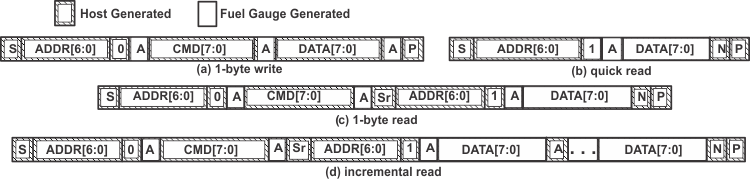 Figure 4-1 Supported
I2C formats: (a) 1-byte write, (b) quick read, (c) 1 byte-read,
and (d) incremental read (S = Start, Sr = Repeated Start, A = Acknowledge, N =
No Acknowledge, and P = Stop).
Figure 4-1 Supported
I2C formats: (a) 1-byte write, (b) quick read, (c) 1 byte-read,
and (d) incremental read (S = Start, Sr = Repeated Start, A = Acknowledge, N =
No Acknowledge, and P = Stop).The “quick read” returns data at the address indicated by the address pointer. The address pointer, a register internal to the I2C communication engine, increments whenever data is acknowledged by the device or the I2C controller. “Quick writes” function in the same manner and are a convenient means of sending multiple bytes to consecutive command locations (such as 2-byte commands that require two bytes of data).
 Figure 4-2 Attempt
To Write a Read-Only Address (Nack After Data Sent By
Controller)
Figure 4-2 Attempt
To Write a Read-Only Address (Nack After Data Sent By
Controller) Figure 4-3 Attempt
To Read An Address Above 0x7F (Nack Command)
Figure 4-3 Attempt
To Read An Address Above 0x7F (Nack Command) Figure 4-4 Attempt
At Incremental Writes (nack All Extra Data Bytes Sent)
Figure 4-4 Attempt
At Incremental Writes (nack All Extra Data Bytes Sent) Figure 4-5 Incremental Read at the Maximum Allowed Read Address
The I2C engine releases both SDA and SCL if the I2C bus is held low for two seconds. If the gas gauge was holding the lines, releasing them frees the controller to drive the lines. If an external condition is holding either of the lines low, the I2C engine enters the low-power SLEEP mode.