SLVA824A January 2017 – July 2025 TAS6422-Q1 , TAS6424-Q1 , TAS6424L-Q1 , TPA3111D1-Q1 , TPA3221 , TPA3244 , TPA3245 , TPA3250 , TPA3251 , TPA3255 , TPA3255-Q1
3.2 Tuning the Circuit
Choosing the correct resistances for a given design may require tuning of the diagnostic circuit. Many amplifiers have pulldown and possibly pullup resistances on the outputs as shown in Figure 3-5. This impacts the behavior of the amplifier when outputs are put into a high-Z state. As a result, TI recommends prototyping this circuit in order to verify that the correct resistance values are chosen for a particular application.
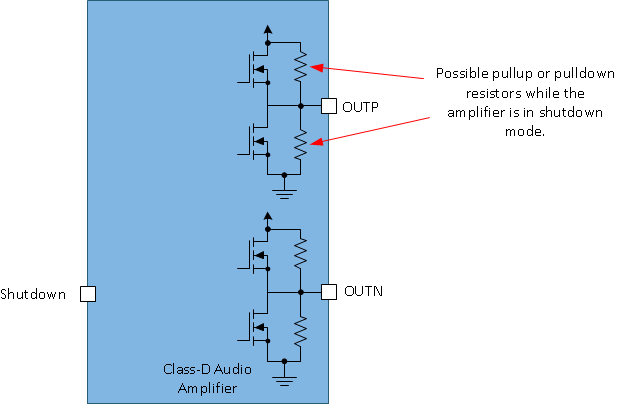 Figure 3-5 Class-D
Amplifier Impedance While in Shutdown Mode
Figure 3-5 Class-D
Amplifier Impedance While in Shutdown ModeThe resistances shown in the example schematic, see Figure 4-1, were chosen based on the design parameters required by this particular implementation. The resistances within the dual PMOS switches control the current necessary to turn on the circuit, while the resistors used in the voltage dividers set the threshold voltages for the comparators. The resistors used in conjunction with the operational amplifier set the desired amplification of the differential signal. This diagnostic circuit design is widely flexible and must be tuned based on the specifications of the application. The procedure for tuning is as follows:
- Connect the diagnostic circuit across the output of the audio amplifier in parallel with the load.
- Switch the diagnostic circuit on by pulling the NMOS gate high.
- Measure the diagnostic line voltages for each of the four possible fault conditions.
- Adjust the resistor divider values to set voltage thresholds for the various fault conditions.
- Verify the functionality of the settings used.
The tuning process allows the designer to specify the sensitivity and margin of error to be used when detecting a given fault. For example, a short-circuit fault can be set to trigger when the resistance across the amplifier outputs drops below 2 Ω, or it can trigger at a threshold of 4 Ω instead. This also allows adjustment for speakers of various impedances; the relevant thresholds in a circuit used to drive an 8-Ω speaker might differ drastically from the same thresholds used to drive a 4-Ω circuit. The resistor divider circuitry can be adjusted to adjust for particular voltage thresholds, while the pullup and pulldown resistor values associated with the diagnostic circuitry can be modified as needed. Additionally, the resistors associated with the differential operational amplifier can be adjusted to raise or lower the sensitivity of the short-circuit detection circuit by varying the differential amplifier gain.
Once again, the passive component values chosen are highly dependent on the amplifier model utilized, the topology of the output circuit, and the way in which various faults are defined. Table 3-1 gives the specific fault definitions which were used in this particular design for the TPA3111D1-Q1.
| Fault | Description |
|---|---|
| Short circuit to PVDD | Resistance to PVDD < 16 kΩ |
| Short circuit to GND | Resistance to GND < 1.8 kΩ |
| Short circuit across the load | Resistance across load < 0.5 Ω |
| Open circuit (load disconnected) | Resistance between outputs > 16 kΩ |