SNAS855F November   2023  – November 2025 LMKDB1102 , LMKDB1104 , LMKDB1108 , LMKDB1120

PRODUCTION DATA  

  1.   1
  2. Features
  3. Applications
  4. Description
  5. Device Comparison
  6. Pin Configuration and Functions
  7. Specifications
    1. 6.1 Absolute Maximum Ratings
    2. 6.2 ESD Ratings
    3. 6.3 Recommended Operating Conditions
    4. 6.4 Thermal Information 
    5. 6.5 Electrical Characteristics
    6. 6.6 SMBus Timing Requirements
    7. 6.7 SBI Timing Requirements
    8. 6.8 Timing Diagrams
    9. 6.9 Typical Characteristics
  8. Parameter Measurement Information
  9. Detailed Description
    1. 8.1 Overview
    2. 8.2 Functional Block Diagram
    3. 8.3 Feature Description
      1. 8.3.1 Input Features
        1. 8.3.1.1 Running Input Clocks When Device is Powered Off
        2. 8.3.1.2 Fail-Safe Inputs
        3. 8.3.1.3 Input Configurations
          1. 8.3.1.3.1 Internal Termination for Clock Inputs
          2. 8.3.1.3.2 AC-Coupled or DC-Coupled Clock Inputs
      2. 8.3.2 Flexible Power Sequence
        1. 8.3.2.1 PWRDN# Assertion and Deassertion
        2. 8.3.2.2 OE# Assertion and Deassertion
        3. 8.3.2.3 Clock Input and PWRGD/PWRDN# Behaviors When Device Power is Off
      3. 8.3.3 LOS and OE
        1. 8.3.3.1 Additional OE# Pins for LMKDB1120 and Backward Compatibility
        2. 8.3.3.2 Synchronous OE
        3. 8.3.3.3 OE Control
        4. 8.3.3.4 Automatic Output Disable
        5. 8.3.3.5 LOS Detection
      4. 8.3.4 Output Features
        1. 8.3.4.1 Double Termination
        2. 8.3.4.2 Programmable Output Slew Rate
          1. 8.3.4.2.1 Slew Rate Control through Pin
          2. 8.3.4.2.2 Slew Rate Control Through SMBus
        3. 8.3.4.3 Programmable Output Swing
        4. 8.3.4.4 Accurate Output Impedance
        5. 8.3.4.5 Programmable Output Impedance
        6. 8.3.4.6 Fail-Safe Outputs
    4. 8.4 Device Functional Modes
      1. 8.4.1 SMBus Mode
      2. 8.4.2 SBI Mode
      3. 8.4.3 Pin Mode
  10. Register Maps
    1. 9.1 LMKDB1120 and LMKDB1120FS Registers
    2. 9.2 LMKDB1112 Registers
    3. 9.3 LMKDB1108 and LMKDB1108FS Registers
    4. 9.4 LMKDB1104 and LMKDB1104FS Registers
  11. 10Application and Implementation
    1. 10.1 Application Information
    2. 10.2 Typical Application
      1. 10.2.1 Design Requirements
      2. 10.2.2 Detailed Design Procedure
      3. 10.2.3 Application Curves
    3. 10.3 Power Supply Recommendations
    4. 10.4 Layout
      1. 10.4.1 Layout Guidelines
      2. 10.4.2 Layout Example
  12. 11Device and Documentation Support
    1. 11.1 Documentation Support
      1. 11.1.1 Related Documentation
    2. 11.2 Receiving Notification of Documentation Updates
    3. 11.3 Support Resources
    4. 11.4 Trademarks
    5. 11.5 Electrostatic Discharge Caution
    6. 11.6 Glossary
  13. 12Revision History
  14. 13Mechanical, Packaging, and Orderable Information
    1. 13.1 Mechanical Data

Package Options

Mechanical Data (Package|Pins)
Thermal pad, mechanical data (Package|Pins)

Application Curves

The following plots are example phase noise plots before and after using the LMKDB at 156.25MHz, respectively. The LMKDB clock buffer adds a 22fs (typical) jitter from 12kHz to 20MHz. All LMKDB devices have very similar performance.

To better understand jitter and how the additive jitter of the LMKDB resulted in 22fs refer to Timing is Everything: How to measure additive jitter TI blog post.
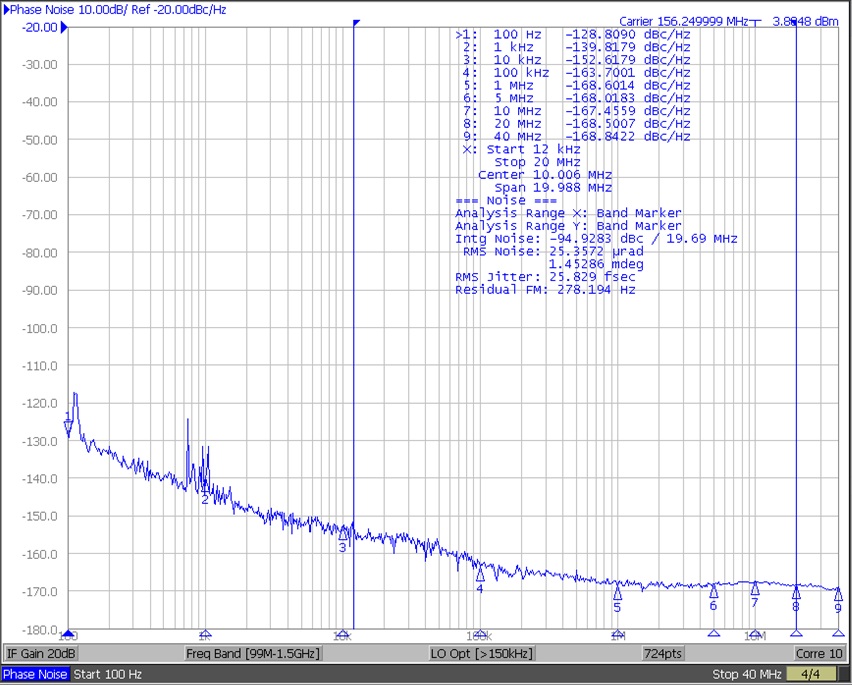
LMKDB1102 LMKDB1104 LMKDB1104FS  LMKDB1108 LMKDB1108FS LMKDB1112 LMKDB1120 LMKDB1120FS Input Source at 156.25MHz
                    (12kHz - 20MHz) Figure 10-2 Input Source at 156.25MHz (12kHz - 20MHz)
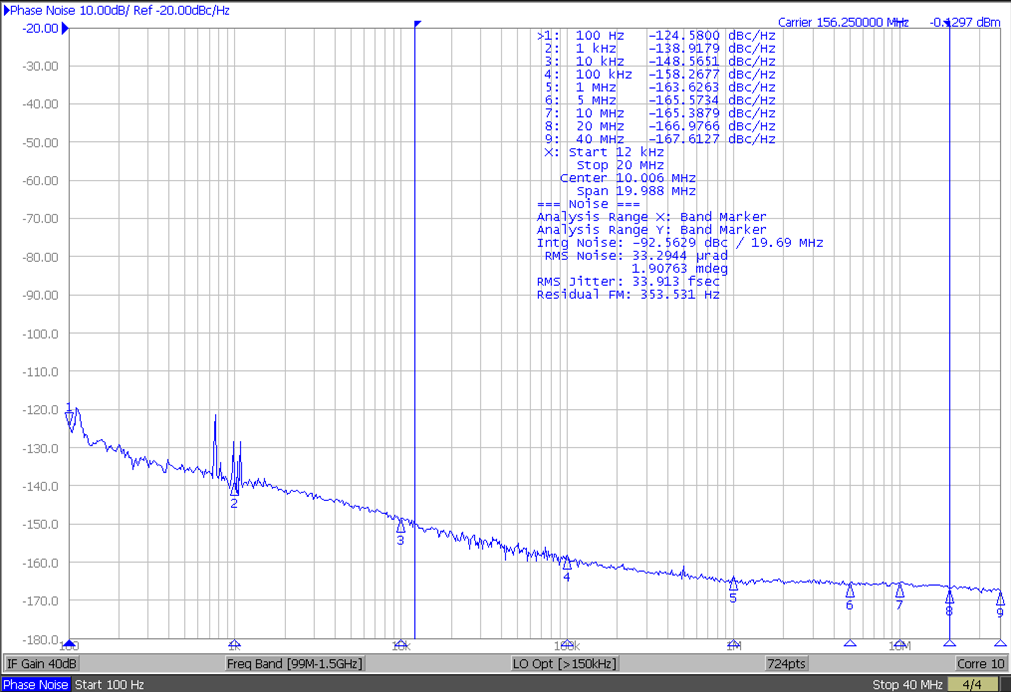
LMKDB1102 LMKDB1104 LMKDB1104FS  LMKDB1108 LMKDB1108FS LMKDB1112 LMKDB1120 LMKDB1120FS LMKDB11xx/120x Phase Noise
                    / Output Jitter at 156.25MHz (12kHz - 20MHz)
See Note 1 and 2 in Graph Notes table
Figure 10-3 LMKDB11xx/120x Phase Noise / Output Jitter at 156.25MHz (12kHz - 20MHz)
Table 10-2 Graph Notes
NOTE
(1) The typical RMS jitter values in the plots show the total output RMS jitter (JOUT) for each frequency and the source clock RMS jitter (JSOURCE). From these values, the Additive RMS Jitter can be calculated as: JADD = SQRT(JOUT2 – JSOURCE2).
(2) JADD at 156.25MHz = SQRT(33.92- 25.82) = 22.0 fs