SLASFD9 April 2025 TAC5301-Q1
PRODUCTION DATA
- 1
- 1 Features
- 2 Applications
- 3 Description
- 4 Pin Configuration and Functions
-
5 Specifications
- 5.1 Absolute Maximum Ratings
- 5.2 ESD Ratings
- 5.3 Recommended Operating Conditions
- 5.4 Thermal Information
- 5.5 Electrical Characteristics
- 5.6 Electrical Characteristics
- 5.7 Timing Requirements: I2C Interface
- 5.8 Switching Characteristics: I2C Interface
- 5.9 Timing Requirements: TDM, I2S or LJ Interface
- 5.10 Switching Characteristics: TDM, I2S or LJ Interface
- 5.11 Timing Diagrams
- 5.12 Typical Charactaristics
-
6 Detailed Description
- 6.1 Overview
- 6.2 Functional Block Diagram
- 6.3
Feature Description
- 6.3.1 Serial Interfaces
- 6.3.2 Phase-Locked Loop (PLL) and Clock Generation
- 6.3.3 Input Channel Configuration
- 6.3.4 Output Channel Configurations
- 6.3.5 Reference Voltage
- 6.3.6 Microphone Bias
- 6.3.7
Signal-Chain Processing
- 6.3.7.1
ADC Signal-Chain
- 6.3.7.1.1 Programmable Channel Gain and Digital Volume Control
- 6.3.7.1.2 Programmable Channel Gain Calibration
- 6.3.7.1.3 Programmable Channel Phase Calibration
- 6.3.7.1.4 Programmable Digital High-Pass Filter
- 6.3.7.1.5 Programmable Digital Biquad Filters
- 6.3.7.1.6 Programmable Channel Summer and Digital Mixer
- 6.3.7.1.7
Configurable Digital Decimation Filters
- 6.3.7.1.7.1
Linear-phase filters
- 6.3.7.1.7.1.1 Sampling Rate: 8kHz or 7.35kHz
- 6.3.7.1.7.1.2 Sampling Rate: 16kHz or 14.7kHz
- 6.3.7.1.7.1.3 Sampling Rate: 24kHz or 22.05kHz
- 6.3.7.1.7.1.4 Sampling Rate: 32kHz or 29.4kHz
- 6.3.7.1.7.1.5 Sampling Rate: 48kHz or 44.1kHz
- 6.3.7.1.7.1.6 Sampling Rate: 96kHz or 88.2kHz
- 6.3.7.1.7.1.7 Sampling Rate: 192kHz or 176.4kHz
- 6.3.7.1.7.2 Low-latency Filters
- 6.3.7.1.7.3 Ultra-Low-Latency Filters
- 6.3.7.1.7.1
Linear-phase filters
- 6.3.7.1.8 Automatic Gain Controller (AGC)
- 6.3.7.1.9 Voice Activity Detection (VAD)
- 6.3.7.1.10 Ultrasonic Activity Detection (UAD)
- 6.3.7.2
DAC Signal-Chain
- 6.3.7.2.1 Programmable Channel Gain and Digital Volume Control
- 6.3.7.2.2 Programmable Channel Gain Calibration
- 6.3.7.2.3 Programmable Digital High-Pass Filter
- 6.3.7.2.4 Programmable Digital Biquad Filters
- 6.3.7.2.5
Configurable Digital Interpolation Filters
- 6.3.7.2.5.1
Linear-phase filters
- 6.3.7.2.5.1.1 Sampling Rate: 8kHz or 7.35kHz
- 6.3.7.2.5.1.2 Sampling Rate: 16kHz or 14.7kHz
- 6.3.7.2.5.1.3 Sampling Rate: 24kHz or 22.05kHz
- 6.3.7.2.5.1.4 Sampling Rate: 32kHz or 29.4kHz
- 6.3.7.2.5.1.5 Sampling Rate: 48kHz or 44.1kHz
- 6.3.7.2.5.1.6 Sampling Rate: 96kHz or 88.2kHz
- 6.3.7.2.5.1.7 Sampling Rate: 192kHz or 176.4kHz
- 6.3.7.2.5.2 Low-latency Filters
- 6.3.7.2.5.3 Ultra-Low-Latency Filters
- 6.3.7.2.5.1
Linear-phase filters
- 6.3.7.1
ADC Signal-Chain
- 6.3.8 Interrupts, Status, and Digital I/O Pin Multiplexing
- 6.3.9 Power Tune Mode
- 6.4 Device Functional Modes
- 6.5 Programming
-
7 Register Maps
- 7.1 Device Configuration Registers
- 7.2
Programmable Coefficient Registers
- 7.2.1 Programmable Coefficient Registers: Page 8
- 7.2.2 Programmable Coefficient Registers: Page 9
- 7.2.3 Programmable Coefficient Registers: Page 10
- 7.2.4 Programmable Coefficient Registers: Page 11
- 7.2.5 Programmable Coefficient Registers: Page 15
- 7.2.6 Programmable Coefficient Registers: Page 16
- 7.2.7 Programmable Coefficient Registers: Page 17
- 7.2.8 Programmable Coefficient Registers: Page 18
- 7.2.9 Programmable Coefficient Registers: Page 19
- 7.2.10 Programmable Coefficient Registers: Page 25
- 7.2.11 Programmable Coefficient Registers: Page 26
- 7.2.12 Programmable Coefficient Registers: Page 27
- 7.2.13 Programmable Coefficient Registers: Page 28
- 8 Application and Implementation
- 9 Device and Documentation Support
- 10Revision History
- 11Mechanical, Packaging, and Orderable Information
Package Options
Mechanical Data (Package|Pins)
- RGE|24
Thermal pad, mechanical data (Package|Pins)
- RGE|24
Orderable Information
6.3.7.1.4 Programmable Digital High-Pass Filter
To remove the DC offset component and attenuate the undesired low-frequency noise content in the record data, the device supports a programmable high-pass filter (HPF). The HPF is not a channel-independent filter setting but is globally applicable for all ADC channels. This HPF is constructed using the first-order infinite impulse response (IIR) filter, and is efficient enough to filter out possible DC components of the signal. Table 6-39 shows the predefined –3dB cutoff frequencies available that can be set by using the ADC_DSP_HPF_SEL[1:0] register bits of P0_R114_D[5:4]. Additionally, to achieve a custom –3dB cutoff frequency for a specific application, the device also allows the first-order IIR filter coefficients to be programmed when the ADC_DSP_HPF_SEL[1:0] register bits are set to 2'b00. Figure 6-24 illustrates a frequency response plot for the HPF filter.
| P0_R114_D[5:4] : ADC_DSP_HPF_SE L[1:0] | -3dB CUTOFF FREQUENCY SETTING | -3dB CUTOFF FREQUENCY AT 16kHz SAMPLE RATE | -3dB CUTOFF FREQUENCY AT 48kHz SAMPLE RATE |
|---|---|---|---|
| 00 | Programmable 1st-order IIR filter | Programmable 1st-order IIR filter | Programmable 1st-order IIR filter |
| 01 (default) | 0.00002 × fS | 0.25Hz | 1Hz |
| 10 | 0.00025 × fS | 4Hz | 12Hz |
| 11 | 0.002 × fS | 32Hz | 96Hz |
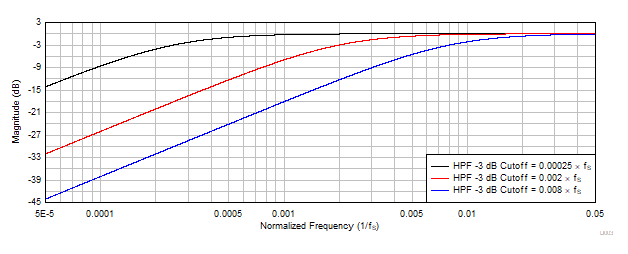 Figure 6-24 HPF Filter Frequency Response Plot
Equation 3 gives the transfer function for the first-order programable IIR filter:

The frequency response for this first-order programmable IIR filter with default coefficients is flat at a gain of 0dB (all-pass filter). The host device can override the frequency response by programming the IIR coefficients in Table 6-40 to achieve the desired frequency response for high-pass filtering or any other desired filtering. If the ADC_DSP_HPF_SEL[1:0] are set to 2'b00, the host device must write these coefficients values for the desired frequency response before powering-up any ADC channel for recording. Table 6-40 shows the filter coefficients for the first-order IIR filter.
| FILTER | FILTER COEFFICIENT | DEFAULT COEFFICIENT VALUE | COEFFICIENT REGISTER MAPPING |
|---|---|---|---|
| Programmable 1st-order IIR filter (can be allocated to HPF or any other desired filter) | N0 | 0x7FFFFFFF | P10_R120-R123 |
| N1 | 0x00000000 | P10_R124-R127 | |
| D1 | 0x00000000 | P11_R8-R11 |