SLVSI74A July 2025 – November 2025 TLV61290
PRODUCTION DATA
- 1
- 1 Features
- 2 Applications
- 3 Description
- 4 Device Comparison Table
- 5 Pin Configuration and Functions
- 6 Specifications
-
7 Detailed Description
- 7.1 Overview
- 7.2 Functional Block Diagram
- 7.3 Feature Description
- 7.4
Device Functional Modes
- 7.4.1 Enable and Start-up
- 7.4.2 Operation Mode Setting
- 7.4.3 Bypass Mode
- 7.4.4 Boost Control Operation
- 7.4.5 Auto PFM Mode
- 7.4.6 Forced PWM Mode
- 7.4.7 Ultrasonic Mode
- 7.4.8 Output Discharge
- 7.4.9 Undervoltage Lockout
- 7.4.10 Current Limit Operation
- 7.4.11 Output Short-to-Ground Protection
- 7.4.12 Thermal Shutdown
- 7.4.13 Power-Good Indication Status
- 7.5 Programming
- 7.6 Register Maps
- 8 Application and Implementation
- 9 Device and Documentation Support
- 10Revision History
- 11Mechanical, Packaging, and Orderable Information
Package Options
Refer to the PDF data sheet for device specific package drawings
Mechanical Data (Package|Pins)
- YBG|16
Thermal pad, mechanical data (Package|Pins)
Orderable Information
7.3.2 Switching frequency and Spread Spectrum Function
The TLV61290 boost converter does not have fixed frequency and it keeps the inductor ripple current in the range of approximately 1.0A, so the frequency is changed and determined by the operation condition.
In auto PFM operation, the minimum switching frequency is not limited, the switching frequency is approximately 20Hz (or even lower) with open load.
In Ultrasonic mode, the minimum switching frequency is limited to 25kHz (min.) to avoid audio band noise. In forced PWM operation, minimum switching frequency is limited to approximately 300 kHz. With this unique feature, the TLV61290 avoids the low frequency switching and prevents the application against the low frequency noise sensitive range.
Switching regulators are particularly troublesome in applications where electromagnetic interference (EMI) is a concern. Switching regulators operate on a cycle-by-cycle basis to transfer power to an output. In most cases, the frequency of operation is either fixed or regulated, based on the output load. This method of conversion creates large components of noise at the frequency of operation (fundamental) and multiples of the operating frequency (harmonics).
The TLV61290 provides a spread spectrum feature. The goal is to spread out the emitted RF energy over a larger frequency range so that the resulting EMI is similar to white noise. The end result is a spectrum that is continuous and lower in peak amplitude, making it easier to comply with electromagnetic interference (EMI) standards and with the power supply ripple requirements in cellular and non-cellular wireless applications. Radio receivers are typically susceptible to narrowband noise that is focused on specific frequencies.
The spread spectrum architecture varies the switching frequency by ca. ±8% of the nominal switching frequency thereby significantly reducing the peak radiated and conducting noise on both the input and output supplies. The frequency dithering scheme is modulated with a triangle profile and a modulation frequency fm.
 Figure 7-1 Spectrum of a Frequency Modulated Sin. Wave with Sinusoidal Variation in Time
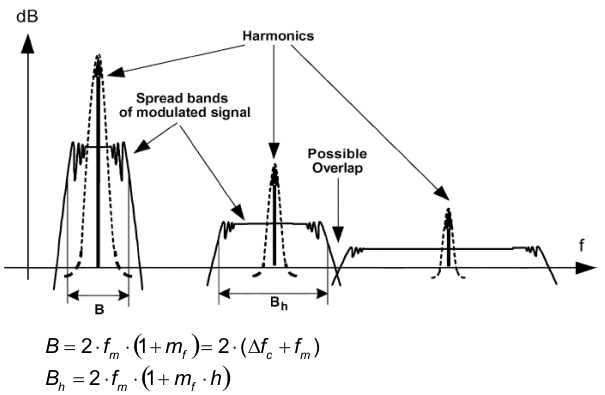 Figure 7-2 Spread Bands of Harmonics in Modulated Square Signals (1)
The above figures show that after modulation the sideband harmonic is attenuated compared to the non-modulated harmonic, and the harmonic energy is spread into a certain frequency band. The higher the modulation index (mf) the larger the attenuation.
where
- fc is the carrier frequency (switching frequency)
- fm is the modulating frequency (approximately 0.5%*fc)
- δ is the modulation ratio (approximately 8%)
The maximum switching frequency fc is limited by the process and finally the parameter modulation ratio (δ), together with fm, which is the side-band harmonics bandwidth around the carrier frequency fc. The bandwidth of a frequency modulated waveform is approximately given by the Carson’s rule and can be summarized as:
fm < RBW: The receiver is not able to distinguish individual side-band harmonics, so, several harmonics are added in the input filter and the measured value is higher than expected in theoretical calculations.
fm > RBW: The receiver is able to properly measure each individual side-band harmonic separately, so the measurements match with the theoretical calculations.