SLVSGC5E January 2023 – October 2025 TPS62870 , TPS62871 , TPS62872 , TPS62873
PRODUCTION DATA
- 1
- 1 Features
- 2 Applications
- 3 Description
- 4 Device Options
- 5 Pin Configuration and Functions
- 6 Specifications
-
7 Detailed Description
- 7.1 Overview
- 7.2 Functional Block Diagram
- 7.3
Feature Description
- 7.3.1 Fixed-Frequency DCS-Control Topology
- 7.3.2 Forced PWM and Power Save Modes
- 7.3.3 Precise Enable
- 7.3.4 Start-Up
- 7.3.5 Switching Frequency Selection
- 7.3.6 Output Voltage Setting
- 7.3.7 Compensation (COMP)
- 7.3.8 Mode Selection and Clock Synchronization (MODE/SYNC)
- 7.3.9 Spread Spectrum Clocking (SSC)
- 7.3.10 Output Discharge
- 7.3.11 Undervoltage Lockout (UVLO)
- 7.3.12 Overvoltage Lockout (OVLO)
- 7.3.13 Overcurrent Protection
- 7.3.14 Power Good (PG)
- 7.3.15 Remote Sense
- 7.3.16 Thermal Warning and Shutdown
- 7.3.17 Stacked Operation
- 7.4 Device Functional Modes
- 7.5 Programming
- 8 Register Map
- 9 Application and Implementation
- 10Device and Documentation Support
- 11Revision History
- 12Mechanical, Packaging, and Orderable Information
Package Options
Mechanical Data (Package|Pins)
- RXS|16
Thermal pad, mechanical data (Package|Pins)
Orderable Information
7.3.2 Forced PWM and Power Save Modes
The device can control the inductor current in three different ways to regulate the output:
- Pulse-width modulation with continuous inductor current (PWM-CCM)
- Pulse-width modulation with discontinuous inductor current (PWM-DCM)
- Pulse-frequency modulation with discontinuous inductor current and pulse skipping (PFM-DCM)
The on-time in PWM-CCM is set by Equation 1. For very small output voltages, a minimum on time (ton, min) of approximately 50ns reduces the switching frequency from the set value. Even when the minimum on-time is reached, the device maintains proper output voltage regulation by extending the off-time.
During PWM-CCM operation, the device switches at a constant frequency and the inductor current is continuous (see Figure 7-2). PWM operation achieves the lowest output voltage ripple and the best transient performance.

Figure 7-2 Continuous Conduction Mode (PWM-CCM) Current Waveform
During PWM-DCM operation, the device switches at a constant frequency and the inductor current is discontinuous (see Figure 7-3). In this mode, the device controls the peak inductor current to maintain the selected switching frequency while still being able to regulate the output.
Use Equation 2 to calculate the output current threshold at which the device enters PWM-DCM.
with tON according Equation 1.

Figure 7-3 Discontinuous Conduction Mode (PWM-DCM) Current Waveform
During PFM-DCM operation, the device keeps the peak inductor current constant (at a level corresponding to the minimum on time of the converter) and skips pulses to regulate the output (see Figure 7-4). The switching pulses that occur during PFM-DCM operation are synchronized to the internal clock.
 Figure 7-4 Discontinuous Conduction Mode (PFM-DCM) Current Waveform
Use Equation 3 to calculate the output current threshold at which the device changes from PWM-DCM to PFM-DCM:
with tON_min_PFM being the minimum on time in PFM-DCM of approximately 20ns.
Figure 7-5 shows how this threshold typically varies with VIN and VOUT for a switching frequency of 2.25MHz.
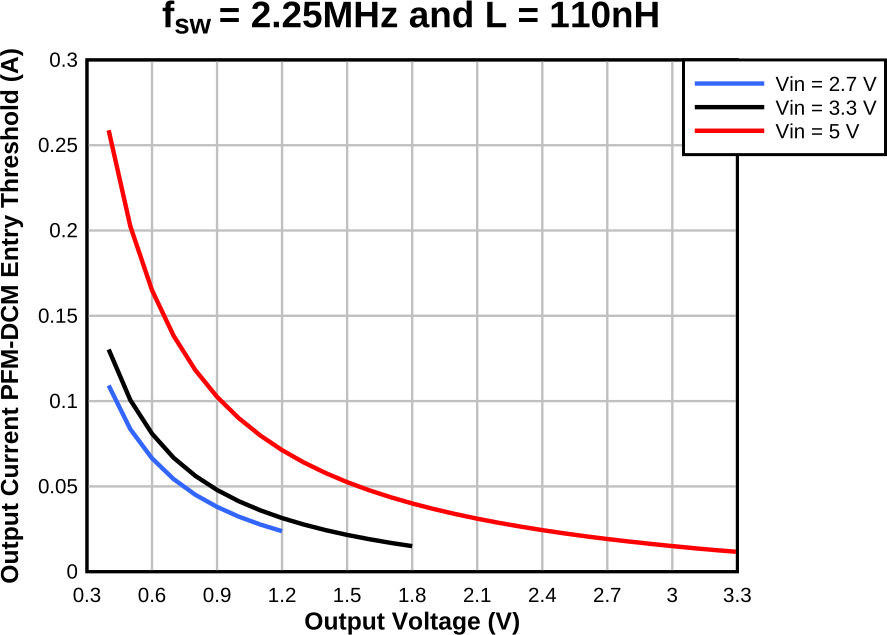 Figure 7-5 Output Current PFM-DCM Entry Threshold
- In forced PWM mode, the device uses PWM-CCM at all times.
- In power save mode, the device uses PWM-CCM at medium and high loads, PWM-DCM at low loads, and PFM-DCM at very low loads. The transition between the different operating modes is seamless.
Table 7-1 shows the function table of the MODE/SYNC pin and the FPWMEN bit in the CONTROL1 register, which control the operating mode of the device.
| MODE/SYNC PIN | FPWMEN BIT | OPERATING MODE | REMARK |
|---|---|---|---|
| Low | 0 | PSM | Do not use in a stacked configuration. |
| 1 | FPWM | ||
| High | X | FPWM | |
| Sync Clock | X | FPWM |