SBVS363B December 2020 – November 2025 TPS7B87-Q1
PRODUCTION DATA
- 1
- 1 Features
- 2 Applications
- 3 Description
- 4 Pin Configuration and Functions
- 5 Specifications
- 6 Detailed Description
-
7 Application and Implementation
- 7.1 Application Information
- 7.2 Typical Application
- 7.3 Power Supply Recommendations
- 7.4 Layout
- 8 Device and Documentation Support
- 9 Revision History
- 10Mechanical, Packaging, and Orderable Information
Package Options
Refer to the PDF data sheet for device specific package drawings
Mechanical Data (Package|Pins)
- DDA|8
- KVU|5
Thermal pad, mechanical data (Package|Pins)
- KVU|5
Orderable Information
7.1.4.1 Thermal Performance Versus Copper Area
The most used thermal resistance parameter RθJA is highly dependent on the heat-spreading capability built into the particular PCB design, and therefore varies according to the total copper area, copper weight, and location of the planes. The RθJA recorded in the Thermal Information table is determined by the JEDEC standard (see Figure 7-1), PCB, and copper-spreading area, and is only used as a relative measure of package thermal performance. For a well-designed thermal layout, RθJA is actually the sum of the package junction-to-case (bottom) thermal resistance (RθJCbot) plus the thermal resistance contribution by the PCB copper.
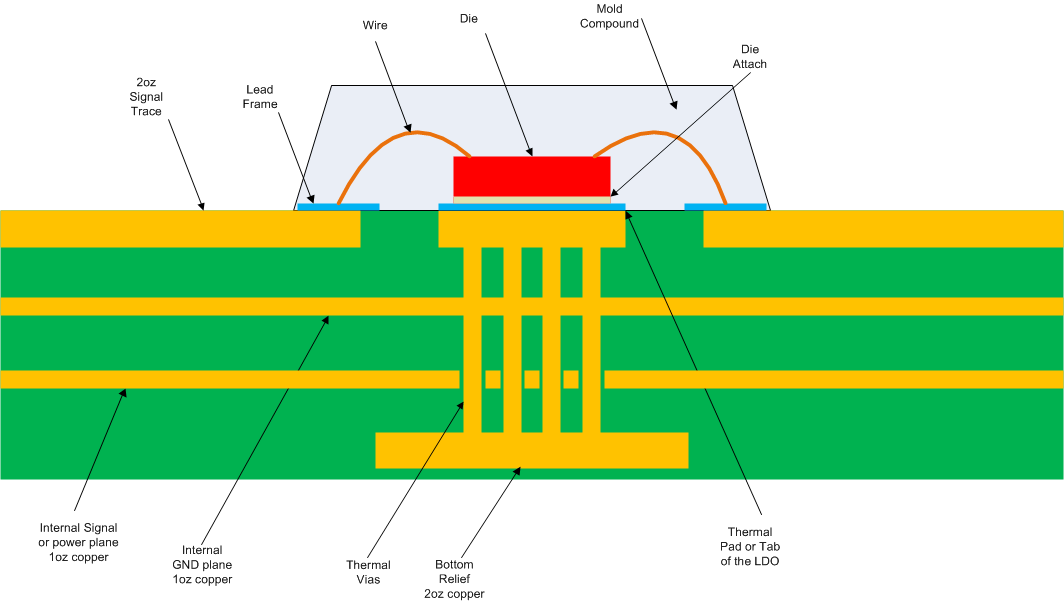 Figure 7-1 JEDEC Standard 2s2p PCB
Figure 7-2 through Figure 7-5 illustrate the functions of RθJA and ψJB versus copper area and thickness. These plots are generated with a 101.6mm × 101.6mm × 1.6mm PCB of two and four layers. For the 4-layer board, inner planes use 1oz copper thickness. Outer layers are simulated with both 1oz and 2oz copper thickness. A 2 × 3 (DDA package) or a 3 × 4 (KVU package) array of thermal vias with a 300µm drill diameter and 25µm copper plating is located beneath the thermal pad of the device. The thermal vias connect the top layer, the bottom layer and, in the case of the 4-layer board, the first inner GND plane. Each of the layers has a copper plane of equal area.
 Figure 7-2 RθJA vs Copper
Area (DDA Package)
Figure 7-2 RθJA vs Copper
Area (DDA Package) Figure 7-4 RθJA vs Copper
Area (KVU Package)
Figure 7-4 RθJA vs Copper
Area (KVU Package) Figure 7-3 ψJB vs Copper
Area (DDA Package)
Figure 7-3 ψJB vs Copper
Area (DDA Package) Figure 7-5 ψJB vs Copper
Area (KVU Package)
Figure 7-5 ψJB vs Copper
Area (KVU Package)